
When managing inventory, businesses generally choose between cycle counting and annual inventory methods. Here's a quick breakdown:
- Cycle Counting: Smaller, frequent inventory counts (daily, weekly, or monthly). Operations continue without interruptions, errors are identified quickly, and costs are spread out over time.
- Annual Inventory: A full, once-a-year physical count of all stock. It provides a complete snapshot for financial reporting but often requires shutting down operations temporarily and incurs higher short-term labor costs.
Quick Comparison
| Factor | Cycle Counting | Annual Inventory |
|---|---|---|
| Frequency | Regular (daily, weekly, or monthly) | Yearly |
| Business Disruption | Minimal | High (requires operational shutdown) |
| Error Correction | Ongoing | Delayed until year-end |
| Labor Costs | Lower, spread over time | Higher, concentrated effort |
| Best For | Large warehouses, high SKU counts | Small businesses, stable inventory |
Both methods have their strengths. Cycle counting is ideal for maintaining accuracy with minimal disruption, while annual inventory suits smaller operations needing a year-end stock review. The best choice depends on your business size, SKU volume, and operational needs.
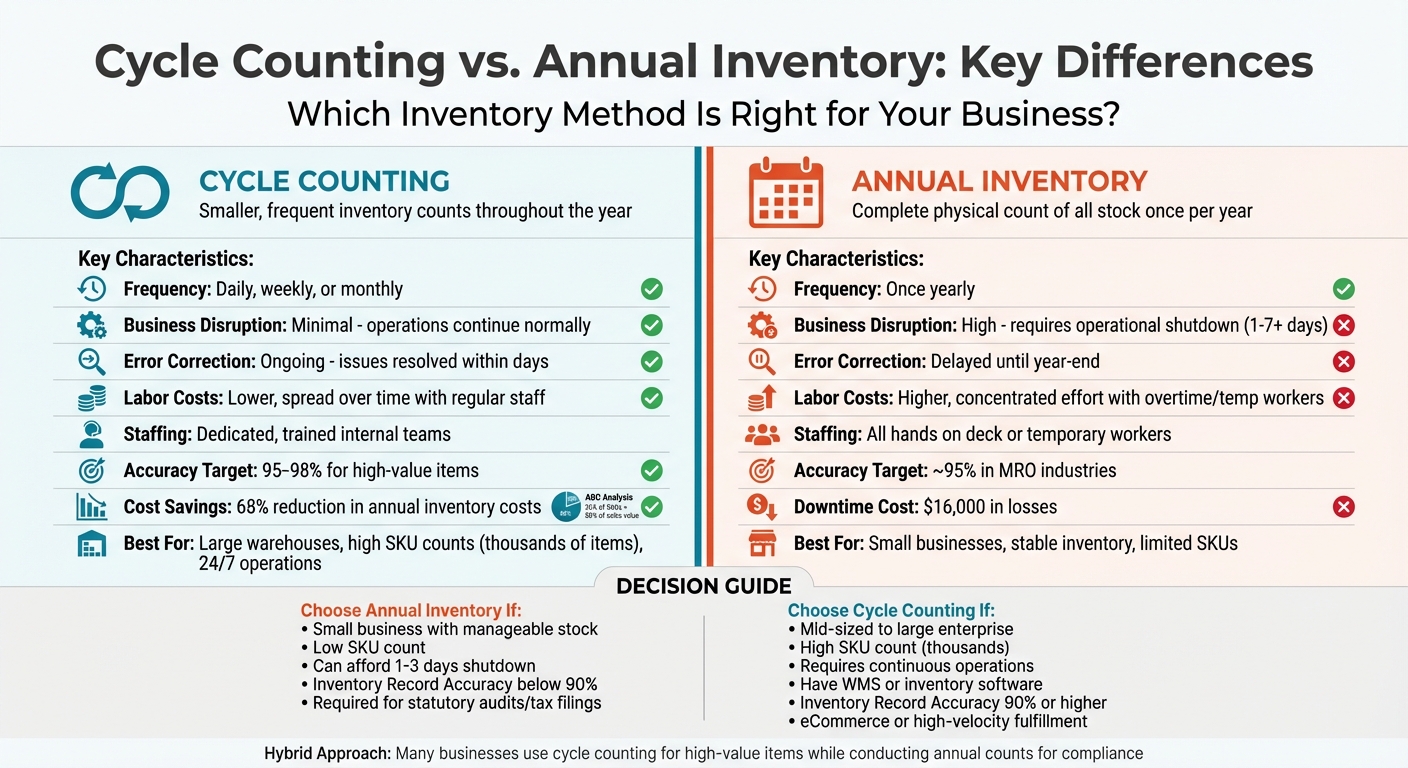
Cycle Counting vs Annual Inventory: Complete Comparison Guide
What Is Annual Inventory?
Annual Inventory Definition
Annual inventory involves conducting a comprehensive, physical count of every item in your warehouse to ensure your stock records match what’s actually on hand with inventory management software. This process covers all inventory items and is typically carried out once a year, often at the end of a reporting period. The goal? To make sure financial records are accurate for tax filings and year-end audits.
During the count, operations are paused to avoid any discrepancies. Once the count is completed, managers compare the physical inventory to the recorded data, investigate any differences, and update the general ledger to reflect the correct numbers. While this approach demands significant effort, its accuracy and reliability make it a trusted method.
Annual Inventory Characteristics
Annual inventory requires careful planning and coordination, balancing its thoroughness against the temporary disruption it causes. It’s recommended to start preparations at least three months in advance. The process is labor-intensive and requires the full involvement of staff to complete the count within a limited timeframe. It also aligns with U.S. GAAP and IRS standards, making it essential for businesses to meet regulatory and financial reporting requirements.
For public companies, accurate year-end inventory counts are critical. These counts directly impact key financial metrics like Cost of Goods Sold (COGS), gross profit, and net income - numbers that are closely monitored by stakeholders and tax authorities. Additionally, auditors rely on these physical counts to verify the accuracy of financial statements.
This method works particularly well for smaller businesses with stable inventory levels, where a temporary shutdown is less likely to cause major disruptions. To reduce the impact on operations, many warehouses schedule their annual counts during weekends or slower business periods. In industries like Maintenance, Repair, and Operations (MRO), accuracy benchmarks for these counts often reach about 95%. These characteristics set the stage for comparing annual inventory to the more frequent and continuous cycle counting approach.
sbb-itb-19ed50f
What Is Cycle Counting?
Cycle Counting Definition
Cycle counting is a method of inventory auditing that happens continuously throughout the year. Instead of halting all operations to perform a full physical inventory, small portions of inventory are counted on a rotating schedule - whether daily, weekly, or monthly. This approach allows essential activities like shipping and receiving to keep running smoothly.
A dedicated team works through these scheduled counts, focusing on specific items. Any discrepancies are quickly investigated and corrected, ensuring the entire inventory is audited over time without disrupting warehouse operations. This method strikes a balance between maintaining inventory accuracy and keeping the warehouse functioning efficiently.
"Cycle counting is an inventory management option that allows you to count items in a designated area of the warehouse without stopping operations to perform a complete physical inventory."
- Bill Conway, NetSuite Practice Director, Blue Horseshoe Solutions
Cycle Counting Characteristics
Cycle counting offers a practical alternative to shutting down the entire warehouse for inventory checks. It focuses on prioritizing inventory based on specific criteria, which helps maximize efficiency. For example, many warehouses use the ABC analysis method, based on the Pareto Principle. This means that about 20% of SKUs (typically high-value items) account for 80% of total sales value. Here’s how it often works:
- High-value items ("A" items) are counted weekly or monthly.
- Mid-tier items ("B" items) are counted monthly or bi-weekly.
- Low-value items ("C" items) are counted quarterly or annually.
This targeted approach ensures that the most critical items are reviewed more frequently, helping to maintain higher accuracy where it matters most.
Frequent cycle counts also make it easier to spot and resolve discrepancies quickly - often within days instead of months. This allows for better root-cause analysis and improves overall inventory accuracy. Industry benchmarks suggest aiming for 95–98% accuracy for high-value items, 92–95% for mid-tier items, and 85–90% for low-value items.
Another key benefit of cycle counting is cost savings. Businesses using this method can cut annual inventory costs by about 68% compared to traditional physical inventories. This is possible because cycle counting eliminates the need for overtime, temporary labor, and downtime. Modern tools like warehouse management systems and mobile barcode scanners further streamline the process, enabling real-time adjustments and making daily inventory tasks more efficient.
Cycle Counting vs. Annual Inventory: Main Differences
Business Disruption
Keeping your operations running smoothly is a top priority in warehouse management. One major difference between cycle counting and annual inventory lies in how they impact daily activities. Annual physical inventory typically requires a full shutdown of operations. This pause can create significant delays for customer orders and disrupt the entire supply chain.
"Physical counts often require companies to suspend operations such as shipping and receiving for as long as the count is in progress."
- Abby Jenkins, Product Marketing Manager, NetSuite
On the other hand, cycle counting only involves checking a small portion of SKUs at a time. This means you can keep your business running without interruptions. These differences highlight how each method affects day-to-day operations and sets the tone for how they handle inventory discrepancies.
Accuracy and Error Correction
Annual inventory provides a single snapshot of your stock each year. The problem? Errors that occur early in the year can go unnoticed for months. This delay in catching discrepancies can lead to compounding issues that are harder to resolve.
Cycle counting takes a more proactive approach. By identifying and addressing discrepancies within days, it allows managers to investigate and fix problems quickly. This method not only improves accuracy but also stops small issues from spiraling out of control.
Labor Costs and Resources
Annual inventory requires an intense, short-term effort. Companies often need to pay for overtime or hire temporary workers to complete the count, which drives up labor costs and increases the chance of mistakes.
Cycle counting spreads the workload throughout the year. A small, dedicated team can handle counts during slower times, like early mornings or between shipping waves. This approach can significantly cut costs - studies show that physical counts can result in $16,000 in downtime losses, compared to no downtime with cycle counting.
| Factor | Annual Physical Inventory | Cycle Counting |
|---|---|---|
| Business Disruption | High; requires operational shutdown | Low; operations continue normally |
| Frequency | Once per year | Daily, weekly, or monthly |
| Staffing | Concentrated effort; temporary workers needed | Spread out; dedicated team or regular staff |
| Error Correction | Once-a-year adjustments | Continuous root-cause analysis |
| Labor Costs | High overtime and temp wages | Ongoing regular wages; lower overall costs |
| Flexibility | Minimal | Substantial; adjusts for seasonality and item value |
Can Cycle Counting Replace Disruptive Annual Inventory Checks? - Smart Logistics Network
Pros and Cons of Each Method
Choosing the right inventory method for your warehouse involves weighing the benefits and challenges of each option. These decisions have a direct impact on your operations, costs, and overall accuracy.
Annual Inventory: Advantages and Disadvantages
Annual inventory offers a detailed, all-encompassing snapshot of your stock, meeting U.S. GAAP and IRS requirements. By reconciling every SKU at once, it sets a clean starting point for your fiscal year. This method is particularly good at uncovering system-wide issues, such as recurring misplacement patterns, that smaller-scale reviews might overlook.
On the downside, annual inventory often requires a complete or partial shutdown, halting operations, delaying orders, and potentially affecting revenue. The process also demands significant labor, leading to higher overtime costs or the need for temporary workers. This concentrated effort increases the risk of human errors due to fatigue. Additionally, because the count happens only once a year, issues like theft or shrinkage can go unnoticed for months, resulting in inaccurate forecasts and potential stockouts.
| Advantages | Disadvantages |
|---|---|
| Provides a complete snapshot for financial reporting | Labor-intensive and time-consuming |
| Meets GAAP, IRS, and audit requirements | Disrupts operations and delays shipping |
| Identifies systemic inventory issues | Increases error risks due to worker fatigue |
| Ideal for slow-moving inventory | Slow to detect theft or discrepancies |
Cycle Counting: Advantages and Disadvantages
Cycle counting allows for ongoing inventory accuracy without the need for operational shutdowns. It spreads labor costs throughout the year, making it less disruptive and easier to manage with regular staff. One of its biggest strengths is the ability to perform quick root-cause analysis - discrepancies can be investigated and resolved within days instead of months.
However, cycle counting requires consistent scheduling and discipline to ensure every inventory category is checked appropriately. Its effectiveness heavily depends on the accuracy of your Warehouse Management System (WMS) and proper scanning practices. Misplaced items or skipped scans can lead to undetected errors. Ongoing staff training and resource allocation are also essential to keep the system running smoothly.
| Advantages | Disadvantages |
|---|---|
| Ensures year-round inventory accuracy | Requires strict scheduling and discipline |
| Avoids operational shutdowns | Needs comprehensive monitoring of all categories |
| Distributes labor costs evenly over time | Relies on WMS accuracy and proper scanning |
| Facilitates prompt error correction | Demands ongoing training and resources |
Cycle counting stands out for its ability to support daily operations while addressing discrepancies quickly and efficiently.
When to Use Each Method
Choosing the Right Method
Deciding between cycle counting and annual inventory depends on your warehouse's specific needs and operations. Factors like the size of your facility, the number of SKUs, and whether halting operations is feasible will guide your choice.
For small businesses with fewer SKUs, annual inventory counts can be completed relatively quickly. These businesses can often finish the process in one to three days with minimal disruption. On the other hand, larger organizations with thousands of SKUs face more challenges. Shutting down operations for a full physical count can significantly impact their workflow. As Bill Conway, NetSuite Practice Director at Blue Horseshoe Solutions, explains:
"Large companies with thousands of items typically halt operations for up to a week or more to perform a full physical inventory count".
Cycle counting is a better fit for larger operations, especially when supported by inventory management software. Such tools automate schedules, sync data in real time, and quickly identify discrepancies. For example, QuickBooks Desktop users can leverage Rapid Inventory, which sends cycle count alerts, enables barcode scanning, and automatically reconciles stock records, making the process more efficient.
Accuracy also plays a major role in deciding which method to adopt. Inventory Record Accuracy (IRA) serves as a key performance indicator. If your IRA is below 90%, experts recommend conducting one final full physical inventory to establish a reliable baseline before transitioning to cycle counting. Once your IRA reaches 90% or higher, cycle counting can take over as the primary method. Compliance requirements may also dictate your choice. Public companies and certain regulated industries often need to conduct full physical inventories for statutory reporting and tax purposes.
Method Selection Guide
Here’s a quick comparison to help you decide:
| Factor | Annual Physical Inventory | Cycle Counting |
|---|---|---|
| Business Size | Small businesses with limited stock | Mid-sized to large enterprises, eCommerce |
| SKU Count | Low/Manageable | High (Thousands of SKUs) |
| Operational Impact | Can afford 1–3 days of shutdown | Requires continuous operations (e.g., 24/7 fulfillment) |
| System Support | Can be done manually with paper | Requires WMS or inventory software with QuickBooks integration |
| Current Accuracy | Below 90% IRA (needs "hard restart") | 90% or higher IRA |
| Compliance Needs | Required for some statutory audits/tax filings | Often accepted by auditors if proven accurate |
| Staffing | Temporary workers or "all hands on deck" | Dedicated, trained internal teams |
How Rapid Inventory Supports Inventory Management
Rapid Inventory is designed to keep operations running smoothly while ensuring accurate inventory tracking. By syncing data in real time and automating workflows, it simplifies both cycle counting and annual physical inventory processes for QuickBooks Desktop users. Its two-way QuickBooks integration ensures that system records and physical counts stay aligned at all times.
With mobile barcode scanning, warehouse teams can count inventory directly from the floor without interrupting shipping or receiving activities. This feature uploads data instantly, flagging variances for quick resolution. It also supports blind counts, where workers verify inventory without seeing expected quantities beforehand, reducing the likelihood of human error. These features work together to promote efficient and uninterrupted warehouse operations.
For businesses managing multiple locations, Rapid Inventory offers bin-level tracking and zone-specific count assignments. This means one area can undergo cycle counts while others continue operating seamlessly. Additionally, it incorporates ABC analysis, prioritizing high-value items based on the Pareto Principle - where 20% of SKUs typically drive 80% of sales. This focused approach strengthens inventory control across various locations.
The platform also provides real-time reporting, giving users continuous visibility into inventory levels to speed up procurement and fulfillment decisions. Customizable tolerance thresholds (usually 2%–5%) automatically flag discrepancies for further review. Another feature, interleaving, integrates inventory verification into workflows by triggering counts when bins are depleted.
Pricing options include the Pro plan at $90 per user per month and the Unlimited plan at $900 per month for 10 or more users. Both plans come with free training, onboarding, and support, making it easier for businesses to transition from annual counts to continuous cycle counting.
Conclusion
Select the inventory method that aligns best with your warehouse's needs and operations. Cycle counting keeps your inventory data accurate in real time with little disruption, making it a great fit for fast-paced warehouses where precision is critical. On the other hand, annual physical inventory offers a full snapshot of stock for financial reporting and audit purposes but requires more labor and often involves operational downtime.
"When inventory counts are wrong, service, efficiency and profitability all suffer."
- Abby Jenkins, Product Marketing Manager, NetSuite
This quote underscores the importance of having an inventory strategy that balances accuracy with minimal disruption. Many businesses have adopted a hybrid approach - using continuous counting for essential items while conducting an annual count to meet compliance requirements.
For QuickBooks Desktop users, tools like Rapid Inventory make this decision easier. This software integrates smoothly into your workflow and uses features like ABC analysis to focus on high-value items. Additional tools, including blind counts and bin-level tracking, help reduce errors and ensure accuracy across multiple locations. With these capabilities, businesses can shift from labor-intensive annual counts to streamlined, ongoing inventory management.
FAQs
What’s the best way to choose between cycle counting and annual inventory for my business?
Choosing between cycle counting and annual inventory comes down to how frequently you need accurate stock data, your operational limitations, and any compliance requirements your business must meet.
If maintaining consistent accuracy without interrupting daily operations is a priority, cycle counting is a great choice. This approach involves regularly counting smaller groups of items, which helps keep inventory records up-to-date and allows you to address discrepancies quickly. It’s especially useful for businesses managing high-demand products, operating across multiple locations, or requiring precise stock tracking. Plus, tools like inventory management software paired with mobile barcode scanning can make the process much more efficient.
On the flip side, annual inventory works best for businesses that need a full inventory review for audits, financial reporting, or tax purposes. While it provides a complete snapshot of your stock, this method can be time-intensive and may disrupt regular operations due to the resources required.
To decide which method suits your business, think about your compliance requirements, how much downtime your operations can handle, the nature of your inventory, and the tools your team has access to. Aligning these factors with your goals will help you maintain accurate stock levels and ensure smooth operations.
What are the cost differences between cycle counting and annual inventory counts?
Cycle counting tends to be less expensive because it breaks the task into smaller, regular counts throughout the year. This approach reduces labor costs and keeps disruptions to daily operations at a minimum. On the other hand, an annual inventory count demands a large, concentrated effort, which often leads to overtime expenses, temporary operational shutdowns, and increased overhead due to the sheer size of the undertaking.
Can you implement cycle counting without using advanced inventory software?
Yes, you can absolutely implement cycle counting without advanced software, though it does require more manual effort and careful planning. A typical method involves choosing a counting strategy, like ABC classification or usage-based sampling, assigning team members to count specific items daily, and recording the results manually using spreadsheets or printed forms. This approach works best for smaller warehouses with lower inventory turnover and stock levels that are easier to manage.
Even so, basic tools like barcode scanners or RFID readers can make a big difference by reducing errors and speeding up the process. For businesses in the U.S. using QuickBooks Desktop, Rapid Inventory offers a helpful solution. It integrates features like mobile barcode scanning, real-time reporting, and seamless two-way syncing with QuickBooks. While manual methods can get the job done, tools like Rapid Inventory can make cycle counting more precise, efficient, and scalable as your business grows.