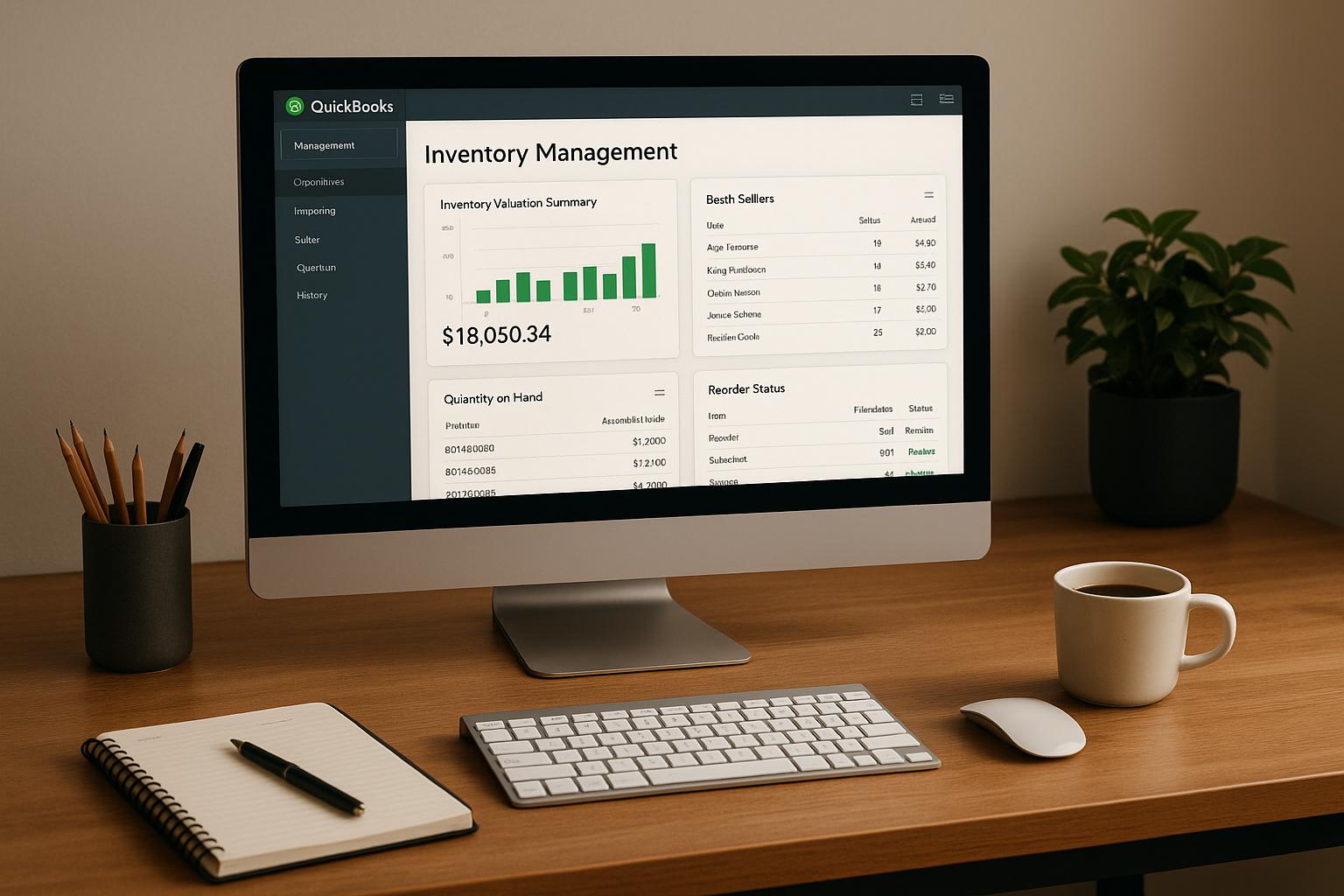

QuickBooks Desktop and Rapid Inventory offer FIFO (First-In, First-Out) solutions, but they cater to different needs. QuickBooks Desktop's FIFO feature focuses on financial reporting accuracy, while Rapid Inventory emphasizes multi-location inventory management and efficiency. Here's what you need to know:
- QuickBooks Desktop FIFO: Built into QuickBooks Desktop Enterprise with the Advanced Inventory module. It tracks costs by location, updates reports automatically, and integrates seamlessly with accounting. However, setup can be time-consuming, especially for large files, and it lacks support for FEFO (First Expiration, First Out).
- Rapid Inventory FIFO: A third-party solution compatible with all QuickBooks Desktop editions. It supports both FIFO and FEFO, offers mobile barcode scanning, real-time stock tracking, and detailed warehouse management. It’s ideal for businesses with complex inventory needs but comes with additional monthly costs.
Quick Comparison
| Feature | QuickBooks Desktop FIFO | Rapid Inventory FIFO |
|---|---|---|
| Primary Focus | Financial reporting accuracy | Multi-location management |
| Costing Methods | FIFO, Average Cost | FIFO, FEFO |
| Multi-Location Tracking | Tracks inventory by site | Tracks warehouses with bins |
| Access | Desktop-based | Web-based |
| Setup Time | Hours (single-user mode) | ~1 week |
| Extra Costs | Advanced Inventory add-on | $90+/user/month |
If your priority is accounting precision, QuickBooks Desktop's FIFO feature works well. For businesses managing perishables, multiple warehouses, or high-volume picking, Rapid Inventory provides better tools for inventory control. Always consult an accountant before changing costing methods, as this impacts financial statements and tax reporting.

QuickBooks Desktop FIFO vs Rapid Inventory FIFO Comparison Chart
1. QuickBooks Desktop FIFO
Location-Specific Costing
In QuickBooks Desktop Enterprise, FIFO (First-In, First-Out) costing is managed through the Advanced Inventory module, which is sold separately. This feature allows you to assign purchases to specific sites and track their monetary values for each warehouse. Essentially, FIFO costing organizes costs based on location, creating cost lots tied to purchases at individual sites.
The platform offers site-specific reports like "Inventory Valuation Summary by Site" and "Quantity on Hand by Site", which make it easier to monitor assets at each warehouse. You can also use the "Transfer Inventory" feature to move items between locations while maintaining accurate costs. However, when FIFO is first enabled, any existing inventory is consolidated into a single cost layer using the current average cost, rather than retaining its original purchase lots.
These location-based tools provide a solid foundation for detailed, real-time reporting.
Real-Time Reporting
QuickBooks keeps key reports, such as Inventory Valuation, Balance Sheet, and Profit and Loss (COGS) reports, updated automatically. This recalculation process begins from a user-defined date and adjusts all inventory transactions moving forward. Hector Garcia, CPA and QuickBooks Consultant, explains:
"When the selection is made, QuickBooks asks for a date as the starting point... As of that date, all existing quantities of an item are used to create the first cost lot at the then existing average cost."
However, recalculating inventory data can be time-consuming. For larger files, this process might take hours and requires the system to be in single-user mode, temporarily blocking access for other users. This limitation can disrupt workflows in multi-user environments.
Integration Complexity
Setting up FIFO within QuickBooks requires careful configuration to ensure everything runs smoothly. You can access FIFO settings by navigating to Edit > Preferences > Items & Inventory > Company Preferences > Advanced Inventory Settings. If the Advanced Inventory Settings button appears grayed out, you’ll need to select "Sync License Data Online" under the Help menu to enable it.
Keep in mind that data processing can get tricky. For example, editing transactions dated before your FIFO start date may impact the beginning cost calculations. To avoid issues, it’s crucial to prepare your system properly.
Before enabling FIFO, run the "Verify/Rebuild Data" utility to ensure there are no errors in your inventory subledger. It’s also a good idea to set your FIFO start date at the beginning of your fiscal year. This approach prevents recalculations from affecting prior-year accounts or altering historical financial reports.
2. Rapid Inventory FIFO
Location-Specific Costing
Rapid Inventory brings FIFO (First In, First Out) and FEFO (First Expiration, First Out) costing to QuickBooks Desktop users with a smooth two-way sync. Unlike QuickBooks Desktop's built-in FIFO, which is exclusive to the Enterprise version with Advanced Inventory, Rapid Inventory works with all Desktop editions. It also offers detailed tracking down to specific bin locations within warehouses. Using mobile barcode scanning, it verifies locations, items, and quantities while automatically generating pick lists with exact bin locations. This ensures efficient order picking and integrates seamlessly into a live, unified inventory overview.
Real-Time Reporting
This web-based platform provides centralized, live stock tracking across all locations, accessible from anywhere. The real-time sync with QuickBooks Desktop keeps financial reports and stock levels consistently updated, eliminating the need for manual batch updates. Customizable reorder alerts for each site help prevent stockouts in high-demand areas while avoiding overstock in slower-moving locations. When combined with regular cycle counts and mobile scanning, Rapid Inventory can improve inventory accuracy to around 97%. Fernanda C., Director of Operations, shared her experience:
Rapid Inventory helps us run our warehouse operations. Easy to use and reliable. Using it since 2015, we especially love the barcode scanning and mobile picking.
Integration Complexity
Setting up Rapid Inventory is simpler compared to configuring QuickBooks Desktop's native FIFO. Most integrations are completed within a week using QuickBooks Web Connector. White-glove onboarding and data migration services - valued at $600 and $1,500, respectively - are included at no extra cost. The two-way sync eliminates the hassle of double data entry and managing manual spreadsheets. Jacob, a CEO using Rapid Inventory, remarked:
My team was up and running in a few days. Very straightforward and easy to use.
Additional Features
Rapid Inventory goes beyond cost tracking and reporting with features like inventory assemblies, cycle counting, backorder tracking, and partial shipping/receiving. Over the past 17 years, the platform has served more than 400 customers while maintaining a 5-star rating. Pricing starts at $90 per user per month for the Pro Plan (1–9 users) with unlimited warehouses and locations, or $900 per month for the Unlimited Plan, which includes unlimited users and a dedicated account manager. These features make it a comprehensive solution for managing multi-location inventory in QuickBooks.
Average Cost vs. FIFO Cost with QuickBooks Inventory
sbb-itb-19ed50f
Pros and Cons
Both QuickBooks Desktop FIFO and Rapid Inventory FIFO cater to different business needs, making it important to weigh their pros and cons before deciding which one fits your operation best.
QuickBooks Desktop FIFO is all about accurate financial reporting. Once activated, it automatically updates critical reports like the Balance Sheet, Profit and Loss (COGS), and Inventory Valuation using cost lots tracked in the background. This seamless integration ensures your financial statements align with FIFO costing without needing manual calculations. However, implementing it can be tricky. Hector Garcia, CPA and QuickBooks Consultant, cautions:
When implementing this on a large file, leave plenty of time for the system to work through the changes. It must be done in single-user mode and on very large files, could take hours.
Another challenge? The "FIFO Cost Lot History by Item" report can be hard to interpret. Plus, it only supports FIFO, which might not suit businesses dealing with perishable goods requiring FEFO (First Expiration, First Out).
On the other hand, Rapid Inventory FIFO prioritizes operational efficiency and multi-location management. It supports both FIFO and FEFO, making it ideal for businesses handling perishables or products with expiration dates. Features like mobile barcode scanning ensure accuracy during transfers, while guided picking streamlines warehouse workflows. Its web-based platform offers real-time stock tracking and site-specific reorder alerts, helping prevent stockouts or overstocking. However, this functionality comes with an additional monthly cost.
| Feature | QuickBooks Desktop FIFO | Rapid Inventory FIFO |
|---|---|---|
| Primary Focus | Financial reporting and accounting accuracy | Warehouse operations and workflow efficiency |
| Costing Methods | FIFO and Average Cost | FIFO and FEFO (First Expiration, First Out) |
| Multi-Location Tracking | Tracks inventory sites within accounting software | Tracks multiple warehouses/locations with mobile barcode verification |
| Access | Desktop-based (or hosted) | Web-based (accessible from anywhere) |
| Implementation Time | Several hours in single-user mode for large files | Typically within one week |
| Historical Data Risk | Editing past transactions recalculates entire system | Maintains external records; syncs current transactions |
| Picking Workflow | Paper-based or basic digital lists | Mobile pick lists that optimize routes |
These differences highlight each system's unique strengths and potential challenges. Doug Sleeter, President of Proformative, points out a key limitation of QuickBooks Desktop FIFO:
QuickBooks will still continue to pull the oldest item from the inventory, whether that's from the picked lot or not.
This means that FIFO costing operates independently from physical lot selection, which can lead to confusion when tracking actual product movement versus accounting costs.
For businesses with multi-location operations, the decision largely depends on your priorities. If accurate financial reporting with minimal warehouse complexity is your focus, QuickBooks Desktop FIFO offers excellent integration with accounting. However, if you're managing multiple locations, handling perishables, or working with high-volume picking workflows, Rapid Inventory's warehouse-oriented features - like mobile scanning and real-time visibility - can significantly improve operational control. When paired with regular cycle counts, it can achieve inventory accuracy rates of around 97%.
Conclusion
Deciding between QuickBooks Desktop's FIFO system and Rapid Inventory's FIFO solution comes down to what your business values more: accounting accuracy or warehouse efficiency. This choice highlights the balance between financial reporting and operational control, as previously discussed.
QuickBooks Desktop Enterprise's built-in FIFO feature is tailored for precise financial reporting. It automatically updates key reports like the Balance Sheet, Profit and Loss, and Inventory Valuation Reports. It’s a great fit for businesses operating on a single system without complex warehouse workflows or the need for expiration-based tracking.
On the other hand, for businesses managing multiple locations, perishable goods, or high-volume picking, Rapid Inventory offers a more operationally focused solution. With mobile barcode scanning, real-time stock visibility, and FIFO and FEFO tracking, it provides a robust system for multi-location operations. It extends these benefits to users of QuickBooks Pro, Premier, and Enterprise, adding features like site-specific reorder alerts to help prevent stockouts and overstocking.
For companies with simpler warehouse needs and a focus on financial reporting, QuickBooks Desktop's FIFO is likely sufficient. But if your operations demand enhanced control, mobile workflows, and expiration tracking, Rapid Inventory’s features justify its additional monthly cost. With regular cycle counting, businesses using Rapid Inventory can achieve inventory accuracy rates of around 97%.
Before making any changes, consult your accountant. Switching inventory costing methods can affect your financial statements and may require IRS approval. Ultimately, your choice should align with both your accounting goals and the complexity of your warehouse operations, as highlighted in the detailed comparisons above.
FAQs
Will switching to FIFO in QuickBooks Desktop change past financials?
When you switch to FIFO (First-In, First-Out) in QuickBooks Desktop, the inventory valuation updates begin from the selected start date. This change doesn’t alter any past financials or historical data. Your previous records stay intact, preserving the consistency of your financial history.
Does QuickBooks Desktop FIFO match what we actually pick and ship?
QuickBooks Desktop uses the FIFO (First In, First Out) method to process inventory, prioritizing the oldest items first, no matter where they're physically located. While this approach helps maintain precise inventory valuation, it doesn't always reflect how goods are actually picked and shipped - especially in businesses with multiple locations. Many companies prioritize items based on factors like location or urgency, which may require extra inventory management tools to better align with their real-world workflows.
When do I need FEFO instead of FIFO for multiple locations?
When managing inventory across multiple locations, using FEFO (First Expired, First Out) instead of FIFO (First In, First Out) becomes essential if your priority is selling products with the nearest expiration dates. This approach minimizes waste and ensures freshness - critical factors in industries like food and pharmaceuticals, where product quality and safety are non-negotiable.