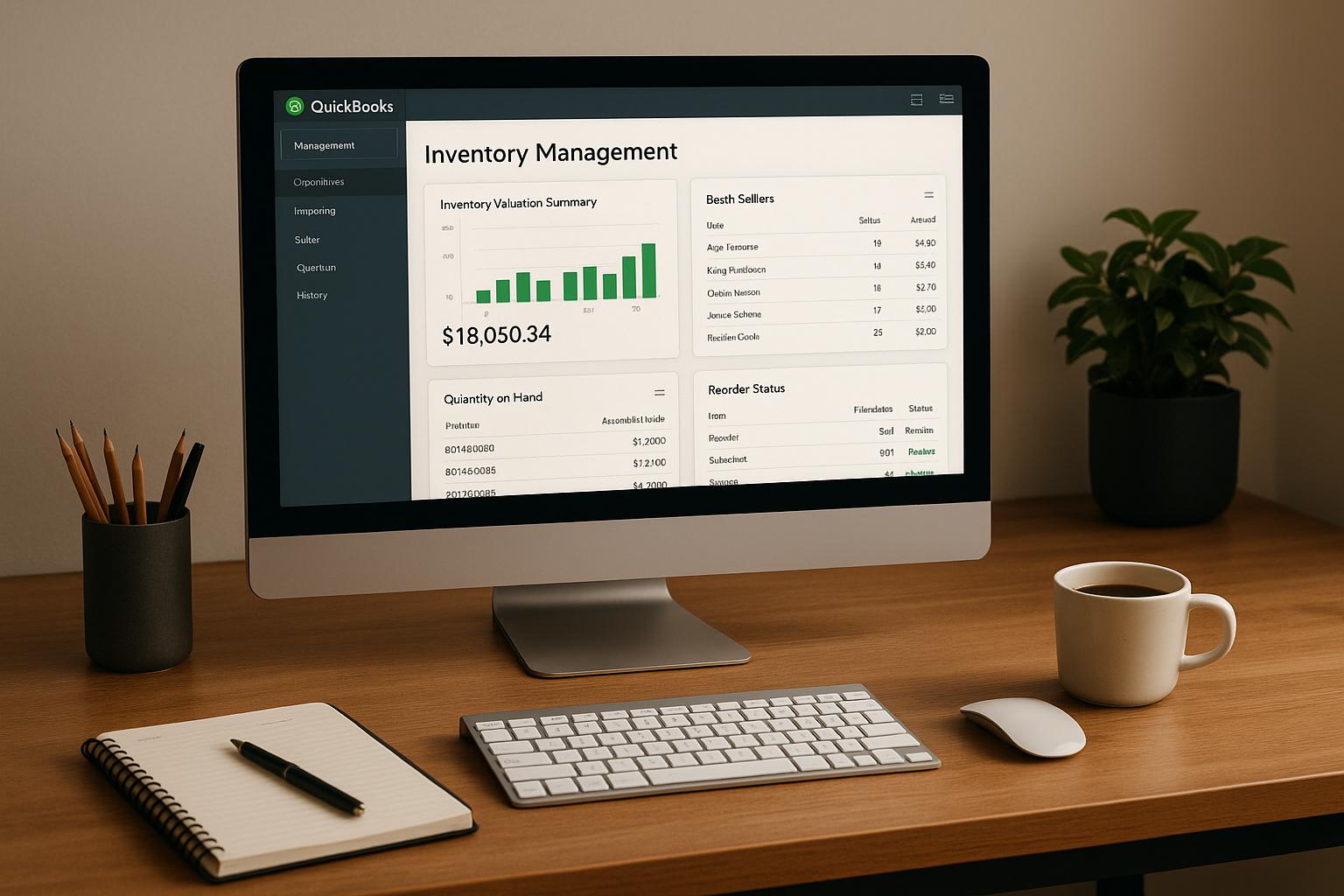

Managing inventory across multiple locations can feel overwhelming, but QuickBooks Desktop Enterprise offers tools to simplify the process. Here's what you need to know:
- What It Is: Multi-location inventory in QuickBooks tracks stock levels, costs, and movements across different sites like warehouses, stores, or delivery trucks.
- Key Features: Assign inventory to specific locations, track real-time stock levels, and manage transfers, sales, and receipts with clear audit trails.
- Setup Steps: Enable Advanced Inventory in the Platinum or Diamond editions, create location sites, and update inventory records.
- Daily Workflows: Record inventory receiving, transfer stock between locations, and fulfill orders from the appropriate site using built-in tools.
- Reports: Use reports like "Quantity on Hand by Site" and "Inventory Valuation Summary" to monitor stock, plan restocks, and reconcile inventory.
- Advanced Options: For more complex needs, tools like Rapid Inventory add barcode scanning, lot tracking, and automated picking strategies.
QuickBooks Desktop helps businesses maintain accurate records and streamline operations across multiple locations, ensuring smoother workflows and better decision-making.
QuickBooks Demo 2025: Multi-Location Inventory | QuickBooks Enterprise Advanced Inventory | Platinum
What Is Multi-Location Inventory in QuickBooks Desktop?

Multi-location inventory in QuickBooks Desktop is a tool designed to help businesses track stock levels, costs, and movements across multiple physical locations - all from a single system. This feature is available in the QuickBooks Desktop Enterprise Platinum and Diamond editions, making it possible to manage inventory across warehouses, retail stores, trucks, and even consignment sites.
With this feature, QuickBooks adds a "Site" field to forms like purchase orders, invoices, bills, and assembly builds. This allows businesses to assign inventory items to specific locations for receiving, selling, or transferring stock. For instance, you can receive shipments at one warehouse, sell products at a retail store, and transfer stock between sites - all while maintaining accurate, up-to-date records. Let’s take a closer look at the data you can track and how this feature benefits your operations.
What Can You Track Across Locations?
The multi-location inventory feature in QuickBooks Desktop tracks key details for each site. It provides real-time visibility into on-hand quantities, showing exactly how many units are available at each location. It also records consistent cost information across all sites and logs inventory movements, such as transfers, sales, and receipts, creating a detailed audit trail.
Why Use Multi-Location Inventory?
Using multi-location tracking gives businesses a complete view of their inventory, improving visibility and simplifying inventory management. By integrating location data directly into QuickBooks Desktop workflows, this feature minimizes manual errors and streamlines operations. Whether you're managing inventory for multiple warehouses, retail locations, or mobile units like delivery trucks, this centralized approach helps keep your daily operations running smoothly.
How to Set Up Multi-Location Inventory in QuickBooks Desktop
Managing inventory across multiple locations in QuickBooks Desktop involves enabling specific features, setting up locations, and updating inventory records. This process ensures accurate tracking of stock while maintaining clear audit trails. Here's a step-by-step guide to getting started with Advanced Inventory features.
How to Enable Advanced Inventory Features
To track inventory across multiple locations, you'll first need to activate the Advanced Inventory feature in QuickBooks Desktop Enterprise. Keep in mind that this feature is only available in the Platinum and Diamond editions, so confirm that your subscription includes it.
To enable Advanced Inventory:
- Open QuickBooks and go to the Edit menu.
- Select Preferences and then click Items & Inventory in the left-hand menu.
- Switch to the Company Preferences tab and look for the option to turn on Advanced Inventory. Check the box to enable it.
QuickBooks will prompt you to restart the software for the changes to take effect. Once restarted, you'll gain access to tools for multi-location tracking, such as creating sites, transferring inventory, and running location-specific reports.
How to Create and Manage Inventory Locations
Once Advanced Inventory is enabled, the next step is to define the locations - or "sites" - where your inventory is stored. These sites can represent warehouses, retail outlets, delivery vehicles, or any other physical storage space.
To set up a new site:
- Navigate to the Lists menu and select Advanced Inventory, then choose Sites.
- Click the New button at the bottom of the window.
- Enter a Site Name that clearly identifies the location (e.g., "Main Warehouse" or "East Side Store"). You can also add a description for additional context.
Make sure each site name is clear and consistent to simplify identification. For example, "Chicago Warehouse" or "Truck 3" works well for quick reference.
After creating your sites, assign starting quantities through inventory adjustments. Go to the Vendors menu, select Inventory Activities, and click Adjust Quantity/Value on Hand. In the adjustment form, choose the appropriate Site and input the current quantity for each item stored at that location. Finally, update any pre-existing inventory records to align with your new multi-location setup.
How to Handle Existing Inventory During Setup
If you already have inventory recorded in QuickBooks before enabling multi-location tracking, you'll need to manage the transition carefully to avoid errors. When Advanced Inventory is activated, QuickBooks assigns all existing inventory to a default site. If you enable Bin Location Tracking, items may initially appear in an "unassigned" site until bins are created.
Here’s how to handle existing inventory:
- External Tracking Systems: If you've been managing inventory outside of QuickBooks, run a report from your external system to determine quantities at each location. Ensure all inventory items are properly set up in QuickBooks before transferring quantities.
- Consolidating Duplicate Items: If you've been tracking the same product as separate items for different locations, combine them into a single item. Calculate total quantities across locations, standardize item names by removing location-specific details, and mark redundant entries as inactive. For items with varying average costs across locations, consult your accountant. Minor differences can often be written off, but larger discrepancies may require adjustments using the "Adjust Quantity/Value on Hand" feature.
Once your inventory is consolidated and assigned to the default site, use QuickBooks' transfer feature to move stock to the correct locations. This step ensures accurate records and maintains a clear audit trail as inventory is relocated from the temporary default site to its actual storage location.
How to Manage Multi-Location Inventory Workflows
Once you've set up your multi-location inventory system in QuickBooks Desktop, the next step is managing the daily tasks that keep your stock levels accurate and your operations running smoothly. Every transaction - whether it's receiving, transferring, or fulfilling inventory - needs to be recorded to maintain up-to-date inventory data.
How to Receive and Allocate Inventory
When new inventory arrives, make sure it's recorded at the correct location right away. With Advanced Inventory enabled, QuickBooks adds Site and Location fields to purchase orders, bills, and receiving forms, allowing you to specify where the stock should go.
To receive inventory at a specific site, open your purchase order or create a new bill under the Vendors menu. Select Receive Items, then choose the appropriate site from the dropdown. Enter the quantity received for each item, and QuickBooks will automatically update your inventory count.
If one location has consistently higher demand - like a downtown store compared to a suburban one - use QuickBooks' inventory reports to guide your allocation decisions. For example, if your city location sells more units, direct a larger portion of incoming stock there. Reviewing sales data by site before placing orders helps ensure you're sending inventory where it will sell fastest.
Consistency in your receiving process is critical. Regularly review inventory reports and document every transaction. This not only keeps your data accurate but also simplifies month-end reconciliations. A smooth receiving process lays the foundation for efficient transfers and order fulfillment.
How to Transfer Inventory Between Locations
Once inventory is received, transferring stock between locations helps maintain accurate records. In QuickBooks Desktop Enterprise, go to the Inventory menu and select Transfer Inventory. The transfer form requires details like the transfer date, a reference number for tracking, and an optional class designation if you're using class tracking.
Specify both the originating site and the destination site. If you're moving stock between bins within the same site, select the same site for both fields and indicate the specific bin locations. Then, choose the items to transfer and enter the quantities - either manually or by using the Quantity on Hand option. You can also add a memo to document the reason for the transfer.
QuickBooks will automatically adjust inventory levels at both locations, keeping your records accurate.
To make transfers more efficient, establish clear procedures. Define who is authorized to initiate transfers, outline the approval process, and set documentation standards. Turnaround times should also be established to ensure timely completion. Regular audits, combined with employee training on multi-location tracking and barcode scanning, can help reduce errors and improve accuracy.
How to Fulfill Orders from the Right Location
Accurate allocation and transfers set the stage for successful order fulfillment. To protect your margins and ensure customer satisfaction, orders should be fulfilled from the most logical location. When creating a sales order or invoice, QuickBooks provides a Site column for each line item. Use this to select the location that makes the most sense based on factors like proximity to the customer, available stock, and shipping logistics. For example, if a customer is on the West Coast and you have warehouses in California and New York, fulfilling the order from California will likely save time and shipping costs.
If stock at the preferred location is insufficient, you can transfer items, split the order, or backorder as needed. QuickBooks' inventory reports make it easy to check stock levels across all locations, helping you make quick, informed decisions.
To keep fulfillment running smoothly, establish clear site selection criteria. For instance, you might assign specific warehouses to certain product lines or set rules to always fulfill orders from the nearest location unless it's out of stock. Documenting these criteria and training your team accordingly helps prevent errors and ensures orders are delivered on time, maintaining customer trust and satisfaction.
sbb-itb-19ed50f
How to Report and Reconcile Multi-Location Inventory
Keeping inventory reports accurate and reconciling regularly is crucial to avoiding issues like misstated profits, unexpected tax liabilities, or cash flow problems. This ongoing attention ensures smooth operations, especially when managing multiple locations. QuickBooks Desktop Enterprise provides powerful tools to track inventory across all sites, seamlessly integrating with the receiving, transferring, and fulfillment processes previously discussed.
Key Reports for Multi-Location Inventory
QuickBooks Desktop Enterprise offers several reports tailored for tracking inventory across multiple locations. These reports are accessible through the Reports menu > Inventory. For example:
- The Quantity on Hand by Site report compares stock levels at different locations, helping you fulfill orders quickly and reduce shipping costs.
- The Inventory Stock Status by Site report tracks reorder points, alerting you when stock levels approach their minimum to avoid running out.
- The Inventory Valuation Summary by Site report shows the total inventory asset value at each location, while the Inventory Valuation Detail report provides transaction-level details to help identify and resolve discrepancies.
When using these reports, always check the "as of date" to ensure you're reviewing up-to-date information. Use filters to focus on specific locations or view all sites at once. Including zero-quantity items in your reports can also reveal unexpected shortages.
How to Reconcile Inventory at Month-End
Reconciliation involves matching your QuickBooks inventory records with physical counts to uncover and fix any differences. While QuickBooks automatically updates your inventory asset and Cost of Goods Sold (COGS) accounts with every transaction, errors can still occur due to issues like data entry mistakes, theft, damage, or system glitches.
Perform physical counts monthly - or weekly if you handle high volumes - and compare the results to the Inventory Valuation Summary and Detail reports. Look for common issues such as missing transactions, unrecorded transfers, or errors in data entry. Even a $50,000 inventory error could result in a $7,500 unexpected tax bill.
To streamline this process, establish clear procedures outlining who conducts the counts, how often they occur, and how to document findings. Automating reconciliation can save significant time. For instance, Webgility customers have reported reducing manual reconciliation efforts by up to 90%, saving 10–15 hours each week and speeding up the financial close process.
Accurate reconciliation not only keeps your records in order but also supports better decision-making.
How to Use Reports to Improve Decisions
Inventory reports are a goldmine of insights that can help you fine-tune your management strategies. For instance, sales reports by site can reveal which locations perform best, highlight the most profitable products, and clarify demand patterns. Armed with this information, you can allocate inventory more effectively.
If one location consistently outperforms another, consider prioritizing it for incoming stock. Seasonal trends may also vary by site, so analyzing historical data can help you anticipate these shifts and adjust inventory levels accordingly.
Additionally, reports can help you cut costs by identifying slow-moving items. By redistributing these products or adjusting purchasing decisions, you can free up working capital, lower storage expenses, and improve both cash flow and operational efficiency.
How Rapid Inventory Improves Multi-Location Inventory Management
For U.S. businesses juggling inventory across multiple locations using QuickBooks Desktop, Rapid Inventory offers a solution to streamline operations. While QuickBooks Desktop Enterprise provides the basics for multi-location inventory tracking, many businesses find themselves needing more advanced tools to handle the complexities of their workflows. This is where Rapid Inventory steps in, enhancing QuickBooks Desktop with features tailored for multi-location management.
Two-Way Sync with QuickBooks Desktop
One of Rapid Inventory’s standout features is its two-way synchronization with QuickBooks Desktop. This means that any inventory activity - whether it’s receiving stock, transferring items between locations, or fulfilling orders - gets automatically updated in QuickBooks Desktop. Similarly, changes made directly in QuickBooks Desktop, like updating item details or adding new inventory sites, sync back to Rapid Inventory.
This real-time syncing ensures consistency across both platforms, so inventory quantities, transaction records, and financial data remain aligned without requiring manual updates. Plus, since Rapid Inventory works within QuickBooks Desktop’s existing structure for inventory sites and locations, there’s no need to overhaul your accounting system to integrate it.
But Rapid Inventory doesn’t stop at integration - it builds on this foundation with advanced features designed to simplify multi-location management.
Advanced Features for Multi-Location Management
Rapid Inventory brings a range of powerful tools to the table, including:
- Lot and Serial Number Tracking: While QuickBooks Desktop Enterprise includes basic lot and serial tracking, Rapid Inventory takes it further. It simplifies assigning, tracking, and reporting on lot and serial numbers across locations, making it easier to trace specific units, monitor arrival dates, or track transfers. This is especially useful in industries with strict regulatory or warranty tracking requirements.
- Mobile Barcode Scanning: Employees can use mobile devices to scan barcodes directly in the warehouse, making tasks like receiving, transferring, and picking faster and more accurate. This feature also streamlines cycle counts, reducing errors and saving time.
- FIFO and FEFO Picking Strategies: Rapid Inventory supports automated picking strategies like First-In-First-Out (FIFO) and First-Expired-First-Out (FEFO). These strategies help reduce waste and ensure product freshness - critical for businesses handling perishable goods.
With support for unlimited warehouses and locations, Rapid Inventory offers flexibility for businesses that are expanding their distribution centers or retail locations. And with real-time inventory reports, you gain instant visibility into stock levels, movement trends, and potential issues, enabling quicker and more informed decisions.
QuickBooks Desktop vs. QuickBooks Desktop with Rapid Inventory
To better understand how Rapid Inventory enhances QuickBooks Desktop, here’s a side-by-side comparison:
| Capability | QuickBooks Desktop Enterprise | QuickBooks Desktop Enterprise + Rapid Inventory |
|---|---|---|
| Multi-Location Tracking | Basic tracking of multiple locations | Unlimited warehouses and locations with enhanced visibility |
| Lot/Serial Management | Basic tracking | Advanced tracking with mobile scanning and automated workflows |
| Barcode Scanning | Requires third-party hardware and manual processes | Mobile barcode scanning for faster, accurate operations |
| Picking Strategies | Manual item selection | Automated FIFO/FEFO strategies for efficient inventory rotation |
| Real-Time Visibility | On-demand reports within QuickBooks | Web-based dashboards accessible anytime, anywhere |
| Data Entry | Manual entry for most tasks | Scan-based entry for faster, error-free workflows |
| Cycle Counting | Manual counts tracked via spreadsheets | Mobile cycle counting with automatic QuickBooks updates |
| Training & Support | Standard Intuit support | Free training, onboarding, and dedicated support included |
Rapid Inventory combines specialized warehouse management tools with the accounting precision of QuickBooks Desktop. This integration ensures businesses can maintain accurate financial records while achieving the operational efficiency needed to manage complex, multi-location workflows.
For businesses with 10 or more users, the Unlimited plan includes all features, along with custom inventory reports, a dedicated account manager, and priority support - resources that become even more valuable as your business grows.
Conclusion
Managing inventory across multiple locations doesn’t have to be overwhelming. While QuickBooks Desktop Enterprise offers a solid starting point for tracking stock at different sites, many U.S. businesses discover they need more advanced tools to tackle the daily challenges of warehouse operations, order fulfillment, and maintaining inventory accuracy.
By integrating advanced tools with QuickBooks, businesses can reduce manual data entry and cut down on costly mistakes. A two-way sync keeps financial data accurate while equipping warehouse teams with tools to work more efficiently. These upgrades build on foundational strategies, making multi-location management smoother and more effective.
For companies looking to go beyond basic tracking, Rapid Inventory provides a powerful solution. It integrates advanced warehouse management features with QuickBooks Desktop, addressing operational gaps that QuickBooks alone cannot cover. From streamlining workflows to improving accuracy, these tools are designed to handle the complexities of scaling operations.
To manage multi-location inventory effectively, start with the basics: enable multi-location tracking in QuickBooks Desktop, create clear workflows for receiving and transferring stock, and use regular reporting to spot inefficiencies. As your operations grow, advanced features like lot tracking, mobile scanning, and automated picking can help eliminate bottlenecks and boost accuracy throughout your supply chain.
The most successful businesses invest in the right tools early on, avoiding errors, stock shortages, and inefficient manual processes. By setting up the right systems now, you can build a strong foundation for long-term growth.
FAQs
How can I transfer inventory between locations in QuickBooks Desktop Enterprise?
QuickBooks Desktop Enterprise streamlines the process of moving inventory between different locations. Simply head to the Inventory menu and click on Transfer Inventory. From there, complete the form by entering essential details like the transfer date, reference number, and the source and destination locations.
This tool is designed to keep your inventory records precise and current, making it easier to manage operations across various sites. Be sure to review all entries carefully to reduce mistakes and maintain accurate records.
What are the advantages of using Rapid Inventory with QuickBooks Desktop for managing inventory across multiple locations?
Integrating Rapid Inventory with QuickBooks Desktop takes the hassle out of managing inventory across multiple locations. Thanks to automatic two-way syncing, inventory data stays accurate and up-to-date in both systems without manual intervention.
Features like multi-location and multi-warehouse tracking let you keep an eye on inventory levels, stock transfers, and movements across all your sites. Plus, real-time inventory reporting delivers actionable insights, helping you make smarter decisions and keep operations running smoothly. This integration simplifies inventory management, minimizes errors, and helps your business work more efficiently.
How can I accurately reconcile multi-location inventory in QuickBooks Desktop?
To keep your multi-location inventory in QuickBooks Desktop accurate, start by examining essential reports like Quantity on Hand by Site, Inventory Valuation Summary by Site, and Inventory Stock Status by Site. These reports give you a snapshot of inventory levels, values, and statuses for each location, helping you stay on top of your stock.
Make it a habit to update and verify inventory data regularly across all sites. Record every transaction - whether it's a purchase, sale, or transfer - promptly and with precision. Consistent data entry and routine reviews are key to avoiding discrepancies and ensuring your inventory records remain reliable, making the reconciliation process much smoother.