
FIFO (First In, First Out) is an inventory accounting method where the oldest stock costs are used first when calculating the Cost of Goods Sold (COGS). This method is widely accepted under U.S. GAAP and IFRS, making it a preferred choice for businesses globally. Here are five key advantages of using FIFO:
- Accurate COGS Calculation: FIFO aligns older inventory costs with sales, creating clear records and simplifying audits. Using inventory management software can further automate these calculations.
- Higher Inventory Valuation: During inflation, FIFO leaves newer, higher-cost inventory on the balance sheet, improving financial metrics like liquidity ratios.
- Reduced Waste: Selling older stock first minimizes spoilage and write-offs, especially for perishable or time-sensitive items.
- Increased Profitability: Lower COGS during inflation boosts gross profits by 2–3%, but it may result in higher tax liabilities.
- Simplified Reporting: FIFO complies with both GAAP and IFRS, streamlining audits and financial consolidation across regions.
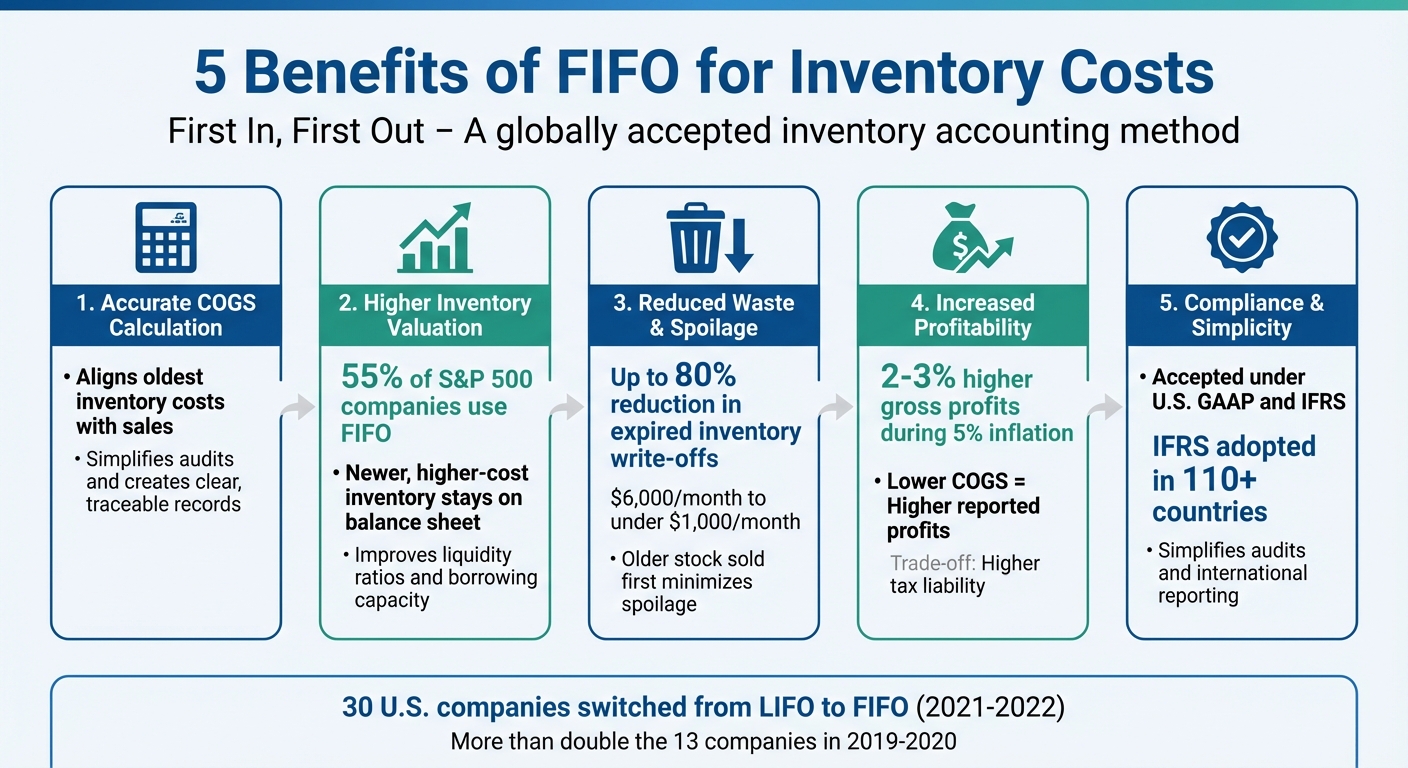
5 Key Benefits of FIFO Inventory Method with Statistics
FIFO Inventory Accounting Method EXPLAINED | First In, First Out Inventory Cost Flow
sbb-itb-19ed50f
1. Accurate Cost of Goods Sold Calculation
FIFO simplifies the calculation of Cost of Goods Sold (COGS) by aligning the oldest inventory costs with current sales. Instead of averaging costs, it uses specific purchase dates and unit costs, systematically depleting the oldest inventory first. This approach creates a clear, traceable record that is easier for external auditors to verify compared to more complex methods like cost averaging. This clarity not only streamlines accounting but also enhances operational workflows.
"FIFO method lets businesses align oldest costs with first sales, yielding cleaner COGS, more accurate margins, and faster audits" - Chinh Nguyen, Revenue and Sales Lead at Finale Inventory
For businesses handling perishable or seasonal items, FIFO reflects the natural flow of inventory - older stock is sold first. This helps ensure that financial records match the physical movement of goods, reducing risks like spoilage or obsolescence.
Modern inventory management systems now automate the FIFO process, eliminating the manual errors common with spreadsheets. To improve accuracy, it's essential to factor in landed costs - such as freight, duties, insurance, and handling - when calculating each inventory layer's unit cost. Using barcode scanning to log exact receipt timestamps can further enhance precision. This automation and attention to detail not only improve financial accuracy but also create a transparent, auditable trail that aligns with FIFO's chronological cost flow.
2. Higher Inventory Valuation on Balance Sheet
FIFO's approach to inventory valuation doesn't just simplify COGS calculations - it also has a noticeable effect on the balance sheet. In periods of inflation, FIFO leaves the higher-cost, newer inventory on the books, which means asset values appear higher. Since the method assumes older, cheaper inventory is sold first, the remaining stock is valued at current, elevated prices. This creates a stronger asset base compared to other inventory methods, which can improve liquidity and borrowing capacity.
This higher valuation directly impacts key financial metrics. By boosting current assets, FIFO enhances liquidity ratios like the current ratio and working capital. For businesses aiming to secure loans or attract investors, this is a big deal. Lenders and investors often view higher asset values as a sign of financial strength, which can positively influence decisions around creditworthiness or investment potential.
"FIFO often results in higher net income and higher inventory balances on the balance sheet... strengthening a company's balance sheet." - Investopedia
The numbers back this up: 55% of companies in the S&P 500 use FIFO as their primary inventory method. Between 2021 and 2022, around 30 U.S. companies switched from LIFO to FIFO, which is more than double the 13 companies that made the same switch in 2019 and 2020 combined. Bill Mayew, a professor at Duke University, explains, "The increase in companies switching to FIFO accounting may indicate that the pressure to present competitive earnings figures is outweighing the tax benefits afforded by LIFO".
However, while FIFO strengthens the balance sheet and boosts reported profitability, it does come with a trade-off: higher tax liability. For example, under 5% inflation, FIFO can increase gross profits by 2%–3%.
3. Reduced Waste and Spoilage
FIFO (First-In-First-Out) ensures that older inventory is sold before newer stock, which plays a crucial role in cutting down spoilage and waste. This approach is especially vital for perishable goods like food, beverages, and pharmaceuticals, where managing expiration dates is non-negotiable. It’s also effective for products with limited selling windows, such as seasonal fashion, electronics, and cosmetics, helping businesses move these items before they lose value.
Take this example: a supplement distributor managed to slash their expired inventory write-offs from $6,000 a month to under $1,000 - an impressive 80% reduction.
"FIFO supports lean inventory practices by ensuring your older stock is sold first, reducing spoilage, obsolescence, and costly write-downs."
– Sage
To make FIFO work, businesses can store newer products at the back and prioritize older stock for picking. Adding clear labels with production and expiration dates ensures proper rotation. For items with extremely short shelf lives, some companies use FEFO (First-Expired-First-Out), which focuses on actual expiration dates rather than arrival dates.
Beyond reducing waste, FIFO also cuts labor costs by minimizing the time spent sorting expired stock and frees up valuable warehouse space. In industries like food service and pharmaceuticals, following FIFO isn’t just a smart practice - it’s often required by regulations like FDA or FSMA standards. By streamlining inventory control and reducing waste, FIFO strengthens inventory management while setting the stage for smoother operations in the long run.
4. Increased Profitability
FIFO accounting doesn't just enhance accuracy and valuation - it also plays a key role in improving profitability. During inflationary periods, FIFO aligns older, lower-cost inventory with current, higher selling prices. This creates a scenario where Cost of Goods Sold (COGS) reflects historical costs, boosting gross profit and net income. After all, profit is simply revenue minus COGS, and lower COGS means higher profits.
Here's a striking example: in a 5% inflationary environment, a retailer using FIFO might report gross profits that are 2% to 3% higher than if they were using LIFO. This edge hasn't gone unnoticed - numerous companies have transitioned to FIFO to take advantage of these better-reported earnings during times of inflation.
"In a highly inflationary environment, FIFO accounting defers the effect of rising prices on net income, while LIFO accounting has a much more punishing impact on earnings."
– Kris Bennati, CEO, Bedrock AI
Beyond profit margins, FIFO also strengthens a company's financial standing by valuing ending inventory at current, higher market prices. This positively impacts liquidity ratios, such as the current ratio, and can help businesses meet profit-based loan covenants. However, there’s a flip side: higher reported profits mean higher tax liabilities, as the increased net income becomes subject to greater income tax.
This trade-off highlights the importance of having a solid inventory management system to balance profitability with compliance. Even so, the widespread adoption of FIFO is clear - about 55% of companies in the S&P 500 use it as their primary inventory accounting method, showing its strong acceptance in financial reporting.
5. Compliance and Simplicity in Reporting
FIFO stands out for its alignment with major accounting standards. While U.S. GAAP allows businesses to choose from various inventory valuation methods, the International Financial Reporting Standards (IFRS) require FIFO and prohibit LIFO usage. With IFRS adopted in over 110 countries, FIFO has become a go-to method for companies operating internationally.
"As a GAAP and IFRS-compliant method, FIFO simplifies audit preparation and regulatory reporting."
– Ryan Grundy, Sage
One of FIFO's key strengths is how it simplifies audit and compliance efforts. Unlike LIFO, which can leave outdated cost layers lingering on financial records, FIFO ensures a continuous rotation of inventory. This reduces the number of active cost layers and minimizes the burden of maintaining historical records. Marshall Hargrave from QuickBooks highlights this advantage, stating, "FIFO is the easiest method to use, regardless of industry, and this inventory valuation method complies with GAAP and IFRS".
For financial reporting and tax purposes, FIFO's alignment with the physical flow of goods - selling the oldest items first - offers additional benefits. This approach reduces tracking errors and creates transparent audit trails. Companies planning to expand internationally can particularly benefit from adopting FIFO early on, as it ensures compliance with IFRS across various jurisdictions.
Another advantage is its ability to simplify financial consolidation. Businesses with multiple entities operating under different accounting standards can consolidate their global financials more efficiently with FIFO. This avoids the need for complex adjustments or additional disclosures required when mixing methods. By streamlining quarterly and annual reporting, FIFO allows finance teams to dedicate more time to strategic decision-making rather than reconciling incompatible inventory valuation methods.
How Rapid Inventory Supports FIFO Implementation
For businesses using QuickBooks Desktop, implementing FIFO (First In, First Out) can be a tough nut to crack. QuickBooks Desktop doesn’t natively support FIFO valuation, requiring users to rely on external software to fill the gap. That’s where Rapid Inventory steps in, offering an efficient and automated solution tailored to these challenges.
With its two-way QuickBooks sync, Rapid Inventory eliminates the need for tedious manual data entry and reduces the dependency on spreadsheets. The system supports both FIFO and FEFO (First Expiration, First Out) picking strategies, ensuring proper stock rotation happens automatically. Mobile barcode scanners play a key role here, recording exact timestamps for inventory movement. This feature not only maintains the integrity of inventory batches through lot control but also creates a detailed, auditable trail that aligns with FIFO’s chronological cost flow requirements.
Warehouse operations become significantly smoother with features like optimized pick lists, which guide staff to the most efficient routes and precise item locations. Meanwhile, real-time reporting offers instant insights into inventory value, stock levels, and reorder points - all seamlessly synced with QuickBooks Desktop. By automating the tracking of lot numbers, serial numbers, and expiration dates, the platform helps businesses stay compliant with FIFO while shedding the burden of manual tracking.
Rapid Inventory has already gained the trust of over 400 customers, with most users getting up and running within just 6 to 7 days. Jacob, a CEO who adopted the platform, shared: "My team was up and running in a few days. Very straightforward and easy to use". The Pro plan starts at $90 per user per month and includes perks like white-glove onboarding (a $600 value) and data migration (a $1,500 value).
For businesses managing multiple warehouses, Rapid Inventory provides real-time tracking across unlimited locations. This feature empowers finance teams to verify FIFO inventory valuations effortlessly while simplifying quarterly reporting and audits.
Conclusion
FIFO offers an effective way to handle inventory costs, ensuring precise calculations for Cost of Goods Sold while minimizing losses from spoilage or outdated stock. It also keeps inventory values in line with current purchase prices, making it especially useful for businesses dealing with perishable or time-sensitive items.
Since FIFO is widely accepted under U.S. GAAP and IFRS, it simplifies audits and boosts transparency with stakeholders. On top of that, automation tools make applying FIFO even easier. For example, QuickBooks Desktop users can leverage Rapid Inventory to automate lot tracking and generate real-time reports. This not only aligns inventory management with financial records but also turns FIFO into a strategic tool for staying competitive.
FAQs
When should a business avoid using FIFO?
When inventory costs are climbing rapidly, FIFO (First In, First Out) might not be the best choice for your business. Why? This method uses the cost of your oldest inventory to calculate the cost of goods sold (COGS). In a rising cost environment, this can lead to higher taxable income and, consequently, larger tax liabilities. Plus, FIFO might not provide an accurate picture of current market values, which could impact financial reporting.
Before opting for FIFO, weigh these potential drawbacks against your financial and operational objectives to ensure it aligns with your overall strategy.
How does FIFO change my taxes during inflation?
During inflation, FIFO (First In, First Out) often leads to higher taxable income. Why? It calculates the cost of goods sold using the oldest, lower-cost inventory. This increases reported profits, which in turn raises the amount of taxes owed. On the other hand, LIFO (Last In, First Out) matches the most recent, higher-cost inventory to revenue. This approach lowers taxable income and reduces the tax burden. The decision between FIFO and LIFO can play a big role in how much tax you owe when prices are climbing.
How can QuickBooks Desktop users implement FIFO correctly?
To use FIFO in QuickBooks Desktop, you’ll need to activate the Advanced Inventory feature. Once that’s set up, follow these steps:
- Navigate to Edit > Preferences.
- Select Items & Inventory, then click on Company Preferences.
- Open Advanced Inventory Settings and switch to the FIFO tab.
- Turn on FIFO and choose a start date, such as the day after your most recent tax filing.
- Hit OK to finalize your changes.
Make sure the start date you select aligns with accurate inventory tracking practices to avoid discrepancies.