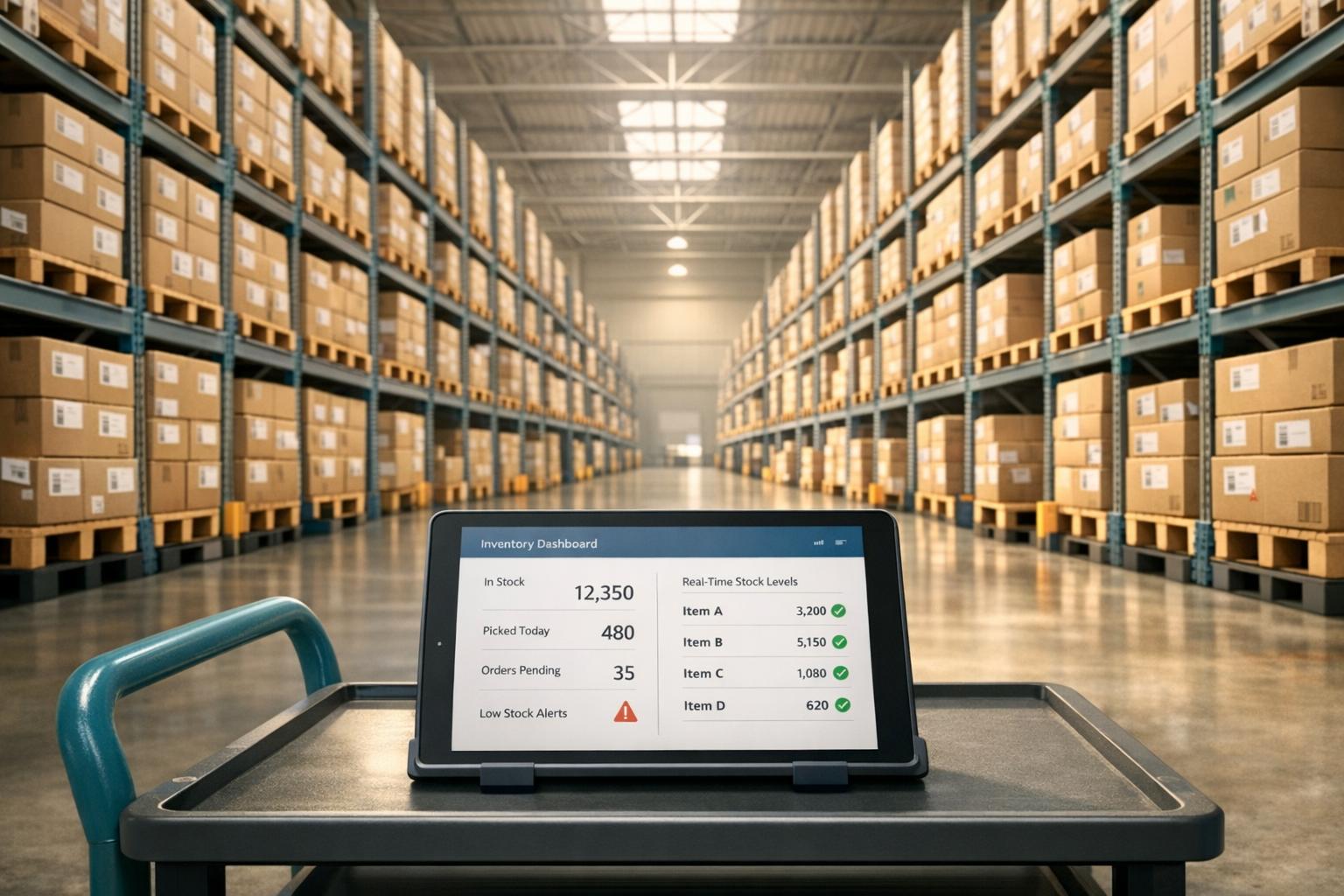
Real-time reporting transforms warehouse operations by providing instant updates on inventory levels, reducing errors, and improving efficiency. Here's why it matters:
- Accuracy Boost: Traditional systems average 63% accuracy, while real-time systems can reach up to 95%.
- Cost Savings: Overstocks and stockouts cost businesses $1.77 trillion globally in 2023. Real-time data reduces carrying costs by up to 30%.
- Faster Fulfillment: Late shipments due to inaccurate stock records impact 34% of businesses. Instant updates prevent these delays.
- Automation Benefits: Tools like barcode scanners and RFID reduce manual errors, improving picking and shipping processes.
Switching to real-time reporting eliminates outdated batch updates, enabling businesses to stay ahead with precise, live inventory tracking. Platforms like Rapid Inventory integrate seamlessly with QuickBooks Desktop, offering features like mobile scanning, FIFO/FEFO tracking, and cycle counting for streamlined operations.

Real-Time vs Traditional Warehouse Systems: Accuracy and Cost Comparison
Real-time warehouse inventory and digital twin for intralogistics
Common Warehouse Accuracy Problems
When warehouses depend on manual processes or batch updates, they often face recurring issues that undermine inventory accuracy and profitability. These problems can create operational headaches, disrupt financial reporting, and damage customer satisfaction.
Inventory Discrepancies
Mistakes in data entry and inconsistent counting frequently lead to mismatches between recorded and actual inventory. Errors like these, combined with unclear measurement units, can throw records off balance. Physical losses - whether from untracked theft, spoilage, or handling damage - add another layer of inaccuracy. Items misplaced due to poor labeling or a disorganized layout create "phantom inventory", where the system shows stock that doesn’t actually exist. These inaccuracies don't just waste time and effort; they also skew asset values on financial statements. Employees often spend hours hunting for missing items, while supervisors scramble to resolve these discrepancies. For businesses with weak inventory management, carrying costs can be up to three times higher than those of top performers. Such issues ripple through operations, leading to stock imbalances and inefficiencies.
Stockouts and Overstocking
Outdated inventory updates often result in poor replenishment decisions, triggering either stockouts or overstocking. To compensate for unreliable data, many businesses overstock as a safeguard. Research shows that 80% of small to medium-sized businesses struggle with a mix of poor planning and excess inventory. For larger SMBs, overstocking can account for an average of 44% of their total inventory, tying up capital and wasting valuable storage space. On the flip side, stockouts lead to lost sales, costly emergency orders, and strained customer relationships. Without real-time visibility into inventory movement - such as items being processed or transferred - warehouses risk double-ordering or missing crucial reorder points. Beyond quantity issues, manual handling errors further disrupt warehouse workflows, compounding the problem.
Picking and Shipping Errors
Relying on manual or paper-based processes creates delays between warehouse floor activities and system updates. This lag leads to phantom inventory, duplicate counts, and wasted labor. Human factors amplify these issues: monotony can cause miscounts, and data entry errors may result in mislabeled or misplaced items. Similar-looking products and unclear picking instructions only add to the confusion, while inaccurate location maps force pickers to waste time searching for stock. These errors don’t just slow operations - they also lead to costly fixes. Warehouses often have to cover expedited shipping costs for replacements or manage extra returns. As Warehouse OS emphasizes:
Inventory accuracy is not just a goal; it's the backbone of efficient operations.
Solving these challenges is essential for maintaining real-time inventory accuracy and ensuring smooth warehouse operations.
How Real-Time Reports Solve Warehouse Problems
Real-time reports tackle common warehouse challenges like inventory mismatches and delayed updates by providing instant visibility into stock levels. With every transaction logged immediately, these reports eliminate data delays and create a single, reliable source of truth. Instead of waiting hours - or even days - for scheduled updates, actions like receipts, picks, returns, or transfers are recorded as they happen. This ensures inventory data is always up-to-date.
Continuous Inventory Updates
Traditional batch systems only refresh data a few times a day, leaving decisions based on outdated information. Real-time tracking changes the game. For example, when an item is scanned during receiving or picking, the system updates instantly, reducing errors caused by manual entries and enabling quick detection of discrepancies . Tools like barcode and RFID scanners further minimize human mistakes, ensuring precision at every step. This level of accuracy allows warehouses to spot issues like theft, damage, or misplaced items immediately, rather than waiting for scheduled audits.
Better Decision-Making
With continuous updates, real-time data drives smarter inventory management decisions. Up-to-date stock levels make it easier to plan restocking and avoid shortages. Alerts can notify teams when inventory approaches critical levels, enabling proactive replenishment . For businesses selling across multiple platforms - such as Amazon, Shopify, and physical retail - real-time synchronization ensures that a sale on one channel instantly updates inventory across all others .
Fewer Errors Through Automation
Automation plays a key role in reducing errors that often occur in picking and shipping. With real-time tracking, warehouse staff work with the most accurate location data using tools like barcode scanners and automated picking lists. The system flags stock discrepancies immediately, resolving issues before they escalate. This approach not only improves delivery times - by as much as 25% - but also cuts supply chain costs by 20%. As Team Omniful highlights:
Real-time inventory tracking systems greatly reduce human errors in the management of inventory by using automation and advanced monitoring capabilities.
This proactive system is a game-changer, helping warehouses achieve inventory accuracy rates of 95%, compared to the 83% average for those relying on less efficient methods.
sbb-itb-19ed50f
Main Benefits of Real-Time Reports
Real-time inventory reporting brings measurable improvements in cost management and operational efficiency. These systems turn warehouse operations from reactive problem-solving into proactive decision-making, delivering clear advantages in accuracy, cost savings, and customer satisfaction.
Higher Inventory Accuracy
The gap between traditional systems and real-time reporting is significant. For example, the average retail store in the U.S. operates with an inventory accuracy rate of just 63%. In contrast, businesses using real-time reporting achieved an impressive 83% accuracy rate in 2024. Companies with higher accuracy rates often experience carrying costs that are three times lower than those with less accurate systems. Real-time updates align physical stock with system data, eliminating guesswork and reducing costly errors.
Lower Costs and Better Efficiency
Improved inventory accuracy has a ripple effect on cost savings. Carrying costs typically account for 20% to 30% of overall inventory value. Real-time visibility lets you maintain leaner stock levels without risking stockouts, cutting excess inventory by up to 20% and supply chain costs by up to 10%. Automation also reduces labor costs by minimizing manual tasks like data entry, reconciliation, and searching for misplaced items. With FIFO/FEFO tracking, businesses can further reduce losses from outdated or expired stock. Considering that inventory distortion from out-of-stocks and overstocks reached $1.77 trillion globally in 2023, the financial benefits of accurate reporting are undeniable.
Faster Order Fulfillment
Speed and precision go hand in hand with real-time data. 34% of businesses have shipped orders late because they sold products that weren’t actually in stock. Real-time reporting eliminates this issue entirely. Instant updates ensure pickers spend less time searching for items, while synchronized systems across sales channels prevent overselling. Automated replenishment triggers help you avoid delays caused by stock that should have been reordered earlier. The result? A smooth order fulfillment process where products move seamlessly from placement to shipment, free from the bottlenecks caused by outdated information or missing inventory. These efficiencies make it easier to integrate real-time reporting with tools like QuickBooks Desktop.
How Rapid Inventory Simplifies Real-Time Reporting
QuickBooks Desktop users can now enjoy real-time visibility without giving up their trusted software. Rapid Inventory (https://rapidinventory.com) bridges the gap between warehouse operations and financial records, turning QuickBooks into a powerful inventory management solution - no need for major system overhauls. Here's a closer look at how Rapid Inventory's features make real-time reporting easier and more accurate.
Seamless Integration with QuickBooks Desktop

Rapid Inventory syncs directly with QuickBooks in both directions, ensuring that warehouse activities - like receiving goods, processing sales orders, or conducting physical counts - are updated in real time in your financial records. During setup, an Accounting Configuration Wizard simplifies the process of mapping accounts between the two systems, keeping inventory costs, income, and cost of goods sold (COGS) aligned with GAAP standards. This automated sync eliminates the need for manual data entry and minimizes errors caused by delayed batch updates.
Mobile Barcode Scanning for Precise Tracking
Mobile barcode scanning takes the guesswork out of inventory management by automating data capture at every step - receiving, storing, picking, and shipping. Every scan updates stock levels immediately, giving you an accurate picture of what's in your warehouse. This feature is especially important for addressing inventory shrinkage, which cost the retail industry a staggering $61.7 billion in 2020.
Comprehensive Tools for Warehouse Management
Rapid Inventory provides a full suite of tools to keep your warehouse running smoothly, all accessible online. Lot and serial number tracking offer detailed insights into product movement, helping prevent errors like mislabeling or misplaced items. FIFO (First In, First Out) and FEFO (First Expired, First Out) picking methods ensure products are moved based on age or expiration dates, reducing waste and improving order accuracy.
Cycle counting replaces the hassle of annual physical inventories with smaller, regular audits, allowing you to spot discrepancies without disrupting daily operations. The system also uses ABC analysis to focus on high-value or fast-moving items, ensuring they’re checked more frequently. With real-time dashboards, backorder tracking becomes a breeze, giving managers the tools to monitor order cycle times and fill rates while addressing bottlenecks before they affect customer satisfaction. Plus, Rapid Inventory includes free training, onboarding, and ongoing support to make adopting real-time reporting as smooth as possible.
Conclusion
Achieving high warehouse accuracy hinges on having real-time visibility into transactions. With real-time reporting, the inefficiencies of batch updates and manual data entry are replaced by automated scans and live dashboards. This shift minimizes picking errors, reduces shrinkage, and allows businesses to address potential problems before they escalate into costly mistakes. The result? A smoother, more efficient operation across the board.
By leveraging real-time data, businesses can reach data accuracy levels of up to 99%, cut carrying costs by as much as 30%, and improve delivery times by roughly 25%. These numbers highlight the clear edge real-time systems have over traditional approaches.
For users of QuickBooks Desktop, Rapid Inventory (https://rapidinventory.com) offers a practical solution to integrate warehouse operations with financial records seamlessly. Without requiring a full system overhaul, Rapid Inventory ensures your books stay in sync with your physical stock through two-way syncing. Mobile barcode scanning tracks every movement, while features like FIFO/FEFO picking and cycle counting keep operations running smoothly. This platform empowers businesses to achieve world-class accuracy rates of 95% or more, all while maintaining their existing QuickBooks setup.
Switching to real-time reporting transforms inventory management from reactive problem-solving to proactive control. If your warehouse still depends on manual counts or end-of-day updates, you might be missing out on opportunities to optimize and grow.
FAQs
How can real-time reporting help reduce warehouse costs?
Real-time reporting plays a key role in cutting warehouse costs by improving inventory accuracy and avoiding expensive problems like stockouts or overstocking. Having access to current data allows you to make quicker, smarter decisions, reducing mistakes and inefficiencies in your workflow.
It also helps streamline essential tasks like order picking, cycle counting, and inventory tracking. By simplifying these processes, real-time reporting not only lowers labor expenses but also boosts overall productivity. The result? A more efficient warehouse that saves both time and money.
How does automation improve accuracy in warehouse operations?
Automation takes warehouse operations to a new level by minimizing human errors and simplifying complex processes. Tools like real-time inventory tracking and warehouse management systems (WMS) keep stock levels updated instantly, cutting out the risks tied to manual data entry. This means more accurate records and fewer headaches from issues like stock shortages or excess inventory.
Automating tasks such as order picking, replenishment, and cycle counting not only speeds up workflows but also ensures operations are more efficient. With real-time visibility into inventory, warehouses can make smarter decisions, keeping everything on track to meet customer demands. In short, automation boosts productivity, sharpens accuracy, and strengthens the overall reliability of warehouse management systems.
How does Rapid Inventory help improve inventory accuracy with QuickBooks Desktop?
Rapid Inventory improves inventory tracking by offering real-time reporting, ensuring you always have the latest data available. This helps reduce mistakes, simplifies stock management, and supports better decision-making.
With tools like mobile barcode scanning, lot and serial number tracking, and multi-location warehouse management, it integrates smoothly with QuickBooks Desktop. These features provide a complete system for managing inventory accurately. Plus, by automating tasks such as cycle counting and backorder tracking, Rapid Inventory cuts down on manual work and increases efficiency.