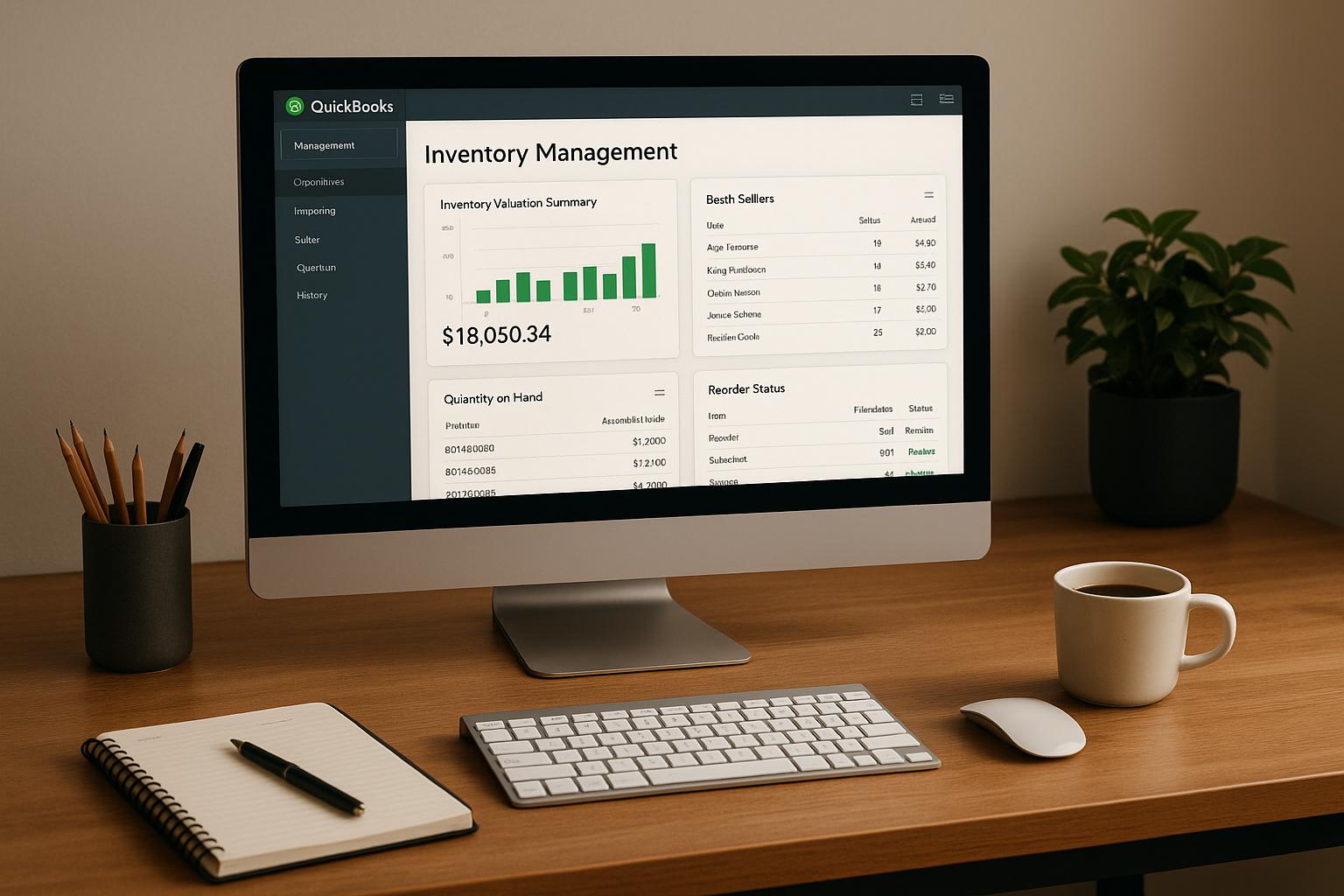

QuickBooks Desktop is great for accounting, but it struggles with warehouse operations like picking, packing, and inventory management. To bridge this gap, integrating inventory software can automate tasks, reduce errors, and improve efficiency. Here's how it works:
- Automated Pick Tickets: Sales orders convert into pick tickets with item details and bin locations.
- Barcode Scanning: Ensures accuracy by verifying items and quantities in real time.
- Real-Time Sync: Updates QuickBooks with inventory levels, shipments, and costs instantly.
- Advanced Tracking: Supports FIFO/FEFO strategies, lot/serial tracking, and multi-warehouse management.
Tools like Rapid Inventory offer two-way sync, mobile scanning, and training to simplify QuickBooks operations for businesses handling large inventories or multiple locations. This integration streamlines workflows, reduces manual work, and keeps records accurate.
Why Integrate Picking and Packing with QuickBooks Desktop?
Limitations of QuickBooks Desktop's Native Inventory Features
QuickBooks Desktop is great for accounting and basic inventory tracking, but it falls short when it comes to the day-to-day demands of warehouse operations. Its built-in tools simply don't cover the needs of modern fulfillment centers.
No barcode scanning or automated pick ticket generation
Without barcode scanning, warehouse teams have to rely on manual data entry for item numbers, quantities, and locations. This not only slows things down but also increases the chances of errors. On top of that, the lack of automated pick ticket generation means someone has to create and distribute pick lists manually, creating delays and miscommunication between the warehouse and accounting teams.
Limited multi-location tracking
QuickBooks Desktop struggles with tracking inventory across multiple warehouses or even different bins within the same facility. This makes it harder to locate stock quickly and efficiently, which can disrupt fulfillment operations.
No advanced picking strategies
The software doesn't support automated picking rules like First-In, First-Out (FIFO) or First-Expired, First-Out (FEFO). For businesses dealing with perishable goods or products with expiration dates, this can be a big problem for maintaining quality and reducing waste.
Basic lot and serial number tracking
While some versions of QuickBooks Desktop offer basic lot tracking, they don't provide the detailed traceability needed for recalls or regulatory compliance. Tracking specific lot numbers and generating detailed movement reports for serialized items is a challenge.
No real-time inventory synchronization
Inventory updates during picking and packing aren't reflected in QuickBooks Desktop immediately. This delay can lead to discrepancies between actual stock levels and what's recorded in the system, increasing the risk of overselling.
These gaps make it clear why many businesses turn to integrated solutions to streamline their warehouse operations.
Benefits of Integration for Picking and Packing
By integrating specialized inventory software with QuickBooks Desktop, businesses can overcome these challenges and create a more efficient fulfillment process.
Automated pick ticket creation and fewer shipping errors
Integrated systems automatically turn sales orders into detailed pick tickets that include item numbers, quantities, bin locations, and customer details. Built-in checks and audit trails help ensure the correct items are picked and packed, reducing costly errors like chargebacks and returns.
Mobile barcode scanning for accuracy
With mobile barcode scanning, warehouse staff can confirm items, quantities, and locations as they go. This real-time verification catches mistakes before items are packed, significantly improving accuracy compared to manual entry.
Real-time inventory synchronization
Every inventory transaction - whether it's picking, packing, or scanning - updates instantly in QuickBooks Desktop. This two-way sync keeps stock levels accurate across all sales channels, helping to prevent overselling and inventory mismatches.
Better multi-warehouse management
Integrated solutions offer real-time visibility across multiple warehouses or storage zones. Orders can be routed to the nearest location for faster delivery, and surplus stock at other sites can be identified and transferred as needed.
Optimized picking strategies and full traceability
Automated FIFO and FEFO picking strategies ensure older or expiring stock is used first, without requiring manual intervention. Combined with advanced lot and serial number tracking, these systems provide complete traceability - essential for quality control and compliance.
Lower labor costs and faster fulfillment
By automating pick ticket creation and reducing duplicate data entry, businesses can cut warehouse labor costs by 20–40% per order. Streamlined workflows also speed up fulfillment, allowing staff to focus on higher-value tasks.
Integrating QuickBooks Desktop with specialized inventory software transforms it into a powerful tool for managing warehouse operations, addressing its native limitations while boosting efficiency and accuracy.
Steps to Integrate Inventory Management Software with QuickBooks Desktop
Selecting the Right Inventory Management Software
The first step is picking inventory software that works seamlessly with QuickBooks Desktop. Not all inventory systems are built the same, and choosing the wrong one can lead to compatibility headaches, syncing errors, and frustrated employees.
A crucial feature to look for is two-way synchronization. This ensures that items and orders automatically sync between QuickBooks and the inventory system, eliminating the need for duplicate data entry and keeping your financial records accurate in real time. Also, confirm that the software supports your specific version of QuickBooks Desktop and any hosted solutions you may use.
Some key features to consider include mobile barcode scanning, lot and serial tracking, multi-warehouse management, FIFO/FEFO inventory strategies, optimized pick lists, and backorder tracking. Integration with QuickBooks inventory sites is another essential feature.
For example, Rapid Inventory ticks all these boxes. It provides automatic two-way syncing with QuickBooks Desktop (including Enterprise, Pro, and Premier editions), supports unlimited warehouses, tracks lot/serial/expiration data, offers mobile barcode scanning, and delivers real-time inventory reports. Plus, it’s web-based, so you can access it from anywhere, even with hosted QuickBooks solutions.
Another consideration is training and support. Some providers offer "white glove" services, handling everything from technical setup and data migration to staff training. This can get your team up and running in days instead of months.
Configuring the Integration
Once you’ve chosen the right software, the next step is configuring it to ensure smooth data flow between QuickBooks Desktop and your inventory system. Proper setup from the start prevents costly data errors later.
A structured onboarding plan is essential. This typically includes discovery, action planning, system staging, and a go-live phase. During the discovery phase, identify your specific needs, such as the number of warehouses you operate, your picking strategies, and your inventory tracking requirements.
Start by setting up users, warehouses, and locations in your inventory software to reflect your physical operations. In QuickBooks Desktop, clean up your item list - remove duplicates, fix incorrect SKUs, and complete any missing product information.
Next, set up the QuickBooks Web Connector and map accounts to enable two-way syncing. Match inventory items, vendors, customers, and financial categories between QuickBooks and the inventory system. Pay close attention to mapping tax codes, income accounts, and payment terms, as mistakes here can cause invoicing errors or inaccurate financial data.
Thoroughly test the integration before going live. Run test transactions, such as entering a sales order in QuickBooks and confirming it appears in the inventory system. Process a test shipment, generate a pick ticket, and check that QuickBooks updates with the correct invoice and inventory adjustments. If you handle partial shipments, test those as well to ensure backorders are tracked properly.
Validate inventory data by confirming that all SKUs, descriptions, prices, and categories sync correctly between platforms. If you use lot or serial numbers, scan test items to verify accurate quantity updates. For multi-warehouse setups, simulate inventory transfers and confirm that QuickBooks reflects these movements.
Before going live, run reconciliation reports to compare inventory quantities and values between QuickBooks and the inventory software. Have your accounting team review test transactions to ensure financial accuracy. These steps help ensure smooth operations, from pick tickets to inventory updates.
Rapid Inventory simplifies much of this process by automating Web Connector setup, user configuration, warehouse creation, and data migration. Their Pro plan even includes white glove onboarding and migration services, valued at $600 and $1,500 respectively, to help your team get started without technical hassles.
Training and Onboarding for Staff
With the integration configured, the focus shifts to training your team. Even the best software is only as effective as the people using it.
Identify key stakeholders across departments. For example, warehouse staff need to master tasks like picking, packing, and barcode scanning, while accounting teams must understand how inventory movements impact QuickBooks records. Managers, on the other hand, require clear visibility into reports and performance metrics.
Develop role-specific training. Warehouse staff should focus on practical tasks like creating pick tickets, using barcode scanners, processing partial shipments, and handling returns. Meanwhile, accounting teams should learn how to reconcile inventory values, generate financial reports, and understand how transactions sync between systems. Tailored training ensures that everyone can quickly become productive.
Many platforms offer free training resources, such as structured onboarding programs, online tutorials, and detailed documentation. For instance, Rapid Inventory provides free training and support with all plans, plus access to an online training center packed with help articles and videos.
"My team was up and running in a few days. Very straightforward and easy to use." - Jacob, CEO
Implement the system in phases rather than rolling it out all at once. Start with a pilot group or a single warehouse location to troubleshoot any issues. This phased approach allows you to refine processes and adjust training based on real-world feedback. Once the pilot group is comfortable, they can help train other team members.
Create clear documentation and standard operating procedures for common tasks, such as processing orders, handling returns, and troubleshooting sync issues. Include step-by-step instructions with screenshots to make these guides easy to follow.
Set up ongoing support channels. Questions will arise as your team encounters new scenarios, so provide a way for them to report challenges and suggest improvements. Rapid Inventory’s Unlimited plan includes a dedicated account manager and priority support for teams with 10 or more users, ensuring quick access to expert help.
Schedule follow-up training sessions 30 and 60 days after the initial rollout. These sessions can address advanced features, optimization strategies, and any lingering questions. Proper onboarding reduces errors in picking and packing, helping your operations run smoothly.
The goal is to get your team comfortable and confident with the new system as quickly as possible. With the right training and support, most teams can become proficient within days, minimizing disruptions to your workflow.
Improving Picking and Packing Workflows with Integrated Systems
When you integrate your systems and train your team, the day-to-day impact on warehouse operations becomes evident. A well-integrated system can redefine how your team handles picking and packing tasks, cutting down errors and speeding up order fulfillment. It all starts with automating manual processes - beginning with the creation of pick tickets.
Automating Pick Ticket Creation
Manually creating pick tickets can slow down fulfillment and lead to mistakes. With integration, this process becomes automatic. As soon as an order is confirmed in QuickBooks Desktop, it’s converted into a detailed pick ticket. The system pulls essential information directly from QuickBooks, such as customer details, order date, item numbers, quantities, shipping address, and warehouse location.
For instance, when a sales order for 10 units of SKU "WIDGET-001" is created for a customer in Los Angeles, the system instantly generates a pick ticket with precise details, including the warehouse bin location. This eliminates duplicate data entry and ensures pickers have clear, real-time instructions.
Rapid Inventory simplifies this process with its two-way sync with QuickBooks Desktop. Sales orders and inventory data update automatically, and optimized pick lists are generated in both mobile and paper formats. You can even configure the system to create pick tickets only for orders marked "Ready to Ship" or set rules for warehouse assignments and partial picking.
This automation not only saves hours of administrative work but also ensures warehouse staff always have accurate instructions. One e-commerce company reported a 75% increase in order volumes year-over-year after implementing software that synced inventory with QuickBooks Desktop.
Using Barcode Scanning and FIFO/FEFO Picking Strategies
Automated pick tickets are just the start. Adding mobile barcode scanning and smart picking strategies like FIFO (First-In, First-Out) and FEFO (First-Expired, First-Out) further boosts accuracy and speed. By scanning barcodes on items and bins, pickers eliminate manual entry errors and ensure real-time inventory updates. This reduces mistakes like picking the wrong SKU or miscounting quantities.
Setting up barcode scanning requires minimal hardware: a mobile device (tablet or handheld scanner), reliable Wi-Fi, and inventory software that supports barcode scanning. Rapid Inventory includes a mobile-friendly interface for scanning both bin and item barcodes. It syncs data back to QuickBooks Desktop in real time, keeping inventory levels and order statuses up-to-date.
FIFO and FEFO strategies are particularly important for industries dealing with perishables, pharmaceuticals, or items with expiration dates. These methods ensure proper inventory rotation, reduce waste, and help businesses stay compliant with regulations. For example, a food distributor managing "Organic Sauce – Lot A (expires 03/15/2026)" and "Lot B (expires 01/10/2026)" would automatically prioritize Lot B to minimize spoilage.
Rapid Inventory enforces these rules using lot numbers and expiration dates stored in item records. When a pick ticket is generated, the system directs pickers to the correct lot based on FIFO or FEFO guidelines. This ensures accurate inventory valuation and compliance while maintaining up-to-date records in QuickBooks Desktop. For businesses needing advanced tracking, Rapid Inventory's Pro plan includes barcode scanning, lot numbers, and expiration tracking for $90 per user/month (1–9 users), while the Unlimited plan at $900 per month supports 10+ users with unrestricted access.
Multi-Warehouse and Lot/Serial Number Tracking
As businesses expand, managing inventory across multiple warehouses becomes essential for faster shipping and cost savings. An integrated system provides real-time visibility into stock levels at each location, making it easier to fulfill orders from the nearest warehouse.
The system can automatically route orders based on proximity or stock levels. It also supports detailed tracking by bin and aisle, tailoring pick tickets to specific warehouse locations. Inter-warehouse transfers are handled seamlessly, with all updates syncing back to QuickBooks Desktop.
Rapid Inventory supports unlimited warehouses and locations, giving you full visibility into inventory at all facilities. It generates location-specific pick tickets and simplifies regional growth with per-warehouse reporting.
Lot and serial number tracking add another layer of precision, especially for industries like medical devices, automotive parts, or aerospace. When an order includes a lot- or serial-controlled item, the system guides pickers to the exact identifier - often via barcode scan. For example, if a distributor needs to ship "Device X – Serial 12345", the system ensures only that serial number is picked.
Once the order is packed and shipped, the lot or serial information is recorded and synced back to QuickBooks Desktop. This creates a complete audit trail, linking shipments to invoices and updating inventory levels accurately. This traceability is critical for managing recalls, warranties, and compliance.
Rapid Inventory ensures QuickBooks Desktop reflects precise inventory data, improving accuracy and providing confidence in your records. Whether you’re tracking batches of perishable goods or individual serial numbers, this system helps streamline operations while meeting industry requirements.
sbb-itb-19ed50f
Maintaining Accuracy and Synchronization in Picking and Packing
Once workflows are automated, keeping everything accurate becomes the next big challenge. Even the most advanced systems can stumble if data gets out of sync or if partial shipments and backorders aren’t handled properly. To avoid these pitfalls, it’s essential to align your warehouse operations with QuickBooks Desktop. This ensures you can tackle the complexities of partial shipments while keeping every transaction accurate.
Handling Partial Shipments and Backorders
Sometimes orders need to ship in parts - maybe stock is running low, or a customer needs an urgent delivery. In these cases, your system should adjust inventory only for the items that are shipped. For instance, if a customer orders 50 units but you only have 30 on hand, your system should deduct 30 units, generate a partial invoice, and flag the remaining 20 as backordered. This keeps inventory records accurate and prevents QuickBooks Desktop from showing incorrect fulfillment data.
Tracking backorders effectively is just as important. When new stock arrives, backordered items should be automatically flagged and prioritized. In QuickBooks Desktop, backorders should remain as pending sales orders or open invoices, ensuring they don’t prematurely affect accounts receivable.
Tools like Rapid Inventory simplify this process by syncing with QuickBooks Desktop. It updates available quantities in real time and creates backorders for items that couldn’t be shipped. This not only reduces the risk of overselling but also keeps cost of goods sold (COGS) calculations accurate.
Reconciliation and Compliance Reporting
Maintaining accuracy across your system requires regular reconciliation. Discrepancies can happen due to picking mistakes, damage, or even theft. To catch these issues early, perform regular cycle counts instead of waiting for a full physical inventory. High-value or fast-moving items should be counted weekly, while other items can be checked monthly or quarterly. Compare these counts with your inventory management software and QuickBooks Desktop, and investigate any mismatches immediately.
For example, one distribution company saw a 40% drop in picking errors and boosted inventory accuracy from 88% to 98% within six months. They achieved this by integrating multi-warehouse management and barcode scanning, ensuring real-time synchronization of all adjustments.
When discrepancies are found, adjustments made in your inventory software should automatically sync with QuickBooks Desktop. This eliminates duplicate entries and minimizes the chance of further errors.
For industries like food distribution, pharmaceuticals, or medical devices, tracking lot numbers, serial numbers, or expiration dates is essential. QuickBooks Desktop Enterprise with Advanced Inventory supports these features, making it easier to maintain traceability and meet regulatory requirements. Pairing this with inventory software that enforces FIFO (First In, First Out) or FEFO (First Expired, First Out) strategies ensures older inventory is used first, reducing waste and staying compliant.
Detailed audit trails are another must-have. Every transaction - whether it’s a pick, pack, shipment, return, or adjustment - should be logged with details about who performed the action and when. Rapid Inventory provides comprehensive activity logs, creating a reliable record for both internal audits and external compliance reviews.
Barcode scanning adds another layer of accuracy by verifying items in real time, reducing manual entry errors and aligning system records with physical inventory.
Monitoring key performance indicators (KPIs) like pick accuracy rates, inventory variance, and reconciliation times can help you identify areas for improvement. If you operate multiple warehouses, ensure each location maintains its own inventory counts and that QuickBooks Desktop tracks these separately using inventory sites or custom fields. Rapid Inventory supports unlimited warehouses and locations, making location-specific reconciliation easier.
Lastly, your system should be prepared for connectivity issues. Offline functionality allows operations to continue when QuickBooks Desktop temporarily loses connection. Transactions are queued locally and synced automatically once the connection is restored. Set clear protocols for how long offline operations can run and use automated alerts to notify management if synchronization fails.
The goal isn’t perfection - it’s about catching and fixing discrepancies early. With regular cycle counts, detailed audit trails, and real-time syncing between your warehouse and QuickBooks Desktop, you’ll create a system that keeps financial records reliable and compliance reporting straightforward.
Conclusion
QuickBooks Desktop can handle basic inventory tasks, but it struggles with the demands of complex warehouse operations. If your business involves managing picking and packing across multiple locations, you'll quickly find its native features - like reorder points and item tracking - falling short. These tools work fine for simple setups but lack the advanced capabilities needed for barcode scanning, automated pick tickets, FIFO/FEFO strategies, and detailed lot or serial number tracking.
That's where integration comes in. By connecting QuickBooks Desktop to a dedicated inventory management system, you get the best of both worlds: accurate financial records paired with powerful tools for warehouse operations. Two-way synchronization ensures real-time updates for item quantities, costs, and order data. This means pickers always have accurate information, and accountants won't waste time resolving discrepancies. The result? A more efficient, error-free warehouse.
On the warehouse floor, the benefits are immediate. Automation eliminates guesswork and reduces mistakes, while FIFO and FEFO strategies help you move older inventory first, cutting waste and helping you stay compliant with industry standards. Multi-location tracking provides full visibility across your warehouses, speeding up order fulfillment. For your team, this means less manual data entry, fewer errors, and better management of backorders and partial shipments. Supervisors gain access to dashboards that track performance and exceptions, replacing the need to sift through endless spreadsheets. It all adds up to a smoother operation that can grow alongside your business.
When choosing a solution, prioritize software with seamless two-way synchronization, mobile barcode scanning, multi-location tracking, and workflows that handle tasks like partial shipments, backorders, cycle counts, and compliance reporting. Platforms like Rapid Inventory are built with these needs in mind. For example, Rapid Inventory offers two-way QuickBooks sync, unlimited warehouse tracking, FIFO/FEFO picking, detailed lot and serial tracking, mobile barcode scanning, and real-time reporting. It also provides free training, onboarding, and support, along with web-based access - an especially useful feature for U.S. businesses managing distributed teams or multiple locations.
Start by analyzing your current processes. How long does it take to pick orders? How often do errors occur? How much time is spent manually entering data into QuickBooks? Identify the weak spots - such as barcode scanning, multi-warehouse tracking, or backorder management - that QuickBooks can't address on its own. Then, research solutions that fill those gaps and integrate seamlessly with QuickBooks. Roll out the new system in phases, starting with a pilot location or product line, and expand once you've confirmed it works smoothly.
With the right tools and a solid plan, you can turn your warehouse operations into a competitive advantage. Fewer stockouts, more accurate shipments, and reliable delivery dates lead to happier customers and more repeat business. As your business scales - whether through increased order volumes, new sales channels, or additional U.S. warehouses - a tightly integrated QuickBooks and inventory system will ensure you're ready to grow without missing a beat.
FAQs
How can integrating inventory management software with QuickBooks Desktop enhance warehouse operations?
Integrating inventory management software with QuickBooks Desktop can transform warehouse operations by boosting efficiency and cutting down on errors. This integration allows for real-time syncing of inventory data, ensuring stock levels are always accurate and orders are processed smoothly.
Some standout benefits include speeding up picking and packing processes, improving inventory tracking across different locations, and enabling advanced methods like FIFO (First In, First Out) or FEFO (First Expired, First Out) picking. Tools like barcode scanning and lot or serial number tracking further enhance precision and save time, making warehouse management more streamlined and dependable.
What features should I consider when choosing inventory management software to work with QuickBooks Desktop?
When choosing inventory management software to pair with QuickBooks Desktop, it's important to focus on features that can simplify your workflow. Start by ensuring the software offers automatic two-way syncing with QuickBooks, so your data stays consistent and up-to-date. If you manage multiple locations or warehouses, having multi-location and warehouse tracking is a must for staying organized. Additionally, support for FIFO (First In, First Out) or FEFO (First Expired, First Out) picking strategies can make order fulfillment smoother and more efficient.
Other helpful features to consider include lot and serial number tracking, which ensures traceability for your products, and mobile barcode scanning to speed up tasks like receiving and picking. Finally, real-time inventory reports can give you the insights you need to make smarter, quicker decisions. Together, these tools can enhance your inventory control and simplify your day-to-day operations.
What steps can businesses take to ensure a seamless integration between QuickBooks Desktop and an inventory management system?
To make sure QuickBooks Desktop works seamlessly with an inventory management system, businesses should focus on a few essential steps:
- Get your QuickBooks data in order: Start by cleaning up your existing data. Fix any discrepancies, remove duplicates, and double-check that all inventory details are accurate. This helps avoid syncing issues later.
- Train your team: Ensure that employees who will use the integrated system receive proper training. They need to understand the new workflows and features to use the system effectively.
- Test the integration: Run a test before going live. This step helps confirm that the inventory management system syncs correctly with QuickBooks Desktop and meets your business requirements.
Following these steps can help reduce disruptions, streamline operations, and make the most out of the integration.