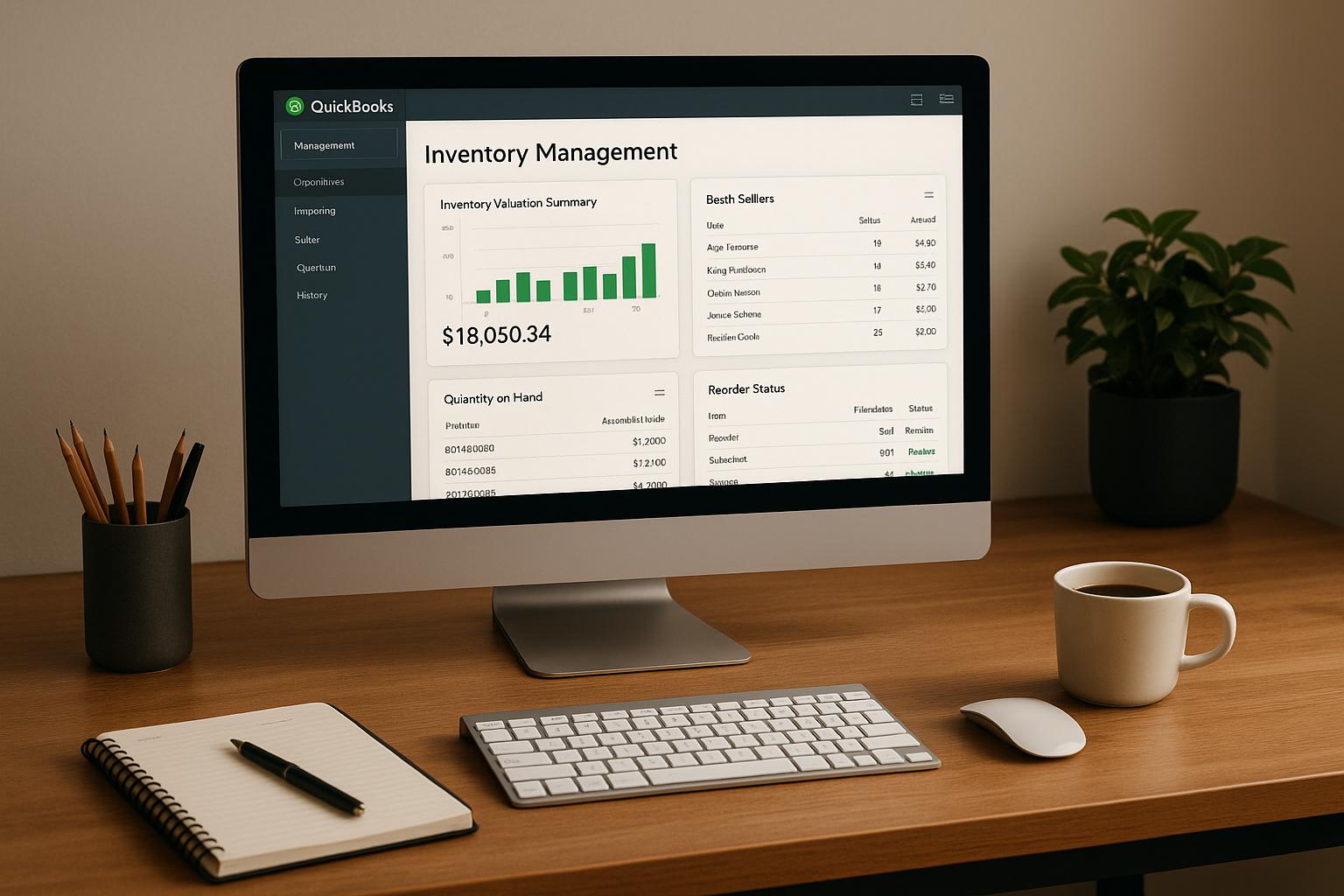

Managing inventory can make or break your small business. Poor practices lead to tied-up cash, stockouts, and lost customers. But with the right reports, you can track stock, spot trends, and make informed decisions. Here are 10 essential inventory reports every small business owner should use:
- Stock on Hand Report: Real-time snapshot of current inventory levels and locations.
- Inventory Valuation Summary: Shows the total value of your stock and its financial impact.
- Sales by Item Summary: Tracks product performance, revenue, and profit margins.
- Open Purchase Orders Detail: Monitors pending orders and expected deliveries.
- Inventory Turnover Report: Measures how often inventory is sold and replenished.
- Stock Reorder Report: Alerts you when items hit reorder points to prevent stockouts.
- Incoming Stock Report: Tracks shipments and arrival dates for better planning.
- Inventory Activity or Detail Report: Detailed transaction history for all inventory movements.
- Build Assemblies or Bill of Materials Report: Tracks components needed for manufacturing or bundling.
- Physical Inventory Worksheet: Ensures recorded inventory matches physical counts.
These reports help you avoid overstocking, reduce waste, and improve cash flow. Tools like QuickBooks Desktop and Rapid Inventory simplify the process, offering real-time updates and advanced tracking features. Regularly reviewing these reports can streamline operations, save money, and keep your customers satisfied.
1. Stock on Hand Report
The Stock on Hand Report is your go-to resource for understanding exactly what’s in your warehouse or store at any given time. It provides a detailed list of every product you carry, along with quantities, locations, and values. Essentially, it gives you a real-time snapshot of your inventory, eliminating the guesswork that often comes with manual tracking.
For small business owners, this report is a game-changer. Instead of relying on memory or outdated spreadsheets, you get precise, up-to-date numbers that reflect your actual stock. It typically includes item names, SKU numbers, quantities on hand, unit costs, and total values based on your current cost basis. If you’re using QuickBooks Desktop, the data is pulled straight from your inventory records, ensuring your financial statements match what’s physically in stock.
Tracks Inventory Levels and Movements
At its core, this report is all about knowing what you have and where it’s located. If your business spans multiple warehouses or retail locations, the Stock on Hand Report breaks down quantities by site, so you can pinpoint exactly which items are in which location. This makes order fulfillment and stock transfers much more efficient.
The report also highlights slow-moving items that might be tying up your cash and storage space. For example, if you notice a product with a high quantity on hand but minimal recent sales, it could signal excess inventory. On the flip side, products with low or zero quantities may indicate potential stockouts, which could lead to missed sales opportunities.
This kind of insight is essential for keeping your inventory in check and ensuring your financial records are accurate.
Supports Financial Accuracy and Decision-Making
Inventory value plays a major role in your balance sheet and cost of goods sold. The Stock on Hand Report provides the total dollar value of your inventory, which is crucial for accurate financial reporting and tax preparation. It helps you see exactly where your capital is tied up and whether those investments are aligned with your business goals.
For instance, the report can reveal which product categories represent the largest share of your inventory and whether they’re delivering the returns you expect. This kind of visibility allows you to make more informed purchasing decisions and better allocate your resources.
Improves Operational Efficiency
When you can answer stock-related questions in seconds instead of hours, running your business becomes much smoother. This report streamlines everything from sales inquiries to warehouse operations and even physical inventory counts. By comparing system data to actual stock, you can quickly verify quantities and flag any discrepancies.
It also simplifies the process of investigating issues like shrinkage, theft, or data entry errors. With the Stock on Hand Report, your team can catch and address these problems before they escalate.
Helps Prevent Stockouts and Overstocking
Finding the sweet spot between too much and too little inventory is a constant challenge for any business. The Stock on Hand Report gives you the data you need to strike that balance. By reviewing it regularly - whether weekly or daily for fast-moving items - you can identify trends early and take action.
For example, you can schedule reorders before stock runs out or adjust purchasing to avoid overstocking. This not only keeps your shelves stocked with what customers want but also optimizes your cash flow, ensuring your money is working for you instead of sitting in excess inventory.
2. Inventory Valuation Summary
The Inventory Valuation Summary provides a clear picture of your inventory's total value and how costs are distributed across your product range. While the Stock on Hand Report focuses on quantities, this report dives into the financial side, showing how much capital is tied up in inventory and how those costs are allocated.
This report typically includes details like item quantities, unit costs, and total values, broken down by valuation methods such as FIFO, LIFO, or weighted average. For small business owners using QuickBooks Desktop, it pulls directly from your records, ensuring that your inventory valuation matches your accounting method. Unlike reports centered on physical counts, this summary connects your inventory to your financial outcomes.
Supports Financial Accuracy and Decision-Making
Your inventory value plays a crucial role in major financial statements like the balance sheet and income statement. This report ensures your numbers are accurate, which is essential for tasks like filing taxes or applying for loans. It also provides year-end inventory figures for financial reporting.
For instance, with the FIFO method, rising costs during a period can result in higher inventory values, which may affect your reported profits. On the flip side, declining costs could lead to lower valuations, impacting your balance sheet equity. This level of detail allows you to anticipate how cost changes might influence your financial statements.
The report can also shine a light on whether a small percentage of your SKUs account for a large share of your inventory's total value. This insight can help you assess whether these high-value items are delivering the returns you expect.
Improves Operational Efficiency
Having an up-to-date inventory valuation can save you significant time during tax season or when preparing financial documents for lenders or investors. Instead of digging through purchase orders and receipts to calculate costs, the Inventory Valuation Summary provides a complete picture in moments. With real-time updates from QuickBooks Desktop, you can trust the data is accurate.
It also simplifies book reconciliation. If there's a mismatch between your inventory value and your general ledger, this report can help pinpoint the issue - whether it's an unrecorded purchase or a data entry error.
For businesses managing products with fluctuating costs, this report is especially useful. Tracking how cost changes impact your overall inventory value over time allows you to refine pricing strategies and prepare for potential margin shifts.
Helps Prevent Stockouts and Overstocking
This report highlights where your capital is concentrated, helping you make better inventory decisions. If inventory values are climbing without a corresponding increase in sales, it might signal overstocking. On the other hand, if inventory values drop while sales remain steady, you could be at risk of stockouts. Both scenarios are critical to address for maintaining a healthy balance between supply and demand.
3. Sales by Item Summary
The Sales by Item Summary gives you a detailed snapshot of which products are thriving and which aren't. By breaking down sales data by SKU, this report shows you how many units you've sold, the revenue each item generates, and the profit margins - all within a specific time frame. For small business owners using QuickBooks Desktop, the report pulls directly from your sales records, making it a reliable tool for tracking performance.
Unlike inventory counts or valuation reports, this summary zeroes in on customer demand. It highlights which products consistently perform well, which ones are seasonal hits, and which might be draining resources without delivering returns. Having this level of clarity on product performance lays the groundwork for deeper financial insights.
Supports Financial Accuracy and Decision-Making
Drilling down into sales patterns at the item level equips you to make more informed financial choices. Knowing which products drive the most revenue allows you to allocate your budget more effectively. For instance, if a particular item generates significant revenue relative to its inventory cost, that’s a clear signal to ramp up stock levels or invest more in marketing that product.
This report also sheds light on profit margins for each item. You might find that your top seller isn’t necessarily your most profitable. For example, a product selling 500 units per month with a $5 profit margin adds $2,500 to your bottom line. Meanwhile, another item selling just 200 units at a $15 margin brings in $3,000. Insights like these help you prioritize products that truly boost profitability.
The data becomes even more valuable during budget planning and forecasting. By examining sales trends over the past six months or a year, you gain a clearer picture of future revenue. This is especially helpful when preparing cash flow statements, setting sales goals, or estimating the working capital needed for upcoming quarters.
Improves Operational Efficiency
The insights from this report also streamline your operations. Instead of sifting through invoices and receipts to figure out which items sold best last month, you get all that information in one place. This saves hours during monthly reviews and allows you to adapt quickly to market trends.
It also helps you refine your product lineup. If you’re managing 200 SKUs but only 40 of them account for 80% of your sales, you’re likely wasting warehouse space and capital on slow-moving items. By identifying these patterns, you can phase out underperforming products and focus on what your customers actually want.
For businesses with seasonal highs and lows, this report becomes an essential planning tool. Comparing sales data from the same period in previous years helps you anticipate demand spikes and prepare accordingly. For example, if you sold 1,200 units of a product in December 2024, you can use that as a baseline to estimate stock levels for December 2025, adjusting for any growth trends throughout the year.
Helps Prevent Stockouts and Overstocking
The Sales by Item Summary is also a powerful tool for spotting and addressing inventory imbalances before they hurt your business. Let’s say a product consistently sells 150 units per month, but you’re only stocking 100 - this report alerts you to the risk of stockouts. On the other hand, if an item sells just 20 units a month but you’re holding 500 in inventory, you’re tying up cash that could be better used elsewhere.
This report enables you to set realistic reorder points based on actual sales velocity rather than guesswork. For example, if a product sells 10 units per day and has a 14-day lead time, you’d know to reorder when stock drops to 140 units.
It also helps you spot trends that may require inventory adjustments. If sales for a product drop steadily over three months - from 200 units to 150 to 100 - it’s a warning sign. You might need to scale back future orders, run a promotion to clear out stock, or investigate whether there’s an issue with the product. Conversely, if sales are climbing month after month, you’ll want to increase your safety stock to meet growing demand without delays. Paired with stock reports, this data gives you a complete picture of your inventory health.
4. Open Purchase Orders Detail
The Open Purchase Orders Detail report is your go-to tool for keeping track of all pending purchase orders. It provides a clear breakdown of product names, quantities, expected delivery dates, and supplier details. For small business owners using QuickBooks Desktop, this report pulls directly from your purchase orders, giving you a clear view of your incoming inventory.
Unlike reports that focus on what’s already in your warehouse or what’s been sold, this one zeroes in on what’s currently in transit or being prepared by suppliers. It helps you monitor transactions and spot purchasing patterns, making it easier to coordinate receiving, storage, and fulfillment activities. Here's how tracking incoming orders can streamline your inventory management.
Tracks Inventory Levels and Movements
This report gives you a forward-looking perspective by tracking stock that’s on its way to your warehouse. It lists the status of each order, helping you plan for deliveries and allocate storage space effectively.
For businesses placing multiple orders for the same item from different suppliers, the report organizes all orders by delivery timelines. This transparency reduces confusion and prevents accidental double orders. With a clear picture of what’s coming, you can optimize your warehouse space to accommodate incoming shipments without hassle.
Supports Financial Accuracy and Decision-Making
The report also sheds light on your financial commitments tied to pending orders. By detailing upcoming expenses, it helps you manage cash flow and plan your working capital needs more precisely. This can be especially useful during financial forecasting, letting you anticipate costs and budget more effectively.
"Purchase order reports deliver insights into your purchase order activity, which you can use to monitor transactional details and fluctuating product trends." - Extensiv
Additionally, reviewing outstanding purchase orders can reveal inefficiencies in your procurement process. If you notice consistent delays in order fulfillment, it might be time to adjust reorder points or reassess supplier performance. These insights can lead to smoother operations and more accurate financial planning.
Improves Operational Efficiency
Having all your order details in one place simplifies follow-ups and speeds up the reordering process. Instead of digging through emails or calling suppliers for updates, you can access everything you need in a single, detailed report. This saves time and reduces administrative work.
The report often highlights each product’s primary vendor, making it easier to reorder or follow up on delays. In some cases, it may even list alternative suppliers if your primary vendor can’t fulfill an order. Regularly reviewing open purchase orders allows you to identify potential problems early, whether it’s a need to renegotiate terms, adjust your ordering schedule, or revisit supplier relationships.
Helps Prevent Stockouts and Overstocking
By comparing incoming quantities with recent sales trends, you can spot potential stockouts or overstocking issues. For instance, if the incoming inventory significantly exceeds demand, it could lead to overstocking. On the flip side, if a high-demand product has no confirmed delivery timeline, it signals a risk of stockouts, prompting you to follow up with suppliers.
Balancing current inventory with incoming shipments lets you make smarter adjustments to orders. This ensures smoother operations, prevents disruptions, and keeps your customers happy.
5. Inventory Turnover Report
The Inventory Turnover Report shows how often your inventory is sold and restocked within a given timeframe. It’s a key indicator of product demand and how well inventory is managed, often pointing out areas that could use some adjustments. By analyzing this metric, you can align stock levels more closely with actual customer demand.
Wilhelm Müller emphasizes its importance: "Inventory turnover is a crucial metric that evaluates how efficiently your company manages its inventory. In this inventory report, the number of sales over a specific period is calculated." Tracking how frequently items sell provides valuable insights for refining operations and making smarter, data-backed decisions about your inventory approach.
6. Stock Reorder Report
The Stock Reorder Report is your go-to tool for identifying which items in your inventory are running low and need replenishment. By comparing current stock levels to preset reorder points, it highlights products that are below their threshold. For small business owners, this eliminates the guesswork of when to order more, ensuring you maintain the right stock levels without constant manual checks.
Typically, this report includes key details like the item's name, current quantity on hand, reorder point, and sometimes a suggested reorder quantity based on your preferences.
Helps Prevent Stockouts and Overstocking
Running out of stock can cost you both sales and customer loyalty. If a customer visits your store or website looking for a specific product and it’s unavailable, they’re likely to shop elsewhere - and they might not return. The Stock Reorder Report helps you avoid this by alerting you before inventory hits zero.
On the flip side, ordering too much inventory ties up cash in unsold goods. Every dollar spent on excess stock is a dollar that could have gone toward marketing, hiring, or other business needs. By setting reorder points based on actual sales trends, you can maintain a balance - keeping enough inventory to meet demand without overextending your working capital.
For example, if a product typically sells 50 units per month and your supplier takes two weeks to deliver, you might set the reorder point at 30 units. This way, you’ll have enough stock to bridge the gap while waiting for your next shipment.
Improves Operational Efficiency
Manually tracking inventory for dozens - or even hundreds - of items is both time-consuming and error-prone. The Stock Reorder Report simplifies this by consolidating all inventory data into a single, easy-to-read view. Depending on how fast your inventory moves, you can review it daily or weekly to see which items need attention.
This streamlined approach extends to your ordering process. Instead of rushing to figure out what to restock, you can quickly generate the report, review flagged items, and send purchase orders to suppliers - all in a fraction of the time. Many small business owners dedicate a specific day each week to run this report and handle reordering, creating a consistent routine that keeps inventory flowing smoothly.
Over time, the report can also reveal patterns in your inventory. For instance, if certain products frequently appear on your reorder list, it’s a sign they’re strong sellers. Conversely, if an item rarely needs reordering, it might be worth reconsidering whether it’s taking up space that could be used for more in-demand products.
Supports Financial Accuracy and Decision-Making
The benefits of the Stock Reorder Report go beyond operational efficiency - it also plays a critical role in financial planning. Inventory is a major asset for any business, and managing it wisely has a direct impact on your bottom line. By running this report regularly, you can better forecast cash needs for upcoming purchases, ensuring you’re prepared for what’s ahead.
This level of visibility is especially valuable for businesses operating on tight margins. Surprise inventory costs can strain your finances, but with regular reorder reports, you can anticipate expenses and plan accordingly - whether that means setting aside funds, negotiating payment terms with suppliers, or adjusting other expenditures.
The report also informs smarter decisions around pricing and promotions. If an item appears repeatedly on your reorder report but isn’t selling as expected, it might be time to run a sale to clear out excess stock before ordering more. This proactive approach helps prevent dead stock from piling up and ensures your inventory aligns with customer demand.
sbb-itb-19ed50f
7. Incoming Stock Report
The Incoming Stock Report focuses on delivery timelines, giving you a clear picture of what’s on the way, when it’s arriving, and which suppliers are involved. It draws from purchase order and reorder reports to provide a detailed view of products expected from open purchase orders within a specific timeframe. For small business owners managing multiple vendors and orders, this report simplifies the often chaotic process of tracking shipments across various purchase orders.
This report typically includes details like the items ordered, quantities expected, anticipated arrival dates, and vendor information. Some versions may even list alternative vendor options. By consolidating all this information into one place, it offers a complete snapshot of your incoming inventory. While purchase orders focus on what’s been ordered, this report emphasizes delivery timing and helps you monitor your inventory pipeline.
Helps Prevent Stockouts and Overstocking
One of the toughest parts of inventory management is timing your orders just right. The Incoming Stock Report gives you the visibility you need to maintain balanced stock levels by showing what’s en route and when it will arrive. This is especially important when you’re working to meet customer demand while managing warehouse space and cash flow.
For example, if you’re running low on a popular item but see that a shipment is arriving in three days, you can avoid placing a costly rush order. On the other hand, if you spot a gap in your incoming inventory for a high-demand product, you can place an order in advance to avoid running out of stock.
Vendor information included in the report is also a game-changer when dealing with potential stockouts. If your primary supplier can’t deliver on time, the report highlights alternative vendors, allowing you to act quickly before your shelves are empty. This proactive approach reduces the stress of last-minute scrambling and keeps your operations running smoothly.
Improves Operational Efficiency
Coordinating warehouse space, scheduling labor, and preparing for order fulfillment all hinge on knowing what inventory is incoming and when it will arrive. The Incoming Stock Report simplifies these tasks by keeping track of shipment details and arrival times, helping you plan ahead.
For instance, if a large shipment of bulky items is scheduled to arrive next Tuesday, you can rearrange your warehouse layout in advance and ensure that staff is available to handle the delivery. This kind of preparation prevents the chaos of unexpected deliveries and ensures your team can process incoming stock efficiently without disrupting daily operations.
The report also makes reordering easier. With vendor details clearly listed for each product, placing follow-up orders becomes a quick task rather than a time-consuming search through old invoices or contact lists. This is particularly useful if you’re managing a wide range of SKUs.
Supports Financial Accuracy and Decision-Making
Knowing what inventory is on its way and when it’s arriving directly impacts your financial planning. The Incoming Stock Report helps you anticipate cash outflows for inventory purchases, so you can better manage your budget. If you see a significant shipment scheduled over the next two weeks, you can ensure you have the necessary funds ready to cover those costs.
The report also provides insights into purchasing patterns and delivery schedules, which can guide smarter ordering decisions. For example, if certain items consistently appear in your incoming stock but aren’t selling as expected, it’s a sign to adjust your order quantities. Additionally, tracking purchase trends over time can help you identify seasonal patterns, emerging bestsellers, and slow-moving items. These insights enable you to fine-tune your inventory strategy, reducing costs tied to excess stock or emergency orders.
8. Inventory Activity or Detail Report
The Inventory Activity or Detail Report provides a detailed, transaction-by-transaction view of your inventory movements. Unlike summary reports that offer a high-level overview, this report dives into the specifics - covering every sale, purchase, adjustment, return, and transfer that impacts your stock. Essentially, it’s a complete audit trail that not only shows what inventory you currently have but also explains how it got there and where it went.
This report typically includes details like transaction dates, item descriptions, quantities moved, transaction types (e.g., sales, purchases, or adjustments), and the resulting inventory balance after each transaction. Many versions also include cost-per-unit and the total value of each transaction. For small business owners, this level of detail turns raw numbers into actionable insights, helping you understand the movement of your products within your business.
Tracks Inventory Levels and Movements
This report does more than show your current stock levels - it allows you to trace every transaction that led to those numbers. By providing a clear picture of how each transaction affects inventory, it becomes easier to spot discrepancies.
For example, if your Stock on Hand Report shows an unexpected quantity for an item, the Inventory Activity Report lets you dig deeper. Maybe a return wasn’t properly recorded, an adjustment was made without documentation, or there was an error during receiving.
This level of detail also helps you understand how specific products move within your business. You might notice that a certain product often sells in sets of three, indicating a customer preference for bundles. Or you could see that returns spike for a particular item during certain months, hinting at seasonal issues or product quality concerns. These insights are invaluable for making smarter decisions about purchasing, pricing, and product selection. Plus, this historical data lays the groundwork for more precise financial analysis.
Supports Financial Accuracy and Decision-Making
Every inventory transaction impacts your financials, which makes this report essential for accurate reconciliation and margin analysis. By detailing the cost and value of each transaction, it helps you see how inventory movements affect your financial statements and cost of goods sold. QuickBooks Desktop users, for instance, can use this data to align real-time inventory records with financial documentation.
This report is also a lifesaver during audits, tax preparation, or when seeking financing. If your accountant or a lender needs details about a specific transaction or variance, you can quickly pull up the activity and provide a clear explanation. This level of transparency demonstrates strong inventory control and shows exactly how much capital is tied up in stock.
Beyond compliance, the report offers insights into profitability. You can track the actual cost of items when purchased and compare it to their sale prices to calculate true margins. If you notice costs creeping up for a particular product, you can adjust pricing or renegotiate terms with suppliers before those increases eat into your profits.
Improves Operational Efficiency
Having a detailed record of transactions streamlines operations and saves time. When a customer calls with questions about their order, you can quickly confirm what was shipped and when. If warehouse staff report discrepancies, you can immediately review recent activity to identify where the issue occurred.
The report also plays a role in training and accountability. New employees can review transaction histories to learn standard procedures, while mistakes can be traced back to specific actions for targeted coaching. This isn’t about assigning blame - it’s about fostering accuracy and promoting continuous improvement.
For businesses managing multiple locations or warehouses, this report is even more crucial. It tracks transfers between locations, showing when items moved and where they ended up. This visibility prevents inventory from being "lost" in transit and allows you to confirm that items leaving one location actually arrived at another. If discrepancies arise, you can address them immediately instead of discovering them weeks later during a physical count.
Helps Prevent Stockouts and Overstocking
By analyzing past transaction patterns, this report helps you identify demand trends and plan your inventory accordingly. For instance, if an item consistently sells 50 units per week during summer but only 20 per week in winter, you can adjust your ordering to match seasonal demand.
The report also highlights unusual activity that could signal problems. A sudden spike in adjustments for a particular item might point to theft, damage, or receiving errors. Frequent returns could indicate quality issues or inaccurate product descriptions. Catching these patterns early allows you to address the underlying causes before they escalate into bigger problems.
Additionally, historical data from this report supports more accurate forecasting. By revealing actual usage patterns and lead times, it enables you to minimize both stockouts and excess inventory. This keeps your working capital optimized and ensures your customers stay satisfied.
9. Build Assemblies or Bill of Materials Report
The Build Assemblies or Bill of Materials (BOM) Report is a must-have for businesses involved in manufacturing, creating kits, or bundling items. It provides a detailed breakdown of the raw materials needed to produce finished goods and calculates how much you can produce with your current inventory. Essentially, it connects the dots between individual components and the final product, offering a clear picture of your production capacity and resource usage.
This report typically includes vital details like the finished product name, the components or raw materials required, the quantities needed per unit, current stock levels of each component, and the number of finished units you can assemble with the inventory on hand. Whether you're assembling gift baskets, building furniture, or packaging meal kits, this tool simplifies production planning. Much like other inventory management reports, the BOM Report delivers actionable insights tailored to your production workflow.
Tracks Inventory Levels and Movements
Knowing how raw materials flow into finished goods is essential for keeping accurate inventory records. The BOM Report lays out exactly which components are consumed during the assembly process and automatically updates inventory levels for both raw materials and finished products. This creates a clear and reliable transaction history.
This level of detail also helps you identify inefficiencies. For instance, if certain materials are frequently left over, it might mean your BOM ratios need tweaking or that assembly practices are inconsistent. On the other hand, if you're often short on parts despite the report showing sufficient stock, it could point to issues like waste, theft, or errors in receiving inventory.
The report also sheds light on the true cost of your finished goods by breaking down every component involved. For example, if you assemble custom computers, you’ll see the exact list of parts - motherboards, processors, memory modules, storage drives, power supplies, and cases - needed for each unit. It also highlights how price changes for individual components impact your overall costs and profit margins. This granular tracking ensures nothing gets lost between raw materials and sellable products.
Supports Financial Accuracy and Decision-Making
Accurate financial reporting hinges on knowing the true cost of your inventory. For businesses assembling products, this means tracking component costs all the way through to the finished goods. The BOM Report aligns these costs, ensuring your balance sheets and cost of goods sold (COGS) calculations are spot-on.
For those using weighted average or FIFO costing methods, the report becomes even more valuable. It shows how older, less expensive components versus newer, pricier ones influence the value of your finished products. This information is critical when setting prices - you need to know whether your product contains $45 worth of components or $52 worth to maintain profitability.
Improves Operational Efficiency
Production planning becomes far easier with the BOM Report. It instantly shows your build capacity. For example, if you need to produce 50 units but the report indicates you can only make 37 based on available inventory, you’ll know exactly which parts need reordering and in what quantities.
The report also streamlines the assembly process itself. Production teams can use it as a reference to ensure they’re using the right components in the correct amounts. For training purposes, it acts like a recipe, standardizing procedures and minimizing errors. This consistency reduces waste from incorrect assemblies and saves time spent troubleshooting.
If your business deals with multiple product variations, the BOM Report becomes even more critical. For instance, if you manufacture three types of gift baskets, each requiring different materials, the report keeps everything organized. It highlights shared components across products and identifies which parts are unique. This insight allows you to consolidate purchasing, negotiate better prices on high-usage items, and even standardize parts across product lines where possible.
Helps Prevent Stockouts and Overstocking
Think of the BOM Report as an early warning system for inventory issues. By showing how many finished units you can produce with current stock, it helps you plan purchases before running out of essential components. If production needs exceed your current capacity, you’ll know to reorder critical materials right away.
At the same time, the report helps you avoid overstocking. If you’re phasing out a particular product, you can review the BOM to see how much of each component remains and adjust your final production run accordingly. This way, you use up existing inventory instead of being stuck with obsolete parts. For components used in multiple products, the report helps you balance stock levels effectively - keeping enough on hand to meet demand without tying up too much capital in unused inventory.
10. Physical Inventory Worksheet
The Physical Inventory Worksheet is a practical tool for ensuring your inventory records match what's actually on your shelves. It provides a detailed checklist of product names, SKUs, and recorded quantities, along with space to note actual counts. Think of it as the link between your digital inventory system and the real-world stock, helping you spot and address discrepancies before they turn into bigger issues.
While many small business owners perform physical counts annually for tax purposes, others find it more effective to count quarterly or even monthly to maintain accuracy. The worksheet organizes items in a logical order - by location, category, or SKU - making the entire process faster and less error-prone. Instead of wandering aimlessly with a clipboard, you follow a structured list that ensures nothing is missed or counted twice.
This document also acts as an audit trail. By recording both system quantities and physical counts in one place, you create a clear record of any variances. This is especially useful for identifying shrinkage, spotting loss patterns, or explaining inventory adjustments to your accountant. For businesses with multiple locations, separate worksheets can be created for each area, allowing different team members to count simultaneously and efficiently.
Tracks Inventory Levels and Reveals Discrepancies
The Physical Inventory Worksheet plays a key role in highlighting differences between recorded and actual stock levels. These discrepancies can arise from various causes - unrecorded theft, unnoticed damage, errors during receiving, picking mistakes in order fulfillment, or simple data entry slip-ups.
By documenting expected and actual quantities side by side, patterns often emerge. For instance, consistent shortages in certain products might point to theft or handling problems, while regularly finding more stock than expected could indicate incomplete receiving records or unprocessed returns.
Routine physical counts also prevent customer service issues. Imagine a customer orders an item that your system shows as in stock, but the warehouse team discovers it’s actually out of stock. This leads to delays, unhappy customers, and potentially lost sales. Regular counts and updates to your records ensure your inventory data reflects reality, improving order fulfillment and customer satisfaction. Plus, this worksheet becomes essential for aligning inventory data with operational, financial, and purchasing decisions.
The worksheet is also helpful for tracking stock movements between locations. For example, if you transfer items from a warehouse to a retail store, physical counts at both sites confirm the transfer was properly recorded. This is particularly important for businesses using consignment models or storing inventory at third-party facilities, where visibility can be limited.
Supports Financial Accuracy and Smarter Decisions
Accurate inventory values are critical for your financial statements, and the Physical Inventory Worksheet ensures those numbers are correct. Your balance sheet should reflect the actual value of inventory you own - not just what your system thinks you own. When discrepancies arise, timely adjustments are necessary, as they directly affect your cost of goods sold (COGS) and overall profitability.
This worksheet also provides confidence in your purchasing decisions. When you’ve recently verified your inventory through physical counts, you can trust your reorder points and purchasing recommendations. This prevents overordering items you already have in abundance or delaying orders for items that are actually running low.
Even businesses using perpetual inventory systems benefit from periodic physical counts. While these systems track transactions in real time, small errors can add up over time. A physical count resets the baseline, ensuring your records stay aligned with actual stock levels - especially important for businesses with high transaction volumes where mistakes can multiply quickly.
Boosts Operational Efficiency
Although physical inventory counts may seem time-consuming, the benefits of accurate inventory data far outweigh the effort. Knowing a count is coming can encourage your team to record transactions more carefully, as discrepancies will be noticed and investigated.
The worksheet streamlines the counting process by grouping items into zones or categories, allowing multiple team members to count simultaneously without overlap. For larger inventories, dividing the worksheet ensures efficiency while maintaining accuracy.
Inventory counts also provide an opportunity to tidy up your storage areas. As you handle items, you can identify damaged goods, consolidate partially filled boxes, remove empty packaging, and reorganize shelves for better access. This "clean as you count" approach turns inventory day into a productive reset for your operations.
Additionally, physical counts help identify slow-moving or obsolete inventory. Dust-covered items or untouched boxes are clear signs of products that may need markdowns, donations, or disposal. Clearing out these items frees up valuable space and reduces the time spent managing stock that isn’t generating revenue.
Prevents Stockouts and Overstocking
Physical counts are key to verifying stock levels and improving inventory distribution. By conducting simultaneous counts across all locations, you gain a complete view of your inventory. This allows you to transfer stock from overstocked locations to understocked ones, balancing inventory without unnecessary purchases. For businesses with both online and physical stores, this coordination is crucial for maximizing sales and minimizing inventory costs.
For seasonal businesses, physical counts before and after peak seasons are especially insightful. A pre-season count ensures you’re prepared to meet demand, while a post-season count highlights what sold well and what didn’t. This data helps you make informed purchasing decisions for the next season, ensuring you stock up on popular items and cut back on underperformers.
Conclusion
Inventory reports can take your operations from guesswork to precision by turning raw data into actionable insights that help increase profits. When you have a clear picture of what’s in stock, what’s moving, and what needs attention, you can make smarter purchasing decisions, cut down on waste, and keep customers happy. Simply put, understanding your inventory saves money and improves your ability to respond quickly to changes.
Each type of report discussed in this article serves its own purpose, but their true strength lies in using them together. Whether it’s tracking current stock levels, analyzing sales performance, or setting reorder points, these reports combine to provide a full view of your inventory. Together, they create a system that strengthens both your financial and operational strategies.
For small business owners, regularly reviewing these reports offers a competitive edge. You can catch trends early, refine pricing strategies using real data, and avoid tying up cash in products that don’t sell. Plus, by placing accurate orders, you can build better relationships with suppliers and prevent stockouts. This level of control over your inventory leads to better cash flow, higher profit margins, and more time to focus on growing your business instead of fixing inventory problems.
If you’re using QuickBooks Desktop, you already have access to these reports. The key is to make reviewing them a regular habit - whether weekly or monthly - to identify trends and avoid costly mistakes. This simple practice can help uncover opportunities you might otherwise miss.
For businesses that need more advanced tools, solutions like Rapid Inventory can expand your reporting capabilities while still working seamlessly with QuickBooks Desktop. Features like real-time inventory updates, multi-location tracking, and mobile barcode scanning offer deeper insights without disrupting the QuickBooks system you’re familiar with. The two-way sync ensures your financial records stay accurate while giving you the detailed data you need to manage more complex inventory setups, such as multiple warehouses or retail locations.
The most successful businesses aren’t the ones with the largest stockrooms - they’re the ones that truly understand their inventory. Start by focusing on the reports that solve your biggest challenges. Struggling with stockouts? Dive into the Stock Reorder Report and Incoming Stock Report. Unsure about inventory costs? Use the Inventory Valuation Summary and Physical Inventory Worksheet. Tight on cash? The Inventory Turnover Report can highlight where your money is tied up.
Inventory management goes beyond counting products or tracking SKUs. It’s about equipping yourself with the right information to make confident decisions that drive your business forward. When used consistently, these reports can reduce costs, boost efficiency, and give you the peace of mind that comes from knowing your business inside and out.
FAQs
How can small business owners use inventory reports to boost cash flow and avoid stockouts?
Inventory reports are a must-have for small business owners looking to keep their cash flow steady and ensure products are always on hand for customers. By diving into reports like stock status, inventory valuation, and sales by item summary, you can make smarter decisions about what to reorder, when to do it, and how much to allocate - without risking overstock.
Take stock status reports, for instance. These show you which items are running low, so you can restock before they’re completely gone. On the other hand, inventory valuation reports break down the total worth of your inventory, giving you a clearer picture of how to manage your working capital. Consistently reviewing these reports not only helps you avoid stockouts but also reduces the risk of overstocking, keeping your operations lean and your cash flow in check.
What’s the difference between the Stock on Hand Report and the Inventory Valuation Summary, and how can they help improve financial decisions?
The Stock on Hand Report gives you a clear view of how much of each item is currently in your inventory. This helps you keep track of stock levels, avoid running out of crucial items, and maintain smooth daily operations. It’s a handy tool to ensure you’re meeting customer needs without piling up excess inventory.
Meanwhile, the Inventory Valuation Summary focuses on the financial side of things. It calculates the total value of your inventory based on the cost of each item. This report is key for financial planning, whether you’re preparing for taxes, setting budgets, or simply understanding the monetary worth of your stock.
When used together, these reports offer a well-rounded understanding of your inventory. They empower you to make smarter decisions, improve cash flow, and keep your operations running efficiently.
How can the Sales by Item Summary report help small business owners focus on their most profitable products?
The Sales by Item Summary report offers small business owners a straightforward view of how each product is performing. It lays out essential details like total sales, quantities sold, and revenue earned, making it easier to pinpoint the items that bring in the most profit.
Digging into this report allows you to focus on your top-selling products, refine your pricing strategies, and make smarter choices about restocking inventory. This way, you can channel your resources into the products that yield the best returns, boosting profits and keeping operations running smoothly.