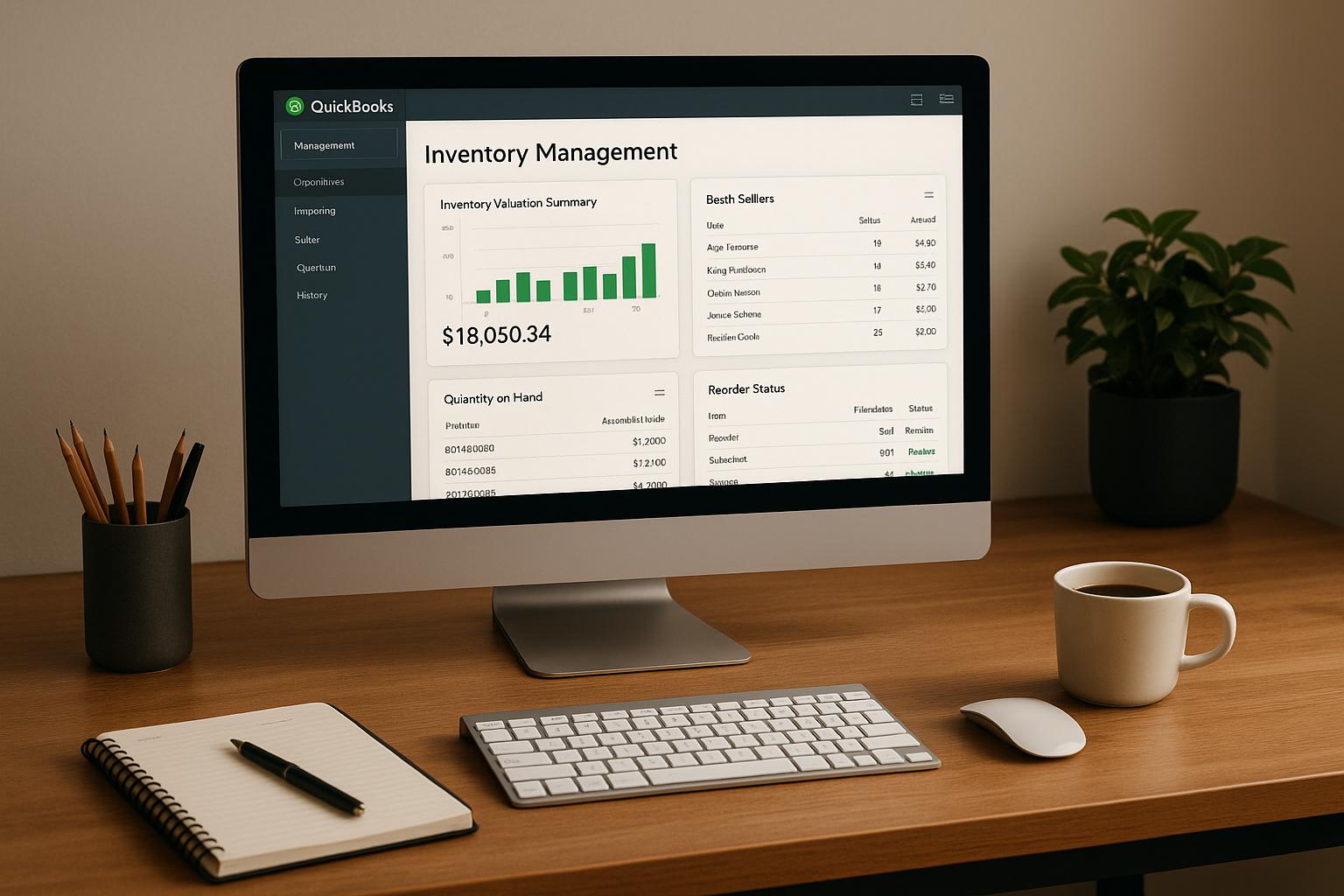

Managing inventory across multiple locations in QuickBooks Desktop Enterprise becomes straightforward with the Advanced Inventory module. This feature allows you to track stock quantities and values at different sites, such as warehouses, trucks, or storage units. The Transfer Inventory form is the main tool for recording stock movement between locations, ensuring accurate records and balanced ledger values. Here's what you need to know:
- Enable Advanced Inventory: Activate it in QuickBooks Desktop Enterprise (Gold, Platinum, or Diamond plans).
- Set Up Locations: Define inventory sites under the Inventory Site List with specific names for clarity.
- Use the Transfer Inventory Form: Record transfers by selecting origin and destination sites, items, and quantities. Save to instantly update stock levels.
- Verify Transfers: Use reports like Inventory Valuation Summary by Site to confirm updates.
- Alternative for Minor Changes: Use quantity adjustments for small corrections, like fixing errors or accounting for damaged goods.
For businesses needing advanced features like barcode scanning or tracking in-transit goods, consider integrating tools like Rapid Inventory. This ensures accurate and efficient inventory management across all locations.
QuickBooks Demo 2025: Multi-Location Inventory | QuickBooks Enterprise Advanced Inventory | Platinum
sbb-itb-19ed50f
What You Need Before Managing Multi-Location Inventory in QuickBooks
Before diving into multi-location inventory management, make sure you have QuickBooks Desktop Enterprise Advanced Inventory activated and the necessary settings configured.
How to Enable Inventory Sites in QuickBooks
Multi-location inventory tracking is a feature exclusive to QuickBooks Desktop Enterprise. However, it’s only available with the Gold, Platinum, or Diamond subscription levels, as part of the Advanced Inventory add-on.
Here’s how to get started:
- First, activate basic inventory and switch to Single-user Mode. You can do this by navigating to File > Switch to Single-user Mode. Then, go to Edit > Preferences > Items & Inventory > Company Preferences, and make sure the box for "Inventory and purchase orders are active" is checked.
- Next, open Advanced Inventory Settings and ensure "Multiple Inventory Sites is enabled". If this option is grayed out, refresh your license by going to Help > Manage my License > Sync License Data Online.
Once the feature is enabled, QuickBooks will automatically assign all your current inventory to a default starting site. Later, you’ll update this with actual site-specific transfers.
After enabling the feature, QuickBooks adds a "Site" column to various transaction forms, including purchase orders, bills, invoices, and sales receipts. This allows you to link every transaction to a specific location.
With this setup complete, you can move on to defining your inventory locations.
How to Set Up Inventory Locations
To set up your locations, go to Lists > Inventory Site List. Click the Inventory Site button and select New to add each location. For each site, you can include details like name, description, contact information, and physical address. QuickBooks Enterprise can handle up to 1,000,000 inventory sites, locations, and bin locations.
For clarity, use specific names like "Austin Fulfillment Center" instead of generic terms. This helps reduce confusion during inventory transfers and when generating reports.
"QuickBooks Enterprise Advanced Inventory feature Multi-Location Inventory is designed to simplify the complex process of managing inventory across multiple sites or warehouses." - Raeann Salter, QuickBooks Advanced ProAdvisor, Minding My Books
If you need to add several locations at once, use the Add/Edit Multiple List Entries tool for bulk setup.
For more detailed tracking, enable bin tracking within Advanced Inventory Settings. This feature is particularly useful for large warehouses where tracking items down to specific aisles or bins is necessary.
One thing to note: global reorder points need to be set separately, as QuickBooks doesn’t automatically consolidate site-specific reorder points.
How to Transfer Inventory Between Locations in QuickBooks Desktop

How to Transfer Inventory Between Locations in QuickBooks Desktop
QuickBooks Desktop makes it simple to transfer inventory between locations using its Transfer Inventory form. This tool updates stock levels as soon as you save the transfer.
Using the Transfer Inventory Form
Start by navigating to the Inventory menu and selecting Transfer Inventory. The form will prompt you to fill out key details in the header, including the Date, an optional Reference No., and Class (if applicable).
From there, use the Transfer From dropdown to choose the origin location and the To dropdown for the destination. Add items by selecting them individually from the Item dropdown or use the Find & Select Items option to add multiple products quickly.
For each item, input the transfer amount in the Qty to Transfer column. If you're transferring all stock from a site - like during a warehouse move - check the Prefill Qty To Transfer with Quantity On Hand box. This automatically populates the available quantities, saving you time. Add a memo for reference, such as "Transfer to Austin Fulfillment Center", and click Save & Close.
Keep in mind, once you save the transfer, the quantity-on-hand updates immediately. There’s no separate receiving step as there is with purchase orders. If you want to track goods in transit between warehouses, create a temporary site (e.g., "In-Transit"). Transfer items to this temporary site first, and once they arrive, do a second transfer to the final destination.
After completing the transfer, use inventory reports to confirm everything updated correctly.
Tips for Accurate Inventory Transfers
To ensure accuracy, run inventory reports before and after each transfer:
- Before transferring: Use the Inventory Stock Status By Site report (Reports > Inventory) to check the available quantities at the source location.
- After transferring: Use the Quantity on Hand by Site or Inventory Valuation Summary by Site reports to confirm stock levels and dollar values updated correctly at both locations.
| Report | When to Use It |
|---|---|
| Inventory Stock Status By Site | Before the transfer, to verify available quantities at the source |
| Quantity on Hand by Site | After the transfer, to ensure stock levels updated correctly |
| Inventory Valuation Summary by Site | After the transfer, to confirm the dollar values moved as expected |
For inventories with more than 3,000 items, break transfers into smaller batches to reduce the chance of errors.
If you frequently transfer the same set of items to multiple locations, save time by using Edit > Duplicate Inventory Transfer. This feature copies a previous transfer, so you don’t have to rebuild the form from scratch each time.
Alternative Method: Using Inventory Adjustments for Simple Transfers
The Transfer Inventory form works well for most stock moves, but sometimes you need a quicker fix for small, one-off issues. That’s where quantity adjustments come in handy. This method is especially useful for addressing minor discrepancies without going through the full transfer process.
When to Use Quantity Adjustments Instead
Quantity adjustments let you modify the total on-hand count without actually transferring stock between locations. They’re best for fixing small errors or unexpected changes, not for planned warehouse moves. Here are some common situations where quantity adjustments make sense:
- Fixing a count error during a physical inventory check
- Accounting for a small amount of spoilage or breakage at a site
- Correcting a data entry mistake that caused an incorrect stock count
To clarify, here’s a quick comparison of when to use each method:
| Situation | Best Method |
|---|---|
| Moving stock from one warehouse to another | Transfer Inventory Form |
| Fixing a count error after a physical inventory | Quantity Adjustment |
| Accounting for damaged or spoiled goods | Quantity Adjustment |
| Restocking a branch from a main distribution center | Transfer Inventory Form |
| Correcting a minor data entry mistake at one site | Quantity Adjustment |
Important: Quantity adjustments impact your Cost of Goods Sold (COGS) account, which means they show up in your financial reports. If you’re unsure how this might affect your average item cost, it’s a good idea to check with your accountant before finalizing the adjustment.
Steps for Adjusting Inventory Quantities
Before making any adjustments, ensure you’ve set up a dedicated "Inventory Adjustments" account in your Chart of Accounts. This account should be categorized under Cost of Goods Sold to keep manual corrections separate from regular sales activity, making audits easier down the road.
Here’s how to adjust inventory quantities:
- Open the adjustment window: Navigate to Vendors > Inventory Activities > Adjust Quantity/Value on Hand.
- Select the adjustment type: From the Adjustment Type dropdown, choose Quantity.
- Assign the account and date: Select your Inventory Adjustments account and set the appropriate Adjustment Date.
- Identify the location: If you’re using Advanced Inventory with multiple sites, select the specific site to ensure accurate reporting.
- Add items: Use the Find & Select Items option to pick the products that need adjustments.
- Enter the new totals: Update the count in the New Quantity column or directly input the change in the Qty Difference column. Use a negative number (e.g.,
-5) for a decrease or a positive number for an increase. - Save: Double-check the Total Value of Adjustment, then click Save & Close.
For clarity, fill in the Memo field with a descriptive note, such as "Physical count discrepancy – Austin site, May 2026". After saving, run reports like Inventory Stock Status by Item or Quantity on Hand by Site to confirm the adjustments are reflected correctly.
How to Verify and Report on Inventory Transfers
After completing an inventory transfer in QuickBooks, it's crucial to verify the results. Transfers are processed immediately - once you save the form, the stock is deducted from the origin and added to the destination. Since QuickBooks doesn't include a built-in confirmation step, manual verification is essential to ensure accuracy.
How to Review Transfer History
To keep your inventory records accurate, check your transfer history right after posting transfers. You can audit past transfers using the Inventory Site List. Here's how:
- Go to Lists > Inventory Site List.
- Right-click the location you want to review and select QuickReport.
This generates a log of all transactions linked to that site, including inventory transfers. To make corrections, double-click the Inventory Transfer line to open the form.
"If you want to change the site of a transfer, just double-click the line that says Inventory Transfer [on the Inventory Site QuickReport]." - Jen_D, Moderator, QuickBooks Community
Another way to review is through the Inventory menu. Select Transfer Inventory and use the Previous button to scroll through historical transfers. Assigning distinct reference numbers to each transfer, like "WH-2026-047", can make it easier to locate specific transactions quickly.
How to Generate Inventory Reports by Location
After completing a transfer, run the Inventory Valuation Summary by Site report to confirm that inventory quantities have updated correctly at both the origin and destination. To access this report:
- Go to Reports > Inventory.
- Select the desired report.
These reports provide insights into stock movements and their financial impact. Use the Site filter to focus on a specific location.
| Report Name | Key Details | Menu Path |
|---|---|---|
| Quantity on Hand by Site | Current unit counts per location | Reports > Inventory |
| Inventory Valuation Summary by Site | Dollar value of stock at each site | Reports > Inventory |
| Inventory Stock Status by Site | Stock levels and reorder points by location | Reports > Inventory |
| Items by Bin Location | Exact row, shelf, or bin placement within a site | Reports > Inventory |
| Inventory Sales by Site | Revenue and sales activity per location | Reports > Sales |
If you're using bin tracking, the Items by Bin Location report is especially useful. Customize it by clicking Customize Report > Display tab, then selecting the Bin Location box. This ensures items are not only in the correct warehouse but also in the right row or shelf.
Verifying your inventory through these steps helps maintain accurate records and ensures seamless management of multi-location transfers.
How Rapid Inventory Improves Multi-Location Transfers for QuickBooks Users
QuickBooks Desktop relies on manual processes for inventory transfers, requiring users to select origin and destination sites, pick items from lists, and input quantities manually. Rapid Inventory, a web-based inventory management tool designed for QuickBooks Desktop users, simplifies this process, minimizing errors and saving time. Here's a closer look at how it works and its standout features.
Key Features of Rapid Inventory
One of the standout tools is mobile barcode scanning, which works with a two-way sync to automate item selection and maintain consistent data. Instead of manually entering item details, staff can scan barcodes directly on-site, ensuring accuracy and speeding up the process. Additionally, Rapid Inventory syncs seamlessly with QuickBooks Desktop, offering real-time inventory reports for better visibility across all locations.
For businesses handling intricate warehouse setups, Rapid Inventory supports multi-location and bin-level tracking, capable of managing up to 1,000,000 inventory sites and bins. It also includes lot and serial number tracking, enabling precise monitoring of inventory during transfers.
Benefits of Using Rapid Inventory with QuickBooks
Replacing manual item selection with barcode scanning reduces errors, saves time, and enhances data accuracy. Another advantage is the ability to track transfer statuses through stages like "Draft", "Shipped", and "Received", ensuring inventory is accounted for even while in transit. Since it’s web-based, Rapid Inventory also allows team members to access inventory data from anywhere, making operations more flexible and efficient.
Conclusion: Key Takeaways for Managing Inventory Transfers in QuickBooks
Managing inventory transfers in QuickBooks becomes much simpler when Advanced Inventory is activated and sites are properly configured. The Transfer Inventory form is your go-to tool for moving stock accurately, ensuring that costs and valuations stay consistent - something manual adjustments can't achieve effectively. While quantity adjustments may work for less complex situations, the Transfer Inventory form ensures better accuracy for average costs and stock valuations.
To maintain accuracy after setup, consider these best practices:
- Always document transfers with a memo.
- Use bulk item selection for efficiency.
- Regularly verify stock levels using inventory reports.
If you're closing a location, make sure to transfer all remaining stock before marking the site as inactive. This prevents it from being accidentally used in future transactions.
One thing to keep in mind: QuickBooks Desktop does not track stock while it’s in transit. As Jen_D explained, transfers immediately update stock quantities at each site once saved, leaving no visibility for in-transit goods. For businesses that need to track items during transit, creating a virtual "In-Transit" site is a practical workaround.
For businesses dealing with higher transfer volumes or more complex inventory setups, Rapid Inventory offers added functionality. It integrates seamlessly with QuickBooks Desktop, providing features like multi-stage workflows, mobile barcode scanning, and bin-level tracking. These tools simplify the process and reduce manual effort while enhancing the existing QuickBooks workflow.
FAQs
Why can’t I see the Multiple Inventory Sites option in QuickBooks?
The "Multiple Inventory Sites" feature in QuickBooks Desktop Enterprise becomes available only when Advanced Inventory is activated. To turn it on, follow these steps:
- Switch to Single-user Mode in QuickBooks.
- Navigate to Preferences > Items & Inventory > Company Preferences.
- Check the box for "Inventory and purchase orders are active."
- Then, go to Advanced Inventory Settings and enable "Multiple Inventory Sites."
Make sure that your version of QuickBooks supports Advanced Inventory and that it's fully activated before attempting these steps.
How do I handle inventory that’s moving between locations (in transit)?
To handle inventory in transit in QuickBooks, you can use the Inventory Transfer feature. Start by enabling multiple inventory sites in QuickBooks Desktop Enterprise. Once that's set up, navigate to the Inventory menu and choose Transfer Inventory. Fill out the form by entering details such as the date, reference number, and the locations for Transfer from and Transfer to. This process helps you track items accurately while they're in transit and updates stock levels once they reach their destination.
How can I undo or fix a posted inventory transfer without messing up COGS?
To correct a posted inventory transfer in QuickBooks without altering your Cost of Goods Sold (COGS), you can use an inventory adjustment. Here's how:
- Navigate to Create > Inventory Qty Adjustment.
- Find the specific items impacted by the transfer.
- Adjust the quantities as necessary to reflect accurate inventory levels.
Once you've made the changes, save the adjustment. This method updates your inventory records while leaving COGS untouched, ensuring your financial reports stay accurate.