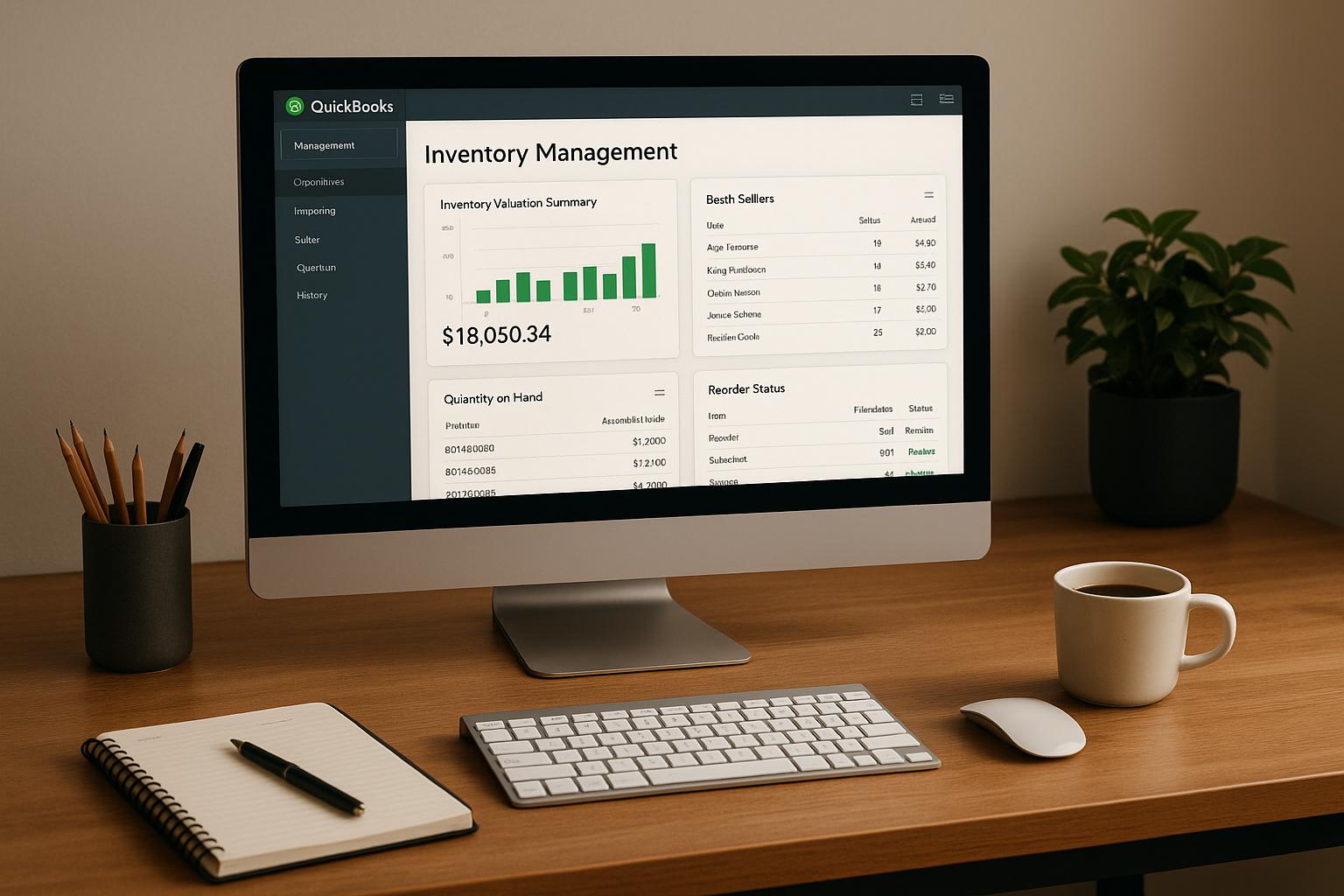

Want to avoid costly inventory mistakes? QuickBooks Desktop, paired with Rapid Inventory, can help you plan for unexpected inventory challenges like demand spikes or supplier delays. By syncing these tools, you can track inventory across locations, analyze sales trends, and simulate "what-if" scenarios to optimize stock levels and cut costs.
Key Takeaways:
- QuickBooks Setup: Enable inventory tracking, set reorder points, and organize stock by location.
- Rapid Inventory Integration: Sync your data for real-time updates, mobile barcode scanning, and advanced reporting.
- Scenario Planning: Use historical sales data to simulate best, worst, and average-case scenarios.
- Actionable Insights: Adjust reorder points, monitor stock trends, and set alerts to prevent stockouts or overstocking.
Why it matters: Businesses using these methods have reduced stockouts by up to 50% and saved thousands annually in inventory costs. Ready to take control of your inventory? Let’s dive in.

QuickBooks Inventory Scenario Planning: 4-Step Implementation Process
Setting Up Inventory Tracking in QuickBooks Desktop
Requirements for Inventory Features
Before diving in, make sure your version of QuickBooks Desktop includes the inventory tools you need. Basic inventory tracking is available in QuickBooks Desktop Pro Plus, Premier Plus, Enterprise (Gold, Platinum, Diamond), and Accountant Desktop Plus. If you’re looking for more advanced capabilities - like managing inventory across multiple warehouses, FIFO costing, or barcode scanning - you’ll need QuickBooks Desktop Enterprise.
Basic inventory tracking covers essentials like monitoring quantities and setting reorder points. For more complex needs, the Advanced Inventory feature in Enterprise editions allows you to track stock across multiple locations, such as warehouses, trucks, or staging areas. It even lets you set reorder points specific to each site.
Turning On Inventory Tracking
To enable inventory tracking, switch to Single-user Mode in QuickBooks. Then, navigate to:
Edit > Preferences > Items & Inventory > Company Preferences, and check the box for "Inventory and purchase orders are active".
If you’re using Enterprise and need to track inventory across multiple locations, click Advanced Inventory Settings in the same menu and enable "Multiple Inventory Sites." If these options are unavailable (grayed out), update your subscription by going to:
Help > Manage my License > Sync License Data Online.
After enabling inventory tracking, define your storage locations:
- Go to Lists > Inventory Site List > New and create a site for each location.
- To set reorder points for each site, navigate to Lists > Inventory Site List > Activities > Set Reorder Points and enter thresholds for restocking.
Keep in mind that reorder points are site-specific and don’t combine into a global total. You’ll need to manage reorder levels for each location individually.
With this setup complete, you’re ready to input your initial inventory data.
Entering Initial Inventory Data
Getting accurate inventory starts with clean and organized baseline data. For each inventory item, you’ll need to provide:
- A unique name or SKU
- A description
- Unit cost and sales price
- The initial quantity on hand
Choose an "As of Date" for your starting quantities. This ensures a clear baseline and avoids errors from back-dated transactions.
To enter your starting data:
- Use the Adjust Quantity/Value On Hand tool in the Inventory menu to input initial quantities and values.
- If you’re using Advanced Inventory, QuickBooks will initially place your inventory in a temporary default site. Use the Transfer Inventory tool to move these quantities to their correct physical locations.
Before entering data, run an Inventory Valuation Summary report from your previous system. This helps confirm that your quantities and costs align with your records. If you’ve been using sub-items or classes to track locations, merge or deactivate them - Advanced Inventory replaces these methods with site-based tracking. Cleaning up your data now ensures everything is ready for accurate inventory management moving forward.
sbb-itb-19ed50f
Managing Inventory in QuickBooks Desktop
Connecting Rapid Inventory to QuickBooks Desktop
After setting up QuickBooks Desktop to manage inventory, the next step is linking it to Rapid Inventory. This integration uses the QuickBooks Web Connector for a seamless two-way sync, enabling real-time updates and more precise inventory management.
Configuring Two-Way Sync with QuickBooks
The two-way sync ensures smooth communication between QuickBooks and Rapid Inventory. Inventory items and orders flow from QuickBooks to Rapid Inventory, while actions like picking, receiving, and adjustments are automatically sent back to QuickBooks. This eliminates the need for duplicate entries and keeps both systems in sync.
Before connecting, it's important to standardize your SKUs and remove any duplicates in QuickBooks. This helps prevent mismatches during the sync process. During the setup phase (Days 4–5), make sure to create users, warehouses, and locations in Rapid Inventory. Conduct pre- and post-sync checks to confirm that quantities and values align between the two systems. For added security, enable multi-factor authentication (MFA), TLS encryption, and certificate verification. With over 17 years of experience and more than 400 customers, Rapid Inventory has fine-tuned its integration process to ensure a smooth setup.
Once the systems are synced, you can take advantage of advanced tools to improve inventory management and scenario planning.
Using Advanced Features for Scenario Data
Detailed inventory data is essential for effective scenario planning. Rapid Inventory's multi-location tracking consolidates live stock data across all warehouses, letting you set reorder points specific to each site. This feature also helps you model potential supply chain disruptions in different regions. Lot and serial number tracking adds another layer of precision, which is especially helpful for managing recalls or expiration-sensitive items using FIFO (First In, First Out) or FEFO (First Expired, First Out) strategies.
The platform works seamlessly with QuickBooks Desktop Enterprise, Pro, and Premier editions. By conducting regular cycle counts with real-time syncing, you can achieve inventory accuracy levels of around 97%. These tools ensure your planning reflects up-to-date warehouse conditions, giving you a more reliable foundation for decision-making.
Working with Mobile Barcode Scanning and Reports
Mobile barcode scanning takes efficiency to the next level by automating data entry during key operations like receiving, picking, and shipping. To ensure compatibility, test barcode scanners (USB/HID or Bluetooth) for Code-128 or EAN-13 formats and verify that they append "Enter" after each scan. This clean data feeds directly into real-time reports, which you can use for "what-if" simulations. Unlike batch updates, real-time reporting provides instant visibility into stock levels across all locations.
Additionally, "Forecast vs. Actuals" reports allow you to track variances between your plans and actual performance. This helps you identify trends early, so you can address potential issues before they affect cash flow.
As Nicholas G., a business owner who has used Rapid Inventory for six years, shares: "Rapid Inventory with QuickBooks Desktop is exactly what we need to run our company... Simple and straightforward, very easy to learn and easy to work with".
Building and Analyzing Inventory Scenarios
Once your systems are synced, you can start building inventory scenarios by using historical data, modeling potential outcomes, and testing them with the advanced tools in Rapid Inventory.
Collecting Historical Sales and Demand Data
Start by creating a reliable baseline using historical data from QuickBooks Desktop and Rapid Inventory. To get sales history reports in QuickBooks Desktop, go to Reports > Sales > Sales by Item Detail. For purchase order data, navigate to Reports > Purchases > Purchases by Vendor Detail. Inventory-specific reports can be found under Reports > Inventory > Inventory Valuation Detail. Ensure that all exports use QuickBooks' standard formats, with dates in MM/DD/YYYY and values in $ USD.
Rapid Inventory simplifies this process with its two-way sync feature, pulling data from QuickBooks into real-time dashboards. You can export advanced reports such as multi-location inventory summaries, lot and serial tracked sales histories, and demand forecasts in CSV or PDF formats. Focus on real-time inventory reports and cycle count histories for the most accurate data, as these include FIFO/FEFO picking details that QuickBooks doesn’t track natively. Additionally, run a Stock Aging Analysis in QuickBooks and export it to Excel to flag slow-moving items, which can then be treated differently in your planning.
Once you’ve established a solid baseline, you’re ready to model potential scenarios.
Creating What-If Scenarios
What-if scenarios allow you to simulate various business conditions by tweaking key variables. The three primary scenarios you’ll want to model are:
- Best-case: Optimistic growth, such as a +20% sales growth rate with 7-day lead times.
- Worst-case: Challenging conditions, like a -15% sales decline, 30-day lead times, and +10% supplier cost inflation.
- Moderate: Based on historical averages, using standard 14-day lead times.
In Rapid Inventory’s web portal, open the Scenario Planner tool, import your QuickBooks data, and adjust variables like sales growth, lead times, and reorder points using sliders. Clearly label each scenario (e.g., Best, Worst, Moderate) and save the results for comparison. Rapid Inventory can also project stockout costs in $ USD and generate data for QuickBooks journal entries. For worst-case scenarios, use the Safety Stock Calculator to set buffer levels that account for longer vendor lead times. The Economic Order Quantity (EOQ) Calculator helps you determine the most cost-efficient order size, balancing ordering and holding costs.
Save these scenarios to prepare for simulation testing.
Running Inventory Simulations
With your data and scenarios ready, you can simulate how different conditions might impact your inventory. Go to Inventory > Simulations and load a scenario. Adjust reorder points (e.g., increase by 20% for worst-case conditions) and enable backorder tracking to see how delays might affect fulfillment. Choose either FIFO (First In, First Out) for non-perishable goods or FEFO (First Expired, First Out) for items with expiration dates.
Simulations will show projected inventory levels, associated costs, and backorder risks. Results sync with QuickBooks, allowing you to see the effects on your profit and loss statement. For example, a best-case simulation with 20% sales growth using FIFO might result in zero stockouts. A worst-case scenario with a 15% sales dip and 30-day lead times could show $5,000 in backorder costs. Meanwhile, a moderate scenario might recommend increasing reorder points to 150 units, cutting risks by 40%, as shown in Rapid Inventory reports integrated with QuickBooks P&L.
To ensure accuracy, cross-check your simulations with 12-24 months of historical QuickBooks data and conduct monthly cycle counts in Rapid Inventory. Test your models with a 10-20% demand shock and monitor key metrics like the inventory turnover ratio, which should ideally range between 4-6 times annually. This validation process ensures your scenarios are grounded in reality and not just theoretical projections.
Reviewing Results and Setting Up Alerts
Once your simulation outcomes are ready, it's time to act. Start by analyzing the results and updating your inventory controls as needed. Thanks to Rapid Inventory's two-way sync with QuickBooks Desktop, all simulation data is automatically transferred, giving you a full picture without the hassle of manual data entry.
Reviewing Scenario Results with Synced Reports
Dive into your scenario results using the real-time reports available in Rapid Inventory. Head over to the reports dashboard, where you'll find key insights from On-hand Inventory, Quantity on Purchase Orders and Sales Orders, Sales Order Status, Inventory Value, and Reorder Reports. These reports help you understand how different scenarios could influence stock levels and cash flow. For instance, if a worst-case scenario highlights high backorder costs, use the Open Sales Orders by Item report to pinpoint which SKUs are most at risk.
Keep an eye on essential metrics like inventory turnover, stockout and backorder rates, reorder points, cost of goods sold (COGS), margins, and on-hand inventory levels. Export the Stock Aging Analysis report to identify slow-moving items and compare that data against your scenario projections. These insights will guide you in fine-tuning your inventory controls.
Configuring Inventory Alerts and Cycle Counts
Stay ahead of potential issues by setting up alerts in QuickBooks Desktop. Go to Edit > Preferences > Items & Inventory, and under Company Preferences, confirm that "Inventory and purchase orders are active" is selected. Then, navigate to Lists > Item List, double-click on each item, and input values into the Minimum Reorder Point field based on your scenario findings.
For reminders, head to Edit > Preferences > Reminders under Company Preferences and enable the Show List option for Inventory to Reorder. In Rapid Inventory, you can also configure location-specific reorder alerts to handle multi-location stock and avoid localized shortages. Use the Cycle Count Scheduler to create a daily counting plan, and pair it with mobile barcode scanning to reconcile discrepancies and validate your scenario assumptions. Pausing transactions during cycle counts can help ensure accuracy, and the results will sync seamlessly back to QuickBooks Desktop. With these alerts and processes in place, you're well-equipped to turn scenario insights into actionable inventory adjustments.
Applying Scenario Insights to Inventory Decisions
Leverage the real-time data from Rapid Inventory's sync with QuickBooks Desktop to refine your inventory strategies. Use tools like the Safety Stock and Reorder Point calculators in Rapid Inventory to set the right buffer levels for demand and lead time uncertainties, then update your QuickBooks settings accordingly.
When negotiating with suppliers, bring your scenario data to the table. For example, if a 30-day lead time caused significant backorder costs in your simulation, use this information to push for shorter lead times or secure backup suppliers. Activate the Stock Replenishment Planner to automate purchase orders based on the reorder points defined by your scenarios. Additionally, review tools like the Inventory Turnover Ratio Analyzer and Stock Aging reports to identify surplus inventory and redirect resources to better-performing SKUs. This data-driven approach ensures that your scenario planning directly shapes smarter, more effective inventory strategies, improving your bottom line.
Conclusion
Inventory scenario planning doesn’t have to be complicated. By following the steps in this guide - setting up inventory tracking in QuickBooks Desktop, syncing with Rapid Inventory for real-time updates, using historical data to build "what-if" scenarios, and analyzing results through live reports and alerts - you can create a solid, data-driven strategy for smarter inventory management.
The integration between QuickBooks Desktop and Rapid Inventory removes the need for manual double-entry. With automatic two-way synchronization, your financial records stay in step with your actual warehouse activity. This means your decisions are always based on accurate, up-to-date information.
This setup doesn’t just simplify processes - it delivers tangible results. Businesses that adopt this integrated, scenario-focused approach report 35% fewer overstock issues and save more than $50,000 annually in holding costs. By simulating scenarios based on past sales and demand trends, you can fine-tune reorder points, cutting stockouts by 30–50% and freeing up cash tied to excess inventory. Considering that 68% of small and medium businesses identify poor inventory visibility as their biggest cash flow obstacle, this method has helped 82% of users overcome that challenge.
Take action this week: try running one scenario using synced reports in Rapid Inventory. Check your stock aging analysis, update reorder alerts in QuickBooks, and schedule a cycle count using mobile scanning. With free training and onboarding available, you can shift from reactive inventory practices to predictive strategies in just a few days.
The tools are ready. Use scenario planning to reduce stockouts, improve cash flow, and strengthen your inventory operation.
FAQs
Do I need QuickBooks Desktop Enterprise for scenario planning?
You don't necessarily need QuickBooks Desktop Enterprise to handle scenario planning. Standard QuickBooks Desktop features are perfectly capable of managing basic "what-if" scenarios.
However, if your business involves advanced inventory management - like tracking across multiple locations, using FIFO/FEFO strategies, or incorporating barcode scanning - then Enterprise might be a better fit. That said, these features are more about inventory complexity than basic scenario modeling.
How do I avoid SKU duplicates before syncing to Rapid Inventory?
To avoid duplicate SKUs when syncing with Rapid Inventory, start by reviewing and merging any duplicate items in QuickBooks Desktop. Ensure that each SKU is distinct by standardizing your naming conventions. Regular audits can help maintain consistency across your inventory. Taking the time to clean up your item list and verify SKU uniqueness in advance minimizes sync errors and prevents inventory mismatches.
What’s the fastest way to test a demand spike scenario?
Using real-time inventory data combined with demand forecasting tools is the quickest way to stay ahead. This approach allows you to simulate how your inventory might respond to unexpected spikes in demand, helping you spot potential stockouts or overstock issues before they happen. Integrating QuickBooks with inventory software like Rapid Inventory can take things further by adding features such as automated reorder alerts, multi-location tracking, and real-time syncing. These tools make it easier to test different scenarios and make smarter, faster decisions.