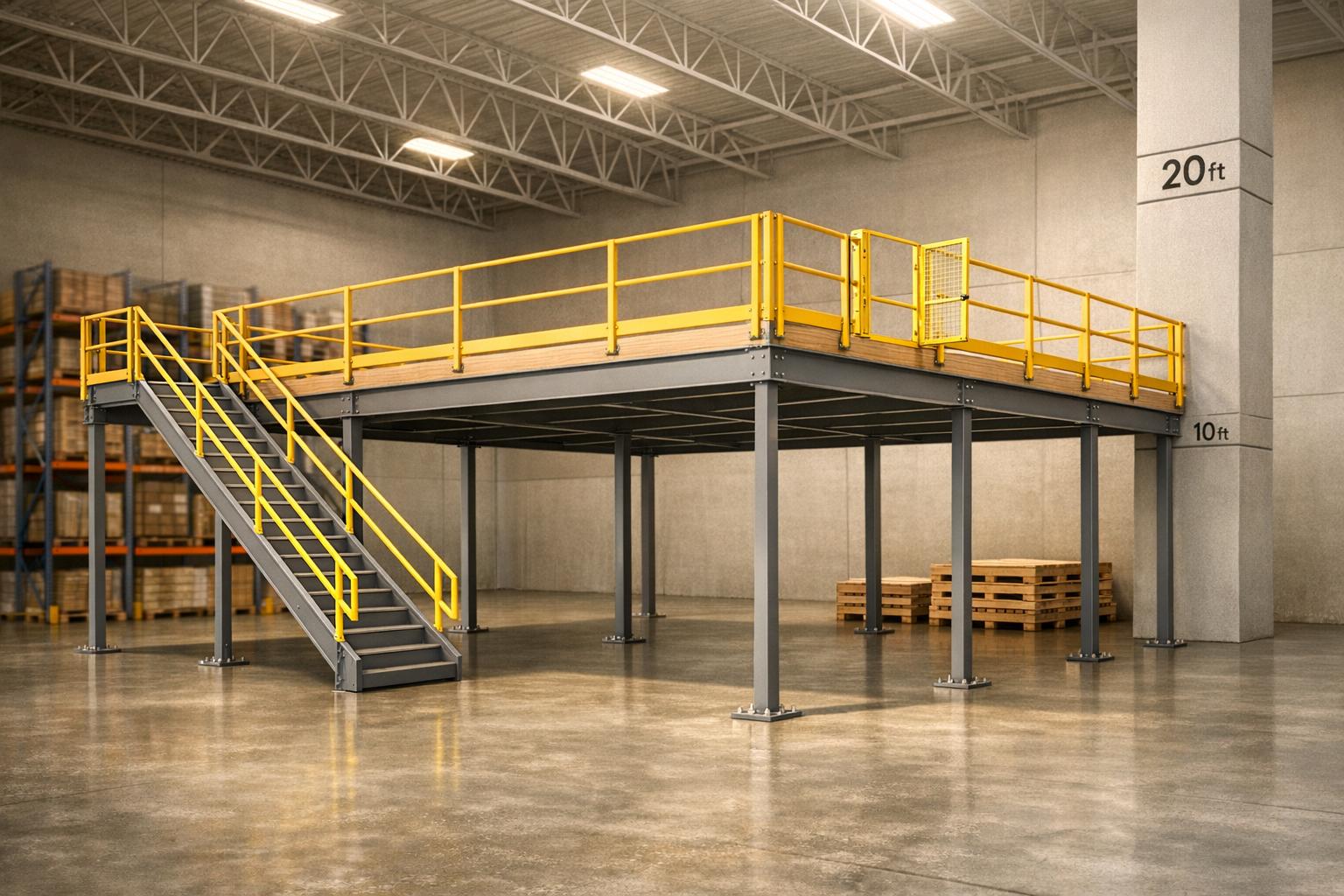
A mezzanine system is a cost-effective way to increase your warehouse space by utilizing unused vertical areas, avoiding the need for a full building expansion. The right mezzanine can double or even triple your usable space at a fraction of the cost of traditional construction, while improving workflow efficiency. However, selecting the wrong type can disrupt operations and lead to unnecessary expenses. Here's what you need to know:
-
Key Factors to Consider:
- Ceiling Height: Minimum 15 feet to ensure sufficient headroom.
- Load Capacity: Plan for current and future weight requirements (e.g., 60–90 psf for offices, 250+ psf for heavy storage).
- Space Usage: Determine if the mezzanine will be used for storage, manufacturing, or office areas.
- Material Movement: Options include conveyors, lifts, or spiral systems.
- Safety & Compliance: Adhere to OSHA and IBC standards for guardrails, stairs, and fire safety.
-
Types of Mezzanines:
- Structural (Free-Standing): Offers flexibility and supports heavy loads but comes with higher upfront costs.
- Rack-Supported: Cost-efficient, built on existing pallet racks, but less adaptable for future changes.
- Shelving-Supported: Ideal for small-item storage and manual picking, though limited in reconfiguration options.
-
Costs:
- Range from $15–$200+ per square foot depending on type, load capacity, and customization.
-
Tips for Success:
- Consult engineers to confirm floor strength and load capacity.
- Plan for future expansion needs to avoid costly retrofits.
- Use inventory management software to maximize efficiency and space utilization.
Choosing the right mezzanine system involves careful planning and consideration of your warehouse's specific needs. Investing in the right design upfront ensures long-term efficiency and cost savings.
HOW IT WORKS: Mezzanines
sbb-itb-19ed50f
Assessing Your Warehouse Requirements
Understanding your warehouse's capabilities and specific needs is essential when planning for a mezzanine. Getting the details right from the start helps you avoid costly mistakes and ensures the mezzanine integrates seamlessly into your operations.
Measure Warehouse Dimensions and Layout
To install a mezzanine, your warehouse ceiling should be at least 15 feet high. This height ensures there’s about 7 feet of headroom both above and below the mezzanine, plus an extra 14 to 18 inches for structural elements like beams and decking. When measuring, focus on two key heights:
- Clear Height: The distance from the floor to the bottom of the lowest mezzanine joist.
- Top of Deck Height: The distance from the floor to the top surface of the mezzanine.
Most mezzanines are square or rectangular, but for more complex layouts, detailed sketches or AutoCAD drawings are invaluable. As Scott Stone, Vice President of Marketing at Cisco-Eagle, points out:
"The placement of building columns dictates where you can place a mezzanine. Other obstructions include ceilings and ceiling-mounted obstructions like ducts and existing equipment like cranes."
Identifying these fixed obstructions early is critical for optimizing column placement.
Building codes typically restrict mezzanines to one-third of a room's total area. Additionally, your warehouse floor plays a big role in determining feasibility. A standard 6-inch concrete slab can usually support around 25,000 pounds, but factors like soil conditions and the water table can affect this. Before moving forward, consult an architect or engineer to confirm your floor can handle the concentrated weight of mezzanine columns.
Once dimensions are clear, the next step is to assess load requirements.
Calculate Load Requirements
The load capacity of your mezzanine defines what it can safely support. You’ll need to account for:
- Dead Loads: The permanent weight of the mezzanine structure (steel framework, decking, handrails, etc.).
- Live Loads: Variable weights such as people, inventory, and movable equipment.
- Point Loads: Concentrated weights from things like machinery legs, rack uprights, or pallet jack wheels, which may need extra structural reinforcement.
Typical load capacities vary based on application:
- 60–90 psf for office spaces or breakrooms.
- 125 psf for light storage or manufacturing.
- 250 psf or more for heavy manufacturing or storage.
Custom heavy-duty mezzanines can even handle up to 500 psf. Apex Warehouse Systems emphasizes:
"It is far more cost-effective to build for heavier capacity from the beginning vs. adding load capacity to an existing structure."
To future-proof your mezzanine, plan for 20–30% more than your estimated maximum load.
| Application Type | Recommended Load Capacity |
|---|---|
| Office Space / Breakrooms | 60–90 psf |
| Light Storage / Manufacturing | 125 psf |
| Heavy Storage / Manufacturing | 250 psf |
Once load capacities are established, you can focus on tailoring the mezzanine to your daily operations.
Define Your Operational Requirements
With dimensions and load calculations in hand, it’s time to determine how the mezzanine will fit into your workflow. Decide whether the space will be used for storage, manufacturing, offices, kitting, or packing. Also, think about how materials will move between levels - options include conveyors, vertical reciprocating conveyors (VRCs), or spiral lifts.
Traffic flow is another key consideration. Ensure there’s enough clear height below the mezzanine to avoid obstructing equipment, utilities, or forklift aisles. For areas with heavy foot and vehicle traffic, design multiple access points and catwalks to separate pedestrians from machinery. As John Geddes, Founder and Director of Sales at East Coast Storage Equipment, wisely notes:
"You can't go down to the local mezzanine store and pick one the same way you buy a car."
Each warehouse is different, so your mezzanine should be custom-designed to meet your specific needs.
Choosing the Right Mezzanine Type

Warehouse Mezzanine Types Comparison: Features, Costs, and Load Capacity
Once you've nailed down your requirements, it's time to pick the mezzanine type that suits your warehouse setup. The three main options - structural, rack-supported, and shelving-supported - each cater to different needs and come with their own pros and cons in terms of cost, adaptability, and functionality. Here's a closer look at what each type offers.
Structural Mezzanines
Structural mezzanines are standalone systems made of steel frames supported by independent columns. This design gives you maximum flexibility since it doesn't rely on racks or shelving for support. You can create custom layouts with open spans, keeping the space beneath clear for forklifts, AGVs, or other operations.
These mezzanines are perfect for heavy loads and dynamic environments. They can handle significant weight and can be reconfigured or relocated as your operations grow. This adaptability makes them a smart choice for businesses with evolving needs. As Apex Warehouse Systems puts it:
"Choosing a freestanding IWP vs. a rack-supported structure is more about tomorrow's plans than it is about today's needs."
However, structural mezzanines come with a higher upfront cost. They require dedicated steel columns and might even need concrete footings if your current floor or soil can't support the concentrated weight. Still, this investment can pay off if you're planning for future layout changes within the next few years.
Rack-Supported Mezzanines
Rack-supported mezzanines are built directly onto existing pallet racks. This makes them a cost-efficient option since they utilize equipment you already have. They're especially useful for high-density pallet storage.
The catch? Limited flexibility. Since the mezzanine is tied to the rack structure, changing or expanding it later is a challenge. If you need open floor space underneath, a structural mezzanine might be a better fit.
Shelving-Supported and Catwalk Platforms
Shelving-supported mezzanines use industrial shelving units as their base, making them ideal for storing smaller items in high-density setups. These are great for manual picking operations where workers need quick access to inventory. Plus, the shelving below remains fully functional, effectively doubling your storage space without increasing your footprint.
Catwalk platforms, on the other hand, are light-capacity walkways installed within or between shelving rows. They provide vertical access for personnel to reach upper storage levels or monitor equipment, all without disrupting ground-floor activity. These are especially handy in tight spaces where a full mezzanine isn't feasible. However, like shelving-supported systems, they can be tricky to reconfigure and result in densely placed columns.
Here’s a quick comparison of the key features for each mezzanine type:
| Feature | Structural (Free-Standing) | Rack-Supported | Shelving-Supported / Catwalk |
|---|---|---|---|
| Primary Support | Independent steel columns | Existing pallet racks | Shelving units |
| Initial Cost | Higher | Lower | Moderate to Low |
| Flexibility | High (Easy to move/change) | Low (Fixed to racks) | Low (Dense configuration) |
| Load Capacity | Heavy (Up to 250+ psf) | Moderate to Heavy | Light to Moderate |
| Best Use Case | Manufacturing, offices, AGV zones | High-density pallet storage | Small parts picking, access |
| Column Density | Low (Wide spans) | High (Matches rack uprights) | Very High |
Choose the type that best aligns with your operational priorities and available space.
Design and Safety Requirements
Once you've chosen your mezzanine type, the next step is to ensure a solid design and strict safety measures. This includes selecting the right materials, providing adequate structural support, and incorporating safety features that comply with OSHA and IBC standards.
Decking and Structural Components
The decking material you choose plays a big role in durability and how much natural light reaches the ground level. Popular options include bar grating (which allows light and air to pass through), corrugated steel roof decks, plywood over steel, diamond plate, and composite boards like ResinDek. Your selection should align with your specific load requirements.
The structural framework - comprising columns, joists, and bracing - needs to be tailored to your expected loads. Additionally, plan for MEP (mechanical, electrical, and plumbing) routing, such as lighting and sprinkler systems, within the joist spaces to maximize headroom and functionality.
If you're placing heavy machinery or concentrated shelving in specific areas, account for point loads by reinforcing those sections of the structure. These choices ensure your mezzanine can handle operational demands while reducing downtime and delivering reliable performance.
But structural strength is only one part of the equation. Safety protocols must also be seamlessly integrated into the design.
Safety Features and Access Points
Safety on mezzanines starts with guardrails. Both OSHA and IBC require guardrails to be 42 inches high (with a ±3-inch tolerance under OSHA), have mid-rails at 21 inches, and include 4-inch kickplates at the base to prevent tools or items from falling. Guardrails must withstand at least 200 pounds of force, and support posts should not be spaced more than 8 feet apart.
Stairs are another critical safety element. According to IBC standards, stairs serving fewer than 50 people must be at least 36 inches wide, with treads no less than 11 inches deep and risers between 4 and 7 inches. OSHA, on the other hand, allows for industrial stairs with a minimum width of 22 inches and treads of 9.5 inches. For material handling areas, safety gates - whether swing, sliding, or self-closing - are essential at loading and unloading points to maintain a protective barrier. Thoughtful planning of these access points not only enhances safety but also supports efficient daily operations.
Fire safety is non-negotiable. NFPA 13 requires at least 18 inches of clearance between sprinkler heads and stored items. Your mezzanine design should incorporate sprinkler systems, smoke detectors, and, where needed, fire-rated materials. As Wildeck highlights:
"The PE-stamp will assure the safety and structural integrity of the mezzanine system. This would include the mezzanine layout, column placement, connections, stairs, gates and all necessary details."
Compliance and Capacity Planning
Once you've established design and safety standards, the next step is ensuring your mezzanine meets all relevant codes and is prepared for potential future expansion. The International Building Code (IBC) focuses on structural integrity and fire safety, while OSHA oversees workplace safety standards. Addressing these requirements early helps avoid costly redesigns and delays.
Building Codes and Permits
Your mezzanine must adhere to specific size and safety regulations. According to IBC 505.2, the total mezzanine area must not exceed one-third of the room's floor area. However, buildings equipped with automatic sprinkler systems and emergency voice alarms may qualify for an increase to one-half. Additionally, you must maintain a minimum 7-foot clearance both above and below the mezzanine.
Egress requirements depend on occupancy. For mezzanines serving fewer than 49 people, one exit suffices; larger areas require at least two exits. Note that ladders or ship’s ladders cannot serve as primary exits under IBC regulations. Travel distances to an exit are capped at 150 feet for non-sprinklered buildings and 200 feet for sprinklered buildings.
The permit review process generally takes 4 to 8 weeks. Submissions typically include CAD drawings, seismic calculations, and High Pile Storage forms if your product height exceeds 12 feet. For those in states like California, Oregon, Washington, Nevada, or Utah, early verification of seismic zone requirements is critical. Engaging local fire departments and building officials during the design phase is highly recommended to prevent post-installation issues.
To streamline the permitting process, consider classifying your structure as an "equipment platform" if it qualifies. As Scott Stone, Vice President of Marketing at Cisco-Eagle, explains:
"Classifying your structure as a mezzanine when it could be a work platform complicates the permitting process".
Equipment platforms often benefit from faster depreciation and exemptions from some IBC requirements, such as minimum clear heights.
Once permits and compliance are in place, focus on ensuring your mezzanine is ready to meet future operational needs.
Capacity and Future Expansion
Plan for additional load capacity - both uniform and point loads - to support heavy machinery or future equipment upgrades. This approach minimizes deck strain and ensures your mezzanine can handle evolving demands.
As emphasized during the warehouse assessment phase, always consult a licensed structural engineer to confirm slab capacity and provide stamped calculations. For areas with poor soil conditions or high water tables, concrete footings may be necessary when cutting through the slab for reinforced supports.
Opt for bolt-together steel systems to simplify future modifications. Modular designs make it easier to relocate, expand, or reconfigure the mezzanine as your business grows. Additionally, plan for MEP (mechanical, electrical, plumbing) routing within joist spaces to maximize headroom for future equipment. If you anticipate adding heavier machinery later, it's far more cost-effective to design for those point loads now rather than retrofitting the structure later.
Cost Analysis and ROI
When planning for a mezzanine system, understanding its financial impact is key to making a well-informed decision. As discussed earlier, a well-designed mezzanine not only makes better use of your space but also delivers cost benefits over time.
Initial and Ongoing Costs
The cost of a mezzanine varies based on the system type and the level of customization. Here’s a breakdown of typical pricing:
- Used mezzanines: $15–$30 per square foot.
- Wooden mezzanines: $20–$50 per square foot, suitable for light loads or temporary setups.
- Steel mezzanines: $30–$60 per square foot for standard systems, and $60–$100 per square foot for heavy-duty steel designs.
- Custom mezzanines: $100–$200+ per square foot for multi-level layouts or specialized features.
Rack-supported mezzanines are often the most budget-friendly option since they utilize your existing racking system instead of requiring standalone columns. On the other hand, structural mezzanines typically cost more due to the need for heavy-duty steel columns and, in some cases, extra concrete footings to support high-capacity loads on standard 6-inch floor slabs. Other factors influencing costs include material choice (e.g., roll-form versus structural steel), labor, design fees, permits, and safety upgrades like fire suppression systems and lighting. Additional expenses can arise if the design includes non-standard layouts, deck heights exceeding 8–12 feet, or load requirements over 125–150 pounds per square foot.
Mike Chorman, Senior Project Director at East Coast Storage Equipment, highlights the importance of focusing on the cost per square foot:
"The cost per square foot to build a mezzanine is the main number you want to look at".
A quality mezzanine can last over 30 years with minimal upkeep. Many businesses see a payback period of roughly 2.5 years. These systems also have fewer moving parts, require little maintenance, and often avoid costly adjustments to HVAC and lighting. Plus, they eliminate relocation expenses like hiring moving crews, obtaining new permits, and dealing with operational downtime. Once installed, optimizing the mezzanine’s use through effective inventory management can further boost your ROI.
Improving ROI with Inventory Management Software
To fully capitalize on your mezzanine investment, integrating inventory management software can help you get the most out of your vertical space. Mezzanines can improve warehouse space utilization from about 55% to 90%, but achieving these gains depends on efficient inventory tracking and workflow management.
Rapid Inventory, for instance, works with QuickBooks Desktop to provide real-time, multi-location inventory tracking across mezzanine levels. This feature ensures you know exactly where items are located - whether on upper levels or the ground floor - reducing wasted time searching for stock. FIFO (First In, First Out) and FEFO (First Expired, First Out) picking strategies further streamline stock rotation across all levels. Mobile barcode scanning allows workers to confirm picks and putaways instantly, whether they’re on the main floor or the mezzanine deck.
The software also syncs directly with QuickBooks, keeping financial records accurate without manual data entry. Its real-time inventory reports provide instant insights into stock levels, turnover rates, and order statuses across all zones. Features like cycle counting and backorder tracking boost accuracy and speed up order fulfillment, making your mezzanine-equipped warehouse more efficient. With free training, onboarding, and support, Rapid Inventory helps transform your mezzanine into a highly organized, data-driven operation.
Conclusion
Taking a close look at your warehouse setup is key to ensuring your mezzanine fits your operational goals. Choosing the right mezzanine system means tailoring its design to meet the specific demands of your warehouse. Start with load calculations and confirm that your facility meets the required ceiling height standards. From there, decide whether a structural mezzanine offers the flexibility you need, a rack-supported system provides cost efficiency, or a specialized platform fits your intended use.
Make sure your mezzanine adheres to IBC and OSHA standards, covering essential factors like fall protection and load-bearing requirements. As Apex Warehouse Systems emphasizes:
"It is far more cost-effective to build for heavier capacity from the beginning vs. adding load capacity to an existing structure".
This kind of forward-thinking can help you avoid expensive modifications down the line.
Once installed, using the mezzanine effectively is what delivers its full value. Today’s mezzanines can incorporate conveyors, picking zones, and advanced inventory systems, which streamline operations and improve workflow. Tools like Rapid Inventory allow you to manage multi-level stock efficiently, apply FIFO/FEFO strategies, and use mobile barcode scanning for real-time tracking and organization. These practical steps can significantly boost your operational efficiency.
FAQs
How do I know if my slab can support a mezzanine?
To figure out if your slab can handle a mezzanine, it's best to consult a qualified architect or structural engineer. They'll examine key factors like the thickness of the concrete, its load-bearing capacity, and the spacing of columns. This assessment ensures the slab is safe and structurally sound for supporting a mezzanine system.
Which mezzanine type is easiest to expand later?
A structural mezzanine offers unmatched flexibility for future expansion. It’s designed to handle higher load capacities and can be tailored to meet evolving requirements, making it an ideal choice for growing spaces and changing operational needs.
What permits and inspections will I need in the U.S.?
In the U.S., setting up a mezzanine system means navigating both federal and local regulations. Two key organizations play a role here: the International Building Code (IBC), which addresses structural integrity and fire safety, and OSHA, which ensures workplace safety with rules around features like guardrails and stairways.
On top of these, local authorities often impose additional requirements, such as installing fire sprinklers or adhering to specific occupancy limits. To avoid potential headaches or delays, you'll need to submit detailed plans for approval, secure the necessary permits, and pass inspections to confirm everything meets the required standards.