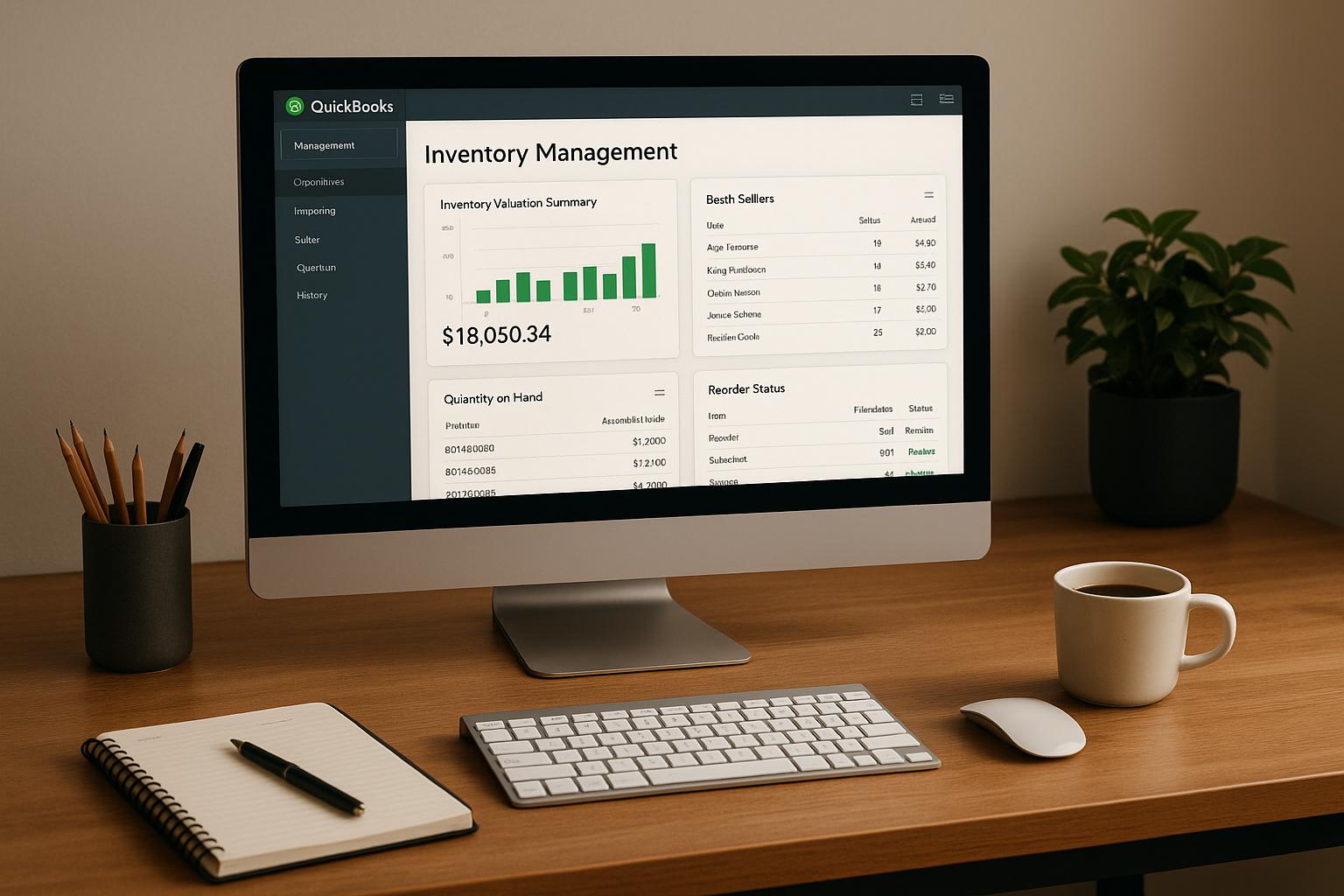

Mobile barcode scanning simplifies inventory management by replacing error-prone manual methods with real-time data entry. This technology allows warehouse staff to scan item and location barcodes directly into devices that sync with QuickBooks Desktop, ensuring immediate updates and accurate inventory records. Businesses using mobile scanning report benefits like improved inventory accuracy (up to 99%), reduced labor time (up to 60%), and faster ROI (often within 12 months). Key features include handheld devices, offline functionality, and integration with tools like Rapid Inventory for multi-location warehouses.
Key Takeaways:
- Accuracy Boost: Real-time scanning reduces errors, achieving up to 99% inventory record accuracy.
- Efficiency Gains: Labor time for cycle counting drops by up to 60%.
- Fast ROI: Many companies recover costs in under a year.
- Seamless Integration: Syncs with QuickBooks Desktop for real-time updates and fewer manual adjustments.
- Practical Workflow: Scanning eliminates the need for annual inventory freezes.
This approach transforms cycle counting into a routine task, eliminating disruptions and improving financial records.

Mobile Barcode Scanning Benefits: Accuracy, Efficiency & ROI Statistics
How Mobile Barcode Scanning Improves Cycle Counting
What is Cycle Counting?
Cycle counting is a way to keep inventory accurate without shutting down operations for a full physical count. Instead, it involves counting smaller portions of inventory on a regular schedule - daily, weekly, or monthly. This approach helps catch errors early, preventing bigger problems like stockouts or financial discrepancies. High-value or fast-moving items are typically counted more often, while less critical items are checked less frequently. This keeps the warehouse running smoothly without major interruptions.
By breaking the inventory down into manageable sections, errors like mis-picks, receiving mistakes, or unnoticed damages can be identified and corrected quickly. Now, let’s look at how mobile barcode scanners make this process even more efficient.
How Mobile Barcode Scanners Work
Mobile barcode scanning systems streamline cycle counting by using handheld devices (like rugged mobile computers or wireless scanners), barcode labels, and direct integration with inventory management software for QuickBooks Desktop. The process is simple: scan the item's location and barcode, input the count, and submit it. This information is sent directly to systems like QuickBooks Desktop or ERP platforms, eliminating the delays and errors of manual data entry.
Take QuickBooks Desktop Enterprise as an example. Managers can assign cycle count tasks directly to mobile devices. If the scanned quantity matches the system’s record, the task is marked as "Complete." If there’s a mismatch, it’s flagged for review, allowing issues like mis-slots or unit-of-measure errors to be resolved on the spot. This real-time validation ensures discrepancies are addressed while the worker is still at the location.
The hardware used is just as important. In fast-paced environments, rugged devices with advanced scan engines (like the Zebra SE4710) outperform consumer smartphones. They can read damaged or poorly printed barcodes and are built to handle rough conditions, such as frequent drops. Many systems also offer offline functionality, so workers can continue counting in areas without connectivity and sync their data later. These features bring clear operational benefits, as outlined below.
Benefits of Mobile Barcode Scanning
Mobile barcode scanners reduce errors by validating both the item and its location during the scan, avoiding mistakes that often arise from handwritten notes or visual checks. This is especially helpful when dealing with items in similar packaging. Industry standards for inventory record accuracy aim for 97% or higher, with top-performing warehouses achieving over 99%. These levels of precision align with QuickBooks Desktop’s focus on real-time, accurate data synchronization.
Since data is transmitted instantly, cycle counting becomes a seamless part of daily operations rather than a disruptive, once-a-year event. There’s no need to halt operations or reassign staff from their regular tasks. As Jon Schreibfeder, President of Effective Inventory Management, puts it:
The implementation of radio-frequency (RF) bar code equipment can almost eliminate cycle count reconciliation problems. In most RF warehouse systems, the on-hand quantity in the computer is updated as soon as material is added to, or removed from, a bin location.
sbb-itb-19ed50f
Technology Options for Mobile Barcode Scanning
Types of Barcode Scanners
USB handheld scanners are a simple, cost-effective choice for stationary setups. These scanners plug directly into desktop computers, making them ideal for tasks like entering data into QuickBooks Desktop for invoices or purchase orders. While easy to use, they keep workers tied to a fixed location.
Mobile computers with built-in scanners provide greater mobility. These all-in-one devices handle scanning, data processing, and wireless connectivity, allowing workers to move freely around the warehouse. This flexibility is especially useful for tasks like cycle counting, as employees can submit data without needing to return to a workstation.
Smartphone-based scanning leverages existing mobile devices with specialized apps, turning them into barcode scanners. This option works well for smaller businesses or those testing barcode scanning solutions, as long as the app supports real-time syncing with QuickBooks.
Features to Look For
When choosing a scanner, barcode format compatibility is critical. Ensure your device supports formats like EAN-13 and Code-128 and can produce a single carriage return at the end of each scan for smooth integration with QuickBooks Desktop. Keep in mind that scanners using serial ports won't work with QuickBooks' native barcode features.
These features ensure accurate and efficient data capture, making the integration process seamless.
Integration with QuickBooks Desktop

QuickBooks Desktop simplifies cycle counting by supporting real-time inventory updates. For example, QuickBooks Desktop Enterprise includes Advanced Inventory Settings, which allow USB scanners to directly input data into transactions like invoices, purchase orders, and inventory transfers. The Barcode Scanning Setup wizard (found under Edit > Preferences > Items & Inventory) even lets you assign unique item fields, such as "Part Number", for precise tracking.
For businesses managing multiple warehouses, third-party integrations can expand functionality. Tools like Rapid Inventory enable two-way syncing between QuickBooks Desktop and mobile devices through a web connector. Fernanda C., Director of Operations, highlights its benefits:
Rapid Inventory helps us run our warehouse operations. Easy to use and reliable... we especially love the barcode scanning and mobile picking and we've implemented it for all our warehouse operations.
This integration removes the need for manual data entry, keeping items, orders, and stock levels updated in both systems without relying on spreadsheets. From the initial demo to staging and go-live training, the implementation process typically takes about seven days. For importing barcodes, you can add a custom "Barcode 2" field, export the data to Excel, and map the fields using the Advanced Import utility in single-user mode.
Implementing Mobile Barcode Scanning for Cycle Counting
Preparing for Implementation
Start by organizing your inventory with an ABC analysis: 20% of your items (Category A) are high-value, 30% (Category B) fall into the mid-tier, and the remaining 50% (Category C) are bulk items. This breakdown helps set counting schedules: weekly for A items, monthly for B items, and quarterly for C items.
Next, prepare your storage areas. Ensure every location - like bins, shelves, or pallet spaces - and each item has a clear, scannable barcode label. Assign specific roles to your team:
- Counter: Handles the physical counts.
- Reconciler: Investigates any variances.
- Owner/Coordinator: Manages scheduling and tracks performance metrics.
To avoid errors during counts, temporarily pause activities like picking, receiving, and replenishment.
On the tech side, configure devices to sync with QuickBooks Desktop. Use either Advanced Inventory Settings or Rapid Inventory for this. For businesses with multiple warehouses, Rapid Inventory offers two-way syncing, allowing managers to assign tasks with "Send to device" and sync completed counts back to the system using "Send to QuickBooks".
With these preparations complete, you’re ready to establish a clear and consistent cycle counting process.
Step-by-Step Cycle Counting Workflow
Follow a straightforward five-step process: verify the location, scan the bin label, scan the item, count, and submit. To ensure accuracy, implement blind counting, where staff record counts without system prompts, reducing confirmation bias.
Counts are entered directly into mobile devices, cutting down on errors. QuickBooks flags discrepancies as "Pending Review", enabling immediate follow-up. When variances occur, staff must select a reason code (like "receiving error", "damage", or "theft") to help identify the root cause.
Once this workflow is in place, focus on training your team to apply it effectively.
Training Staff on the New System
Training is key to success. Start with mock counts to help staff gain confidence. Teach them how to:
- Verify locations by scanning bin labels first.
- Perform blind counts without relying on system cues.
- Enter data in real time.
- Assign reason codes for any variances.
To keep things fresh and avoid burnout, rotate staff through different zones regularly. Post standardized procedures in visible locations for quick reference. Maintain open communication so employees can report any issues with hardware, labels, or software workflows. This feedback loop supports ongoing improvements.
Mobile barcode scanners also simplify training compared to traditional paper-based methods. Plus, businesses often see a return on investment from mobile data collection technology within just 12 months.
QuickBooks Enterprise Mobile Barcode Device for Cycle Counts
Improving Cycle Counting Efficiency Across Multiple Locations
Building on mobile scanning workflows, improving cycle counts across multiple locations can significantly boost warehouse operations.
ABC Analysis and Prioritization
In warehouses with multiple locations, using ABC analysis ensures that high-value items (Category A) are counted more often than lower-value stock. This approach helps catch errors early, protecting your profits. Since demand for certain items can change with the seasons, it’s a good idea to reassess classifications every few months.
Zone-Based and Rotational Counting
A systematic approach to scanning each warehouse zone ensures no area is overlooked. Mobile barcode scanning plays a key role here by verifying location labels before counting, reducing the risk of errors caused by counting in the wrong spot. During active operations, it’s a good practice to temporarily pause activity in the zone being counted to avoid discrepancies while keeping the rest of the facility running smoothly. Rotating staff assignments also helps reduce bias and promotes accountability.
These strategies not only improve local accuracy but also contribute to a clearer, unified picture of inventory across all locations.
Centralized Visibility for Multi-Location Warehouses
Mobile barcode scanning sends data directly to your system as it’s collected, avoiding the delays and errors that often come with manual, paper-based methods. For QuickBooks Desktop users, this means real-time synchronization across all warehouse locations. Managers can track the status of cycle counts - like Open, Pending Review, Complete, or Closed - through a centralized dashboard. This seamless connection with QuickBooks Desktop eliminates isolated data issues between warehouses.
Case studies have shown that using mobile cycle counting leads to noticeable improvements in both labor efficiency and inventory accuracy. Even in areas with poor connectivity, mobile apps can handle offline counts, syncing the data once a connection is restored. Tools like Rapid Inventory support this process with two-way syncing for QuickBooks, allowing managers to assign tasks and update completed counts effortlessly.
Measuring Success and Maintaining Accuracy
Once mobile barcode scanning is implemented, it’s crucial to monitor key metrics to confirm the system is delivering improvements. One of the most important metrics is Inventory Record Accuracy (IRA), calculated as the number of correct counts divided by the total counts. The industry standard for IRA is 97%, with top-performing warehouses often achieving over 99%. Another critical measure is the adjustment rate, which tracks the percentage of items needing corrections in the system. Ideally, this should stay below 5%; rates above 10% indicate deeper issues that need attention.
Variance value, which represents the total dollar value of discrepancies found during counts, is another vital metric. For high-value "A" items, high variance often signals that these items aren’t being counted often enough. With tools like QuickBooks Desktop syncing data in real time, these metrics are constantly updated, creating a solid foundation for ongoing operational improvements.
Key Performance Metrics
In addition to IRA and adjustment rates, labor efficiency is a valuable indicator, measuring the time saved compared to manual methods. Mobile barcode scanning can cut labor time for tasks like cycle counting and reconciliation by up to 60%. Tracking shrinkage trends - unaccounted losses when physical counts don’t match system records - can highlight potential security or theft issues. For QuickBooks Desktop users, Rapid Inventory provides real-time reports to simplify tracking these metrics, with two-way syncing to ensure data stays accurate across multiple warehouse locations.
| Metric | Definition | Target/Benchmark |
|---|---|---|
| Inventory Record Accuracy | (Correct Counts / Total Counts) × 100 | 97% – 99%+ |
| Adjustment Rate | (Items Adjusted / Items Counted) × 100 | < 5% |
| Variance Value | Sum of the absolute dollar value of discrepancies | Minimize (especially for A-items) |
| Shrinkage | Unaccounted losses | Downward trend |
Tracking these metrics is just the start - continuous improvement is essential to maintain accuracy.
Continuous Improvement Practices
Maintaining long-term accuracy requires strong processes. Use reason codes for every adjustment - whether it’s due to receiving errors, mis-picks, damage, or theft - to pinpoint weaknesses in the system. As Jon Schreibfeder, President of Effective Inventory Management, advises:
"Review repeat offenders monthly and fix the process, not just the number".
Other practices to improve accuracy include blind counts, which prevent staff from relying on expected quantities, and reconciling variances immediately while details are still fresh. Standardizing workflows is another key step. Every shift should follow the same sequence: verify the location, scan the item, enter the quantity, and submit. Additionally, reassess ABC classifications quarterly, as product velocity and value can change over time.
A great example of these principles in action comes from CryoLife, which used mobile barcode scanners to conduct offline cycle counts on consignment inventory in hospitals without Wi-Fi. This replaced manual paper checklists and introduced digital traceability in challenging environments. For any SKU with two or more variances in a month, escalate the issue for a process audit.
Audit Trails and Compliance
Digital systems automatically create detailed records of who performed each count, when it happened, and which device was used. Mobile apps also enforce consistent data capture, which is invaluable for audits and compliance. Features like location verification before scanning help prevent "wrong bin" errors, while reason codes document the cause of every adjustment. For QuickBooks Desktop users, Rapid Inventory ensures all adjustments are synced back to QuickBooks in real time, keeping financial records aligned with physical inventory without manual intervention.
Accurate inventory counts offer more than just operational benefits. They can reduce stock-outs and excess inventory, potentially lowering overall inventory costs by 10%. Additionally, mobile data collection technology typically pays for itself within 12 months. The key to success lies in treating cycle counting as a routine part of daily operations rather than an annual emergency. Clean execution - right location, right item, right quantity, and real-time updates - is essential for achieving lasting results.
Conclusion
Mobile barcode scanning transforms cycle counting into an efficient, daily task. By ditching manual paper-based methods in favor of real-time digital data capture, warehouses can avoid common errors like mismatched SKUs or incorrect unit counts - all while keeping operations running smoothly. Many leading companies have already seen a sharp drop in labor hours and a boost in accuracy.
For QuickBooks Desktop users, the integration offers even more advantages. Warehouse managers can assign counting tasks directly to employees' devices, track progress through a centralized dashboard, and automatically reconcile quantity and value discrepancies in batches. This two-way sync keeps financial records aligned with physical inventory, eliminates manual data entry, and provides real-time alerts for reordering. These streamlined processes not only improve data accuracy but also pave the way for meaningful financial benefits.
In fact, mobile data collection systems often pay for themselves within a year and can increase sales by 4% to 8%. Beyond the financial impact, these systems promote accountability with digital audit trails and enforce consistent workflows across multiple warehouse locations.
Rapid Inventory takes these benefits further for QuickBooks Desktop users. Its features include multi-location tracking, FIFO/FEFO picking strategies, and lot and serial number tracking, all accessible online. With free training, onboarding, and support, the platform ensures a smooth implementation. Plans start at $90 per user per month for the Pro tier or $900 per month for unlimited users.
The secret to long-term success lies in treating cycle counting as a daily habit instead of an annual chore. Regular, real-time updates not only sustain the operational improvements achieved but also lay the groundwork for ongoing efficiency.
FAQs
What do I need to start mobile barcode cycle counting?
To get started with mobile barcode cycle counting, you'll need a compatible mobile device or scanner and access to your inventory management system. Make sure all items have barcode labels, and confirm that your scanner supports the necessary barcode formats, such as EAN-13 or Code-128. Setting up your equipment correctly and integrating it with your system is crucial for ensuring accurate and efficient inventory counting.
Will barcode scanning work without Wi‑Fi in the warehouse?
Yes, barcode scanning works even without Wi‑Fi, as long as you use compatible scanners that are set up correctly. These devices can collect data offline and sync it later, ensuring your inventory records stay accurate and up to date.
How does mobile scanning sync cycle counts back to QuickBooks Desktop?
Mobile scanning allows cycle counts to sync directly with QuickBooks Desktop through real-time updates. Once you finish a cycle count on your mobile device, just hit 'Send to QuickBooks' in the system. This instantly updates your inventory records with the new data, ensuring QuickBooks reflects accurate quantities - all without disrupting your daily workflow.