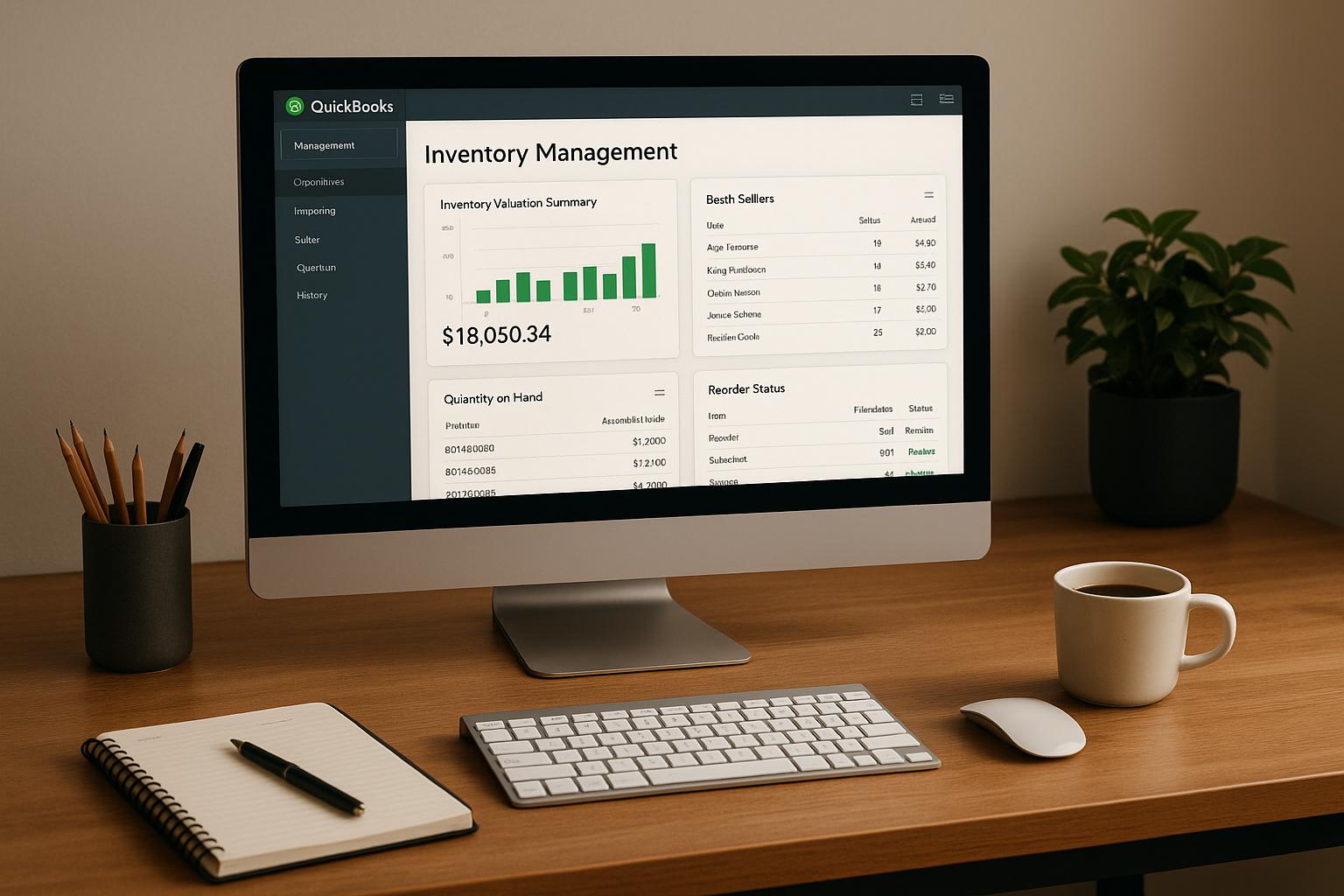

QuickBooks Desktop is great for accounting but struggles with inventory management, especially for growing businesses. Manual updates, limited multi-location visibility, and lack of mobile access can cause issues like stockouts and overstocking, cutting into profits. Cloud-based tools like Rapid Inventory solve these problems with real-time tracking, multi-user access, and mobile features.
Key Benefits of Rapid Inventory Integration:
- Two-way sync with QuickBooks Desktop: Reduces manual entry errors by 50%.
- Mobile barcode scanning: Cuts picking errors by 40%.
- FIFO/FEFO picking and lot tracking: Improves inventory accuracy to 97%.
- Multi-location and warehouse tracking: Simplifies operations across sites.
Proper training is essential to maximize these features. Structured onboarding can reduce setup time by 30–40% and improve inventory accuracy by 25%. Rapid Inventory offers free training and onboarding (worth $600), making it easy for teams to go live in about a week.
This guide covers everything you need to know, from setup and sync configuration to advanced workflows like cycle counting, backorder management, and real-time reporting. Whether you're managing one warehouse or multiple, this system ensures smoother operations and accurate data.

Rapid Inventory Benefits and ROI Statistics for QuickBooks Users
Setting Up Rapid Inventory for QuickBooks Desktop
System Requirements and Preparation
Before you connect Rapid Inventory to QuickBooks Desktop, make sure your system is ready to handle the integration. Rapid Inventory works with QuickBooks Desktop Pro, Premier, or Enterprise (2018 or newer) and requires a computer running Windows 10 or later. Your system should have at least 4GB of RAM (though 8GB is better for multi-user setups) and a broadband connection with speeds of at least 5 Mbps to ensure smooth real-time syncing.
It's also important to prepare your data and environment. Start by backing up your QuickBooks company file using the built-in backup tool (File > Create Backup). Ensure that the account you'll use to install Rapid Inventory has admin permissions in QuickBooks. Spend 2–4 hours auditing your inventory - double-check SKUs and quantities to minimize syncing errors during setup.
Once you're ready, download the Rapid Inventory installer from rapidinventory.com and run it as an administrator. During installation, the setup wizard will ask you to select your QuickBooks company file, usually found in the default QuickBooks company file location. The installation process takes about five minutes. Afterward, restart QuickBooks, log into the Rapid Inventory web portal, and add a sample inventory item to confirm the connection is working.
Setting Up Two-Way Sync Between QuickBooks and Rapid Inventory
After preparing your system, you can set up the two-way sync for seamless data integration. Rapid Inventory uses the QuickBooks Web Connector to enable this synchronization between your desktop software and the cloud platform. To configure it, go to the Rapid Inventory dashboard, navigate to Settings > QuickBooks Sync, and enter your QuickBooks credentials. During this step, you'll map inventory fields like "Item Name" and "Quantity on Hand." You can choose between real-time synchronization or scheduled updates (e.g., every 15 minutes). The first sync can process up to 10,000 items in under 30 minutes.
When mapping fields, exclude non-inventory items like services to avoid errors. After completing the sync, compare the inventory balances in QuickBooks and Rapid Inventory to ensure they match, allowing for a one-cent tolerance. Use the QuickBooks Inventory Valuation Detail report for this comparison. If you encounter "Access Denied" errors, try running QuickBooks as an administrator, ensure multi-currency is enabled if needed, and confirm that firewall ports 443 and 80 are open. Many sync issues can also be resolved by simply closing all QuickBooks sessions and retrying. For duplicate items, use the deduplication tool under Sync > Clean Data. This automated process eliminates manual data entry, ensuring your inventory remains accurate in both systems.
Setting Up Multi-Location and Warehouse Tracking
Once your data is synced, you can optimize your inventory management by setting up multi-location tracking. Start by configuring additional locations in the Rapid Inventory Locations menu. Click "Add Location" and input details like "Warehouse A – New York", including the address and square footage. Use the drag-and-drop interface to assign inventory items and establish transfer rules, such as FIFO (First In, First Out) for perishables. By linking these locations to QuickBooks classes or locations, updates will sync seamlessly, keeping data accurate across all sites. Test the setup by transferring a small quantity between locations and confirming that QuickBooks reflects the change.
For warehouse-specific tracking, go to Locations > Warehouse Setup to create bin locations. Organize bins into zones (e.g., "Zone 1: Dry Goods > Bin A1") and set capacity limits, like 500 units per bin. You can even print barcode labels in U.S. letter size that integrate with QuickBooks via custom fields. One distributor with three warehouses reported a 40% drop in picking errors after implementing this system. To ensure a smooth rollout, start with two or three locations and scale up after 30 days. Pre-labeling bins with serialized barcodes that align with QuickBooks item lists can also speed up onboarding by about 25%. This structured approach improves inventory accuracy and simplifies warehouse operations.
sbb-itb-19ed50f
Training Modules for Rapid Inventory Features
Once your locations and warehouses are set up, the next step is training your team on Rapid Inventory's features. The platform offers free training and onboarding, and most teams complete the process within 6–7 days. This training ensures your team is equipped to handle daily operations smoothly, building on the foundation set during the initial configuration.
To suit different learning preferences, Rapid Inventory provides multiple training formats. These include live onboarding sessions with the support team, an online training center with detailed documentation, and a library of help videos for self-paced learning. This approach ensures that warehouse staff, QuickBooks administrators, and managers receive tailored guidance suited to their roles.
The training modules cover key areas such as picking strategies with lot tracking, mobile barcode scanning paired with label printing, and advanced workflows like cycle counting and managing backorders. Each module builds on the previous one, showing how interconnected features like FIFO picking and QuickBooks syncing work together.
"My team was up and running in a few days. Very straightforward and easy to use." – Jacob, CEO
With over 400 customers giving the platform 5-star ratings, the training program has proven effective across industries and warehouse sizes. Let’s take a closer look at the key training modules that help your team master these features.
FIFO/FEFO Picking Methods and Lot/Serial Number Tracking
The first module focuses on First In First Out (FIFO) and First Expiration First Out (FEFO) picking methods. FIFO ensures older stock is shipped first, while FEFO prioritizes items nearing expiration - especially important for perishables and time-sensitive goods. Rapid Inventory simplifies this process by generating optimized pick lists that improve picking accuracy.
The system tracks inventory using lot numbers, batch numbers, serial numbers, and expiration dates. Staff assign these identifiers when receiving inventory, and the platform automatically recommends which lots to pick based on the chosen strategy. FIFO picks are synced with QuickBooks Desktop, updating lot numbers and quantities for accurate valuation.
Training includes hands-on exercises where warehouse staff practice receiving shipments, assigning lot numbers, and executing picks using the mobile interface. QuickBooks administrators learn how lot and serial data flows between systems and how to troubleshoot discrepancies. Once these picking techniques are mastered, the next module introduces mobile barcode scanning to streamline operations further.
Mobile Barcode Scanning and Label Printing
Mobile barcode scanning reduces manual entry errors and improves accuracy at every stage of inventory handling. Staff use scanners to confirm locations, items, quantities, and shipments in real time.
The training covers scanning barcodes during receiving to verify item identity and quantity, scanning bin locations during picking to ensure accuracy, and updating inventory levels during cycle counts. Participants also learn to print barcode labels in U.S. letter size, which integrate seamlessly with QuickBooks through custom fields.
Warehouse staff practice using scanners during the "Execute" phase (Days 6–7) of onboarding. Scenarios include receiving shipments with multiple SKUs, picking complex orders, and conducting cycle counts with mobile devices. One distributor noted a 40% reduction in picking errors after implementing barcode scanning.
"Using it since 2015, we especially love the barcode scanning and mobile picking and we've implemented it for all our warehouse operations." – Fernanda C, Director of Operations
Cycle Counting, Backorder Management, and Partial Shipments
Advanced workflows focus on maintaining inventory accuracy and managing complex scenarios. Cycle counting training helps teams perform regular counts without shutting down operations. Staff schedule counts by location or product category, use mobile scanners to execute counts, and reconcile discrepancies between physical and system records. Establishing a routine by zone ensures errors are caught early.
For backorder management, staff learn to identify and prioritize backordered items, fulfill orders as stock arrives, and communicate updates to customers. The system flags backorders and generates reports highlighting pending orders. Training also covers handling partial shipments - when some items are available while others are pending - and processing partial receiving for incomplete supplier deliveries.
Real-world examples include fulfilling an order when only 60% of items are in stock, updating arrival dates for backordered items, and identifying recurring backorder issues. QuickBooks administrators learn how these transactions sync with QuickBooks, keeping sales and purchase orders up to date and consistent between systems.
Training for Reports and Customization
Once teams have mastered the essential workflows, the next step is learning how to extract actionable insights from inventory data. Rapid Inventory provides live updates on on-hand inventory, inventory value, and the status of purchase and sales orders. This training is included as part of the white-glove onboarding process, which is valued at $600.
The system tracks 10 critical metrics, including inventory turnover, stockout and backorder rates, reorder points, COGS, margins, and cycle-count accuracy. Training sessions show how these metrics can inform daily operations. For example, teams learn to use the Audit Trail to filter transactions when investigating discrepancies. This data can then be exported to Excel for reconciliation. Reports consolidate real-time stock data from multiple warehouse locations and include site-specific reorder alerts.
For businesses requiring advanced customization, the Unlimited Plan ($900 per month) offers custom inventory reports valued at $2,000, along with a dedicated account manager. Meanwhile, the Pro Plan ($90 per user/month) delivers real-time inventory reports and activity logs, making it a great fit for smaller teams with standard reporting needs. These tools provide the foundation for generating and interpreting live reports, which is covered in the next module.
Creating and Using Real-Time Inventory Reports
Training begins by exploring the core types of inventory reports. The On-Hand Inventory report provides stock levels across all locations, while the Order Status report highlights current purchase and sales orders. The Reorder Report pinpoints items that have fallen below their reorder points, and the Inventory Value report calculates the overall value of stock on hand.
The Audit Trail is another essential tool, allowing users to track inventory edits, filter transactions, and identify discrepancies. Staff practice resolving sample discrepancies by filtering data based on transaction type, date range, or SKU. This hands-on method equips QuickBooks administrators to troubleshoot synchronization issues independently.
"Reorder points ensure that your inventory levels never fall below the minimum required to fulfill demand." – Raeann Salter, QuickBooks Advanced ProAdvisor
For deeper analysis, report data can be exported to Excel. This enables teams to create tools like stock aging buckets, which help identify slow-moving items that may be tying up cash flow. To measure the financial impact of backorders, staff can run the "Open Sales Orders by Item" report and export it to calculate the total cost of unfulfilled orders.
Combining regular cycle counts with mobile scanning and real-time data synchronization can boost inventory accuracy to around 97%. This high level of accuracy ensures that report data can be trusted for critical decision-making.
Configuring Reorder Points and Inventory Assemblies
Once live reports are analyzed, the next step is fine-tuning inventory controls with customized reorder settings and assembly management. Training covers both global and site-specific reorder points. Global reorder points are set in the inventory information section of an individual inventory part to ensure stock remains above the minimum needed to meet demand. Site-specific reorder points, on the other hand, are configured using the "Inventory Site Info" button, allowing each location to have its own reorder threshold without impacting the global total.
For businesses managing multiple warehouses, staff learn to decouple reorder totals. This means setting individual reorder points for each site based on local demand, which prevents overstocking in low-demand locations while ensuring adequate inventory at high-volume sites. However, reorder points cannot currently be set for specific bin locations within a site.
When it comes to inventory assemblies, training focuses on enabling inventory tracking, creating Bills of Materials (BOMs), and executing assembly builds within the system. Staff practice building BOMs with precise component quantities, then complete assembly builds using mobile barcode scanning. This improves accuracy and ensures updates are reflected across all locations.
"Mobile barcode scanning improves accuracy, speeds multi-location assemblies, and provides real-time inventory updates with QuickBooks integration." – Rapid Inventory
Common errors during assembly builds in QuickBooks Desktop, such as pending builds or sync issues, can be resolved using tools like Verify/Rebuild or by clearing pending builds. Training includes exercises where participants troubleshoot incorrect BOM quantities, resolve sync errors, and confirm that assembly builds are correctly updating QuickBooks. Staff also learn to use the "For Assemblies" column in the Inventory Stock Status by Item report to identify which components need to be ordered to fulfill pending builds.
Finally, QuickBooks administrators practice customizing transaction templates, such as invoices and sales orders, to include fields for inventory site and bin location. This ensures accurate data entry during order fulfillment and keeps reorder alerts and assembly data consistent between Rapid Inventory and QuickBooks Desktop.
Best Practices for Training Success
Achieving mastery with Rapid Inventory isn't just about the initial onboarding. Continuous training and well-structured routines are key to keeping staff skilled in two-way syncing and mobile barcode scanning, which are essential for maintaining accurate inventory. Businesses that prioritize regular inventory training see 25% fewer stock discrepancies, and those conducting weekly cycle counts experience a 40% reduction in audit variances when using QuickBooks-integrated systems.
Incorporate training into everyday tasks by addressing discrepancies during cycle counts, utilizing mobile scanners in live operations, and reviewing real-time reports regularly. This practical approach helps employees naturally reinforce their skills while directly improving inventory accuracy.
Scheduling Regular Training and Cycle Counts
Short, bi-weekly training sessions lasting 30 to 60 minutes can keep staff updated on key features like FIFO/FEFO picking and lot tracking. Each session should target a single topic, such as resolving assembly errors or troubleshooting sync issues, rather than overwhelming employees with multiple features at once.
For cycle counts, a monthly schedule works for most businesses, but high-volume operations might benefit from weekly counts. Use ABC analysis to prioritize your efforts: focus on high-value or fast-moving items (Category A) to make the biggest impact on accuracy. Tools like a Cycle Count Scheduler can automate this process, calculating daily item counts based on total inventory and available workdays.
To maintain consistency, pause all inventory transactions during active cycle counts. This prevents discrepancies between physical inventory and digital records, allowing staff to verify quantities and practice updating counts in real time using mobile scanners. When combined with regular cycle counts and real-time syncing, businesses can achieve inventory accuracy rates of approximately 97%.
Once a training schedule is in place, the next step is tackling syncing issues that may disrupt inventory accuracy.
Fixing Common Sync and Training Problems
Sync issues between QuickBooks Desktop and Rapid Inventory often arise from duplicate records, mapping mismatches, inactive items, or invalid characters in item fields. To stay ahead of these issues, check sync logs daily to identify and resolve error codes before they escalate.
Here are some common problems and their solutions:
| Common Sync/Training Issue | Recommended Fix |
|---|---|
| Negative Quantity on Hand (QOH) | Reconcile counts and verify all receiving transactions have been entered |
| Mapping Mismatches | Update field mapping between QuickBooks and Rapid Inventory |
| Duplicate Records | Merge duplicates in QuickBooks and re-sync |
| Assembly Build Errors | Check component quantities, correct BOMs, and clear pending builds |
For technical problems, tools like QuickBooks' "Verify/Rebuild Data" utility or the QuickBooks Tool Hub can repair corrupted inventory files. If staff encounter challenges with specific features, document the issue, review training logs for gaps, and provide targeted refreshers using Rapid Inventory's free onboarding materials. Validate fixes by performing live cycle counts to ensure the problem has been resolved.
To avoid recurring issues, standardize data entry early by training staff to use consistent SKUs and ensure all fields are mapped correctly before the first sync. Provide quick-reference guides for tasks like backorder tracking and store them in a central, easily accessible location. Track progress by monitoring metrics like sync success rates (aim for >95%), cycle count accuracy (within 2% variance), and reductions in staff errors using real-time reports. By embedding these strategies into daily operations, teams can ensure training efforts translate into long-term improvements in inventory management.
Conclusion
Rapid Inventory's cloud training takes QuickBooks Desktop inventory management to a whole new level. With features like two-way sync, manual double entry becomes a thing of the past. Add to that mobile barcode scanning, FIFO/FEFO picking, and multi-location tracking, and businesses are seeing real, measurable results: 25–50% faster cycle counts, a 20% drop in backorder rates, and 99% sync accuracy.
Real-time data access is another game-changer. You can monitor inventory levels, manage partial shipments, and generate reports from any device with internet access. For instance, a mid-sized distributor cut picking errors by 40% and slashed fulfillment time from 2 days to just 4 hours. These efficiencies allowed them to expand to 5 warehouses - all without the need for on-site hardware. It's a system designed to make onboarding smooth and fast.
Speaking of onboarding, you can be fully up and running in just 7 days. The package includes free white-glove training (a $600 value) and complimentary data migration services (worth $1,500). As Nicholas G, an owner, shared:
"Simple and straightforward, very easy to learn and easy to work with. Onboarding was very smooth".
But the support doesn’t stop there. You'll have access to an online training center, detailed help articles, video tutorials, and direct support through email, phone, or text.
To maintain success, regular practices like bi-weekly training sessions and monthly cycle counts are key. These help refine skills in troubleshooting, assembly management, and reporting. With these steps, QuickBooks users can consistently achieve inventory accuracy rates of around 97% and potentially save $10,000 annually on carrying costs for a $1M inventory operation.
FAQs
Will two-way sync change my existing QuickBooks items or quantities?
Two-way sync keeps your QuickBooks items and quantities updated in real time. Whether it's shipments, adjustments, or sales, any changes are instantly reflected without altering your existing data. This helps maintain accurate and up-to-date inventory records.
What data should I clean up before the first sync?
Before syncing with Rapid Inventory, it's crucial to tidy up your inventory data for accuracy. Start by ensuring all items are categorized as Inventory Part and properly linked to the correct accounts. Double-check that your inventory valuation aligns with your balance sheet, and address any discrepancies you find.
Standardize your SKUs and item names to maintain consistency. Remove any outdated or duplicate items from your records. Lastly, verify that location details and serial or lot numbers are accurate - this will help prevent errors during the synchronization process.
How do I train warehouse staff on mobile scanning fast?
When it comes to training warehouse staff on mobile scanning, the key is to keep it practical and straightforward. Focus on hands-on practice, clear workflows, and understanding system integration to ensure they can hit the ground running.
Start with the basics: show them how to properly use the scanner. Demonstrate essential tasks like receiving shipments, picking orders, and updating inventory. Use plenty of visual aids - diagrams, videos, or even step-by-step guides - to make the process easy to follow. Then, let them practice. Real-world exercises build confidence and help them learn faster.
It’s also crucial to explain how mobile scanning connects to your inventory system. Highlight how real-time updates work and why accuracy is important for keeping operations smooth. Finally, don’t stop at the initial training. Offer regular refreshers to keep their skills sharp and maintain efficiency across the team.