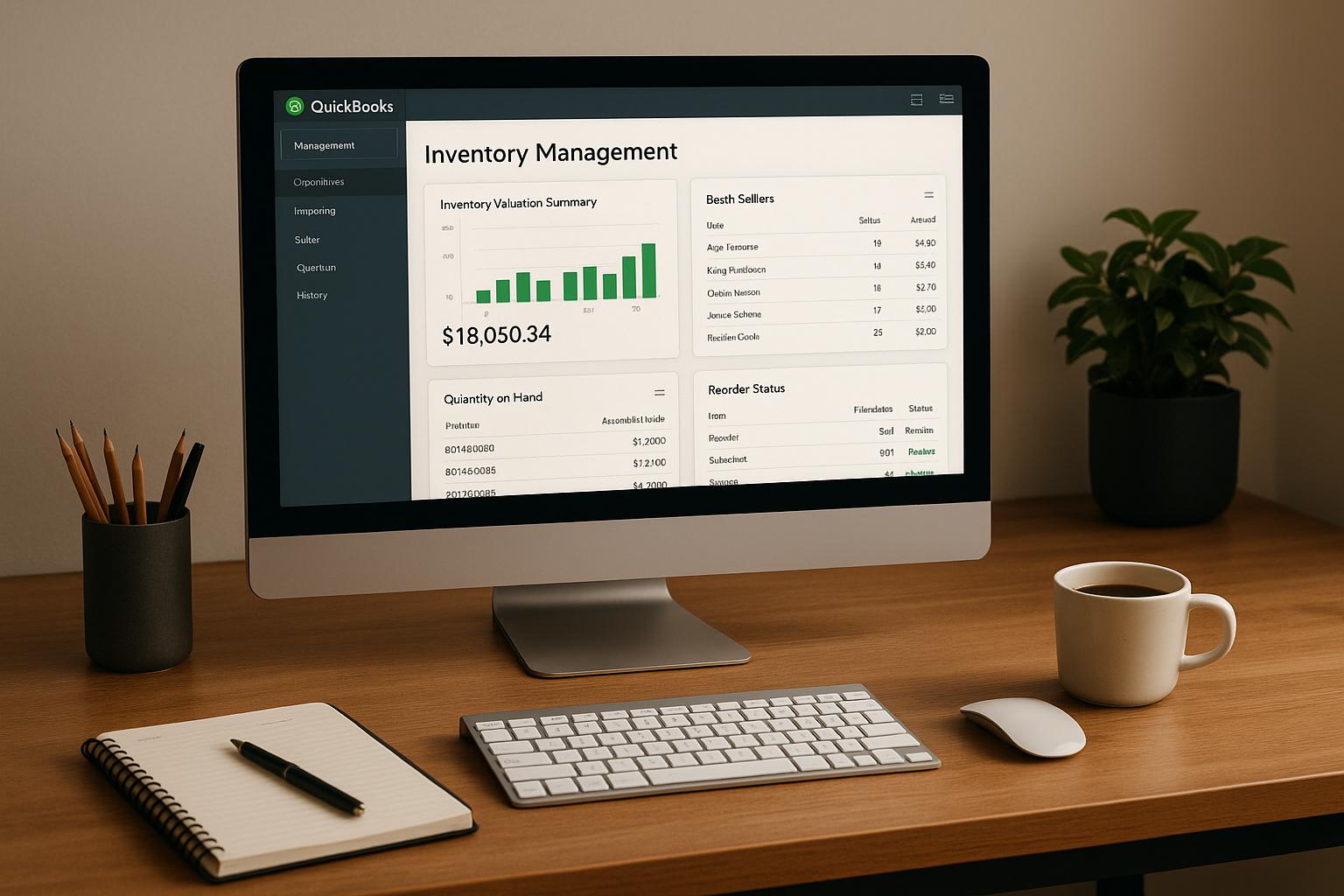

QuickBooks Desktop uses user roles and permissions to control inventory management access. These roles ensure employees only see and perform tasks relevant to their jobs, safeguarding sensitive data. QuickBooks Pro and Premier offer three access levels: No Access, Full Access, and Selective Access, while QuickBooks Enterprise provides 14 predefined roles and custom role-building options for more granular control.
For warehouse-specific needs, Rapid Inventory integrates with QuickBooks to deliver advanced tools like mobile barcode scanning, task-specific permissions, and real-time updates. This system is ideal for businesses requiring precise inventory workflows beyond QuickBooks' native capabilities.
Key Takeaways:
- QuickBooks Pro & Premier: Basic access levels for inventory tasks.
- QuickBooks Enterprise: Predefined roles and custom permissions for detailed control.
- Rapid Inventory: Specialized for warehouse tasks with mobile and cloud-based features.
Quick Comparison:
| Feature | QuickBooks Enterprise | Rapid Inventory |
|---|---|---|
| Primary Focus | Financial & inventory control | Warehouse management |
| Access Levels | Predefined/custom roles | Task-specific permissions |
| Mobile Access | Limited | Full mobile barcode scanning |
| Platform | Desktop/hosted | Web-based |
| Pricing | Tiered | $90/user/month or $900/month |
Choose QuickBooks for broader financial controls or Rapid Inventory for specialized warehouse operations.

QuickBooks Enterprise vs Rapid Inventory: Feature Comparison for Inventory Management
1. QuickBooks Desktop User Roles

Role Permissions
In QuickBooks Desktop Pro and Premier, the Admin assigns one of three access levels - No Access, Full Access, or Selective Access - to different functional areas, like Sales or Purchases. Selective Access allows users to handle transactions and generate reports without requiring full administrative rights.
QuickBooks Desktop Enterprise takes this further with Role‑Based Access Control (RBAC). Admins can create specific roles with customized permissions and choose from 14 predefined roles. For example, the Inventory role is designed for tasks like adjusting stock quantities, reviewing item receipts, and running inventory-related reports. The Platinum, Diamond, and Accountant editions go even deeper, restricting user access to specific customer, vendor, or employee groups.
These permission settings are integral to shaping how day-to-day inventory tasks are managed.
Inventory Workflow Impact
The way permissions are set up has a direct effect on inventory team efficiency. For instance, a warehouse manager assigned the Inventory role can adjust stock levels and create reports without being exposed to sensitive data, like payroll or banking details. Admins can also enhance security by restricting access to sensitive financial information on the home page by setting "Sensitive Accounting Activities" to "No Access".
However, if a user has conflicting role assignments, QuickBooks defaults to the least restrictive permission. This could unintentionally grant full invoice access even if another role denies it. Any changes to roles require the user to log out and back in for the updates to take effect. For businesses operating across multiple locations, Enterprise’s data-level permissions ensure that staff only see the inventory relevant to their specific department or region.
Additional Features
Enterprise users have access to tools like the "Permission Access by Roles" report, which provides a detailed overview of what each role can view and perform within inventory workflows. The Audit Trail report, located under Accountant & Taxes, keeps a record of user activities - such as inventory adjustments or bill entries - adding an extra layer of accountability. Admins also have the flexibility to duplicate and modify existing roles to tailor permissions for individual users.
How to Use User Rights and Role Permissions in QuickBooks Enterprise
2. Rapid Inventory
Rapid Inventory takes QuickBooks Desktop's permission settings a step further, offering refined controls specifically designed for warehouse management.
Role Permissions
This system enhances QuickBooks Desktop's framework by introducing role-based access tailored to the needs of warehouse operations. Administrators can decide exactly what each user can view and do - whether it's cycle counting, lot tracking, inventory transfers, or mobile barcode scanning. This ensures that warehouse associates can handle their tasks, like verifying items and quantities, without exceeding their designated responsibilities.
Rapid Inventory integrates seamlessly with QuickBooks Desktop (Enterprise, Pro, and Premier) through an automatic two-way sync. Administrators can assign specific users, warehouses, and locations, ensuring the Web Connector aligns properly with QuickBooks. This setup avoids permission conflicts and keeps warehouse activities in sync with the accounting system. These customized permissions streamline daily inventory processes.
Inventory Workflow Impact
Having clearly defined roles speeds up workflows and improves accuracy. Mobile barcode scanning, for instance, allows authorized users to confirm locations, items, and quantities during key tasks like receiving, picking, counting, moving, and transferring. All this data updates QuickBooks in real time, cutting down on manual entry and potential errors.
Rapid Inventory helps us run our warehouse operations - easy to use and reliable. The barcode scanning and mobile picking features have transformed our processes.
- Fernanda C, Director of Operations
Multi-location tracking is another standout feature. Users only see inventory relevant to their assigned warehouse or bin locations, while role restrictions safeguard sensitive data such as lot numbers, serial numbers, and expiration dates.
Additional Features
Rapid Inventory goes beyond simple role controls. It supports advanced stock management strategies like FIFO (First In, First Out) and FEFO (First Expired, First Out). Security features include multi-factor authentication, activity logging, and checklist procedures to ensure data integrity. Its web-based design also allows remote access to inventory information, adding flexibility for teams.
Most teams can get started with Rapid Inventory in just 6 to 7 days. As Jacob, a CEO customer, shared, "My team was up and running in a few days. Very straightforward and easy to use." The platform also offers specialized workflows for inventory assemblies, backorders, and partial shipments, all governed by the same role-based permissions.
With over 17 years of experience and more than 400 customers, Rapid Inventory has earned a strong reputation. It boasts a 5-star rating, with users frequently highlighting the efficiency of mobile picking and the helpfulness of the technical support team.
sbb-itb-19ed50f
Pros and Cons
When it comes to inventory permissions, QuickBooks Desktop and Rapid Inventory take distinct approaches. Each has its own strengths and challenges, and understanding these can help businesses make an informed decision based on their specific needs.
QuickBooks Desktop Enterprise offers predefined roles that cover a wide range of functions, but these roles apply universally to all users assigned to them. Customization is possible, but it requires creating entirely new roles from scratch. On the plus side, the system provides a "Permission Access by Roles" report, making it easier to audit who has access to what. However, in the Pro and Premier versions, inventory permissions are bundled into broader categories, which might unintentionally grant warehouse staff access to sensitive financial information like vendor payments.
Rapid Inventory, on the other hand, is designed specifically for warehouse operations. It allows for task-specific permissions, such as receiving, picking, counting, and transferring inventory. Its web-based platform supports mobile barcode scanning with role-based restrictions, enabling users to access inventory data from virtually anywhere. This cloud-based setup offers more flexibility for teams spread across multiple locations compared to QuickBooks Desktop, which relies on local or hosted environments.
Here's a quick comparison of the two systems:
| Feature | QuickBooks Desktop Enterprise | Rapid Inventory |
|---|---|---|
| Primary Focus | Accounting and financial control | Warehouse operations and accuracy |
| Predefined Roles | 14 roles (e.g., Inventory, Finance, View Only) | Task-specific (Picking, Receiving, Counting) |
| Access Levels | None, Full, or Partial | Role-based warehouse permissions |
| Mobile Access | Limited to specific mobile manager features | Full mobile barcode scanning permissions |
| Platform | Local or Hosted Desktop | Web-based (SaaS) |
| Pricing | Tier-based pricing (1–40 user licenses) | $90 per user/month (1–9 users) or $900 per month (10+ users) |
This table underscores the different priorities of each system. QuickBooks Desktop Enterprise is well-suited for businesses that need robust financial controls across various departments. In contrast, Rapid Inventory specializes in warehouse-specific tasks and supports real-time, mobile-friendly workflows, making it a better fit for operations that prioritize inventory accuracy and mobility. Each system has its place, but the choice ultimately depends on what aligns best with your business goals.
Conclusion
User roles in QuickBooks Desktop play a critical role in ensuring your team manages inventory efficiently and accurately. QuickBooks Desktop Enterprise offers 14 predefined roles with up to 115 detailed permissions, enabling administrators to separate responsibilities - like purchasing and inventory adjustments - and limit sensitive accounting tasks to authorized individuals. This level of precision reduces the risk of accidental stock changes and helps maintain data integrity.
This contrasts with the broader permissions found in QuickBooks Pro and Premier. These versions combine inventory permissions into general categories, such as "Purchases and Accounts Payable", which can inadvertently grant access to sensitive financial data. With only three basic access levels - No Access, Full Access, and Selective Access - these versions lack the task-specific controls needed for more complex or high-volume operations.
For businesses where QuickBooks' native roles don’t meet operational needs, Rapid Inventory offers specialized, warehouse-focused permissions. It’s a great fit if your operation requires mobile barcode scanning, task-specific permissions for activities like receiving or picking, or web-based access for teams across multiple locations. Rapid Inventory is priced at $90 per user per month (or $900 per month for 10+ users) and includes free training and onboarding, simplifying the transition process.
Ultimately, your choice should reflect the complexity of your operations. For smaller, simpler setups, QuickBooks Enterprise’s built-in roles (supporting up to 30 users) may be sufficient. However, for advanced warehouse controls and mobile flexibility, a dedicated platform like Rapid Inventory is a better fit. Regularly reviewing permissions using the "Permission Access by Roles" report ensures that access remains aligned with employee responsibilities.
FAQs
What’s the safest way to set up inventory permissions in QuickBooks Desktop?
To set up inventory permissions securely, start by logging in as the admin. Navigate to Company > Users > Set Up Users and Roles. Here, you can create custom roles tailored to specific inventory tasks, such as viewing or editing items. Assign these roles to users according to their job duties. This approach limits access to only the areas relevant to their responsibilities, helping prevent unauthorized changes and safeguarding sensitive inventory information.
Why can users end up with more access when they have multiple roles?
When users in QuickBooks have multiple roles, their access levels may expand since permissions from each role can overlap or stack. In such cases, the system automatically provides the highest level of access from all assigned roles. This setup ensures users can carry out any task permitted by any of their roles.
When should I use Rapid Inventory instead of QuickBooks roles?
When your inventory demands surpass what QuickBooks roles can handle - like managing user permissions - Rapid Inventory steps in to fill the gap. It provides advanced capabilities such as multi-location tracking, FIFO/FEFO inventory methods, barcode scanning, and real-time updates. These tools are perfect for businesses that require more detailed reporting, automation, or intricate workflows. By offering these features, Rapid Inventory ensures greater accuracy and efficiency, going far beyond what QuickBooks roles alone can achieve.