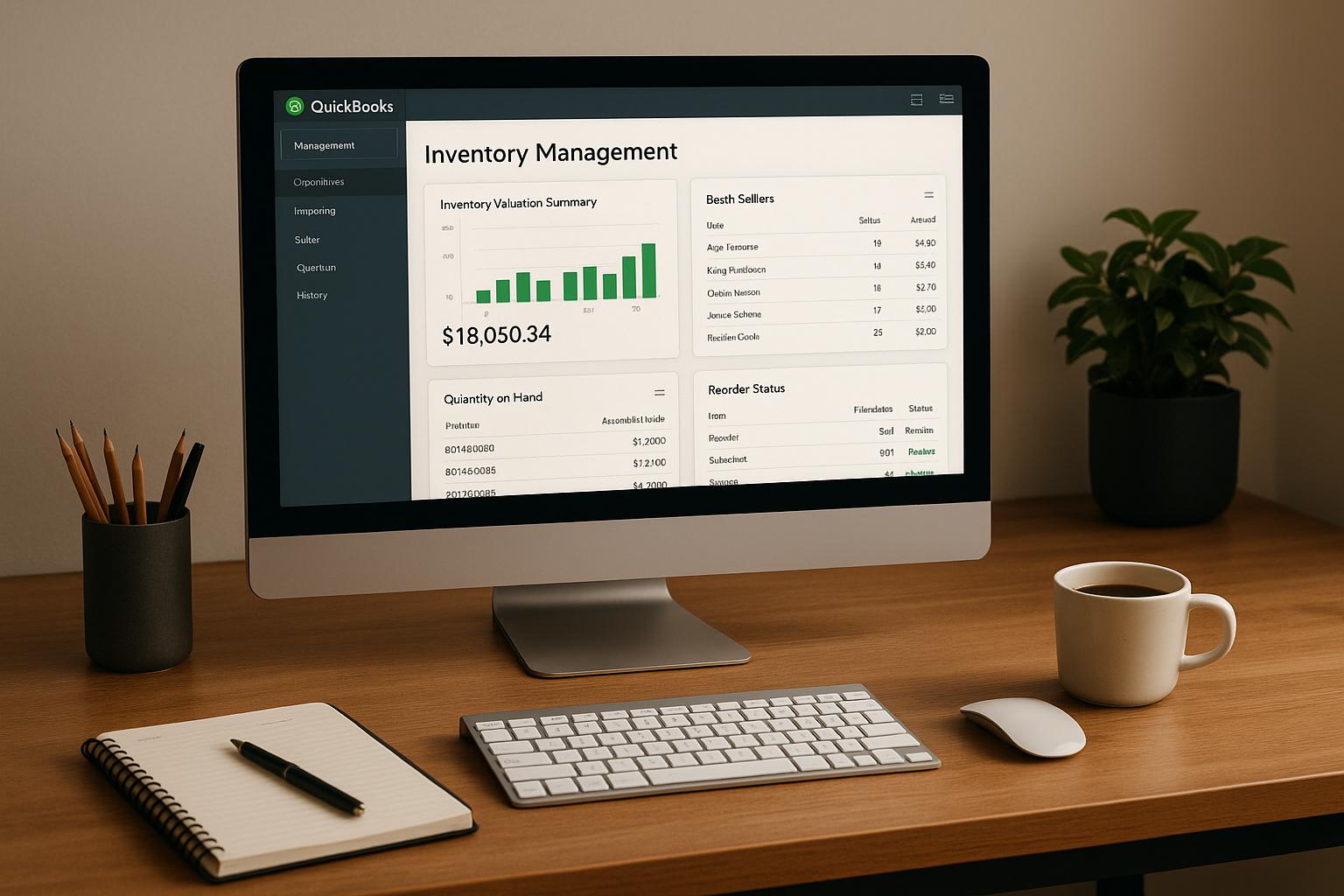

Barcode scanning simplifies inventory management by replacing manual data entry with fast, automated processes. A quick scan updates item quantities, logs transactions, and ensures real-time accuracy, reducing human errors. When integrated with tools like QuickBooks Desktop, it connects warehouse activity with accounting data, streamlining tasks like receiving shipments, picking orders, and cycle counts.
Here’s what you need to know:
- How it works: Scanners read barcode labels to instantly update inventory records.
- Key benefits: Faster processes, fewer errors, real-time updates, and improved tracking.
- Setup steps: Clean inventory data, assign barcodes, label items, and choose compatible hardware.
- Common uses: Automating receiving, order fulfillment, and inventory counts.
Barcode systems boost efficiency and accuracy, making them a valuable tool for small businesses managing inventory.
How Barcode Scanning Works in Inventory Management
What Is Barcode Scanning in Inventory Management?
Barcode scanning is a fast and efficient way to input data. Instead of manually typing a product name or SKU into your system, you just scan a label, and the information is instantly transferred - reducing the likelihood of errors.
"A barcode inventory system is a method that helps businesses track inventory faster and easier." - Marshall Hargrave, Financial Writer, QuickBooks
A typical system includes four key components: barcode symbols, printed labels, a scanner, and inventory software. Each part has a specific function, and the system operates best when all are in place. For small businesses, a basic setup can cost less than $100 using a free smartphone app and standard printed labels.
Now, let’s see how barcode labels link your physical inventory to your digital records.
How Barcode Labels Connect Physical Items to Digital Records
Barcode labels act as unique identifiers, like a digital key that connects physical items to your software. When a label is scanned, the system pulls up the corresponding digital record and updates it automatically, eliminating the need for manual data entry.
Labels can be used to identify individual products, storage bins, or even warehouse locations. Traditional 1D barcodes store simple data like SKUs or UPCs, which are often enough for small businesses. On the other hand, 2D barcodes, such as QR codes, can store more complex information, including lot numbers, batch details, or expiration dates. This makes them particularly useful for businesses that need detailed tracking at the item level.
"Barcode scanning eliminates the risk of typos and data entry errors. It helps maintain accurate inventory records even as SKU counts, order volume, and locations increase." - Marshall Hargrave, Financial Writer, QuickBooks Blog
Platforms like Rapid Inventory integrate barcode scanning directly with QuickBooks Desktop. This two-way sync ensures your warehouse activity and accounting data stay perfectly aligned.
By assigning digital identities to physical items, each scan ensures your records are always up to date.
How Real-Time Inventory Updates Work
Every scan triggers an immediate update to your inventory records. For example:
- Receiving shipments: Scanning items instantly increases your "on-hand" count.
- Fulfilling orders: Scanning during the picking process deducts the correct quantities from your inventory in real time.
Here’s a quick look at how common warehouse actions translate into real-time updates:
| Transaction Type | Real-Time Action via Scanning |
|---|---|
| Purchase Orders / Item Receipts | Increases "On Hand" quantity immediately upon scan |
| Sales Orders / Invoices | Deducts items from inventory and updates sales records instantly |
| Inventory Transfers | Moves stock between locations as the physical move occurs |
| Cycle Counts | Adjusts quantity on hand to match the physical count recorded by the scanner |
This real-time syncing is what makes barcode scanning so effective. It keeps your digital inventory aligned with your physical stock throughout the day - no need for end-of-shift spreadsheet updates.
sbb-itb-19ed50f
QuickBooks Enterprise Barcode Scanning Tutorial

How to Prepare Your Inventory System for Barcode Scanning

How Barcode Scanning Automates Inventory Management: Step-by-Step Setup Guide
Clean and Organize Your Inventory Data First
Before diving into barcode scanning with inventory management software for QuickBooks Desktop, it’s crucial to have your inventory data in top shape. If your records are messy - think duplicated SKUs, inconsistent item names, or missing data - your barcode scans won’t align with your system, leading to errors and frustration.
Start by exporting your QuickBooks Desktop item list to Excel. Use this opportunity to clean up duplicates, fill in missing SKUs, and standardize item names. Assign unique SKUs to every product variation. For example, a small white T-shirt could be labeled as "TS-WHITE-S", while a medium blue version might be "TS-BLUE-M."
"Stock discrepancies are common when taking inventory due to human error, like misplacing items and double counting." - Marshall Hargrave, Financial Writer, QuickBooks Blog
Once your data is clean, choose a primary field - such as Item Name or Part Number - to serve as the anchor for barcode tracking. Before importing any updated data back into QuickBooks, back up your company file and switch to single-user mode. This ensures a smooth import process without data conflicts.
With your inventory data cleaned and organized, you’re ready to assign barcodes to your items.
How to Set Up and Label Your Items
The next step is linking barcodes to your inventory items. QuickBooks Desktop offers a Barcode Wizard, which you can find under Edit > Preferences > Items and Inventory > Company Preferences > Advanced Inventory Settings. This tool can generate barcodes automatically for items that don’t already have one.
If your products already have manufacturer barcodes, such as UPCs, you can import them into QuickBooks. Create a custom field, like "Barcode2", to store this data. Add the barcode information to your exported Excel file and use the Advanced Import tool to sync the updated data back into QuickBooks. Be sure your column headers match exactly to avoid import errors.
When it comes to labeling, invest in a durable barcode printer. Place labels where they’re easy to scan - on product packaging, storage bins, or warehouse shelves. Avoid placing them in hard-to-reach spots, like under packaging or against walls. Proper labeling ensures smooth tracking during receiving, picking, and shipping processes.
Once your items are labeled, you’re ready to move on to choosing the right scanning hardware.
Choosing and Setting Up Barcode Scanning Hardware
For small businesses, a USB handheld scanner is often the best choice, with prices typically ranging from $100 to $500. If you’re just starting or have a low scan volume, a smartphone can also work as a cost-effective option for tasks like cycle counts or receiving.
There are two non-negotiable hardware requirements for QuickBooks compatibility: your scanner must support EAN-13 and Code-128 symbologies, and it must be configured to send a single carriage return after each scan. This ensures QuickBooks automatically moves to the next line item after scanning. Avoid serial port scanners, as they aren’t compatible with QuickBooks Desktop’s barcode features.
Once your hardware is in place, test it in a small area before rolling it out across your entire operation. Run sample transactions and double-check counts on high-turnover items to ensure everything syncs correctly with QuickBooks. This step helps you catch any issues early and fine-tune your setup for smooth operation.
How to Use Barcode Scanning to Automate Common Inventory Tasks
Once your system is set up, barcode scanning can help you handle inventory tasks faster and with fewer errors. Below are three key workflows where barcode scanning can make a big difference.
How to Automate Purchase Receiving
When a shipment arrives, you can simplify the receiving process by using barcode scanning in QuickBooks Desktop. Just open a Purchase Order or Item Receipt and start scanning. Each scan automatically creates a line entry, so there's no need for manual data entry. This reduces the chances of errors during receiving.
If you're using Rapid Inventory, the process becomes even more efficient. At the loading dock, team members can use mobile scanners to confirm an item's location, identity, and quantity. Rapid Inventory syncs with QuickBooks in real time, updating order statuses and inventory levels as items are scanned. The system also supports partial receiving, so you’ll always know exactly what has arrived and what’s still outstanding.
"Using it since 2015, we especially love the barcode scanning and mobile picking and we've implemented it for all our warehouse operations." - Fernanda C., Director of Operations
Next, let's look at how barcode scanning can speed up order fulfillment.
How to Speed Up Sales Picking and Shipping
Barcode scanning simplifies the order fulfillment process by removing guesswork. Instead of relying on handwritten pick lists, warehouse staff can use mobile scanners to verify the correct shelf location, item, and quantity before picking products. Rapid Inventory enhances this by providing digital pick lists that optimize the route through the warehouse. Once an item is scanned and picked, QuickBooks updates the sales order status and inventory availability instantly.
The system even supports partial shipments, allowing you to track which items have shipped while keeping the remaining balance visible on open orders.
Finally, barcode scanning can also improve inventory counts.
How to Automate Cycle Counts and Adjustments
Cycle counts become faster and more accurate with barcode scanning. Instead of manually recording numbers, warehouse staff can walk through the facility with a mobile scanner, logging counts in real time as they scan barcodes.
With Rapid Inventory, these counts sync directly to QuickBooks Desktop, ensuring that any adjustments are recorded immediately. To stay on top of inventory, schedule monthly spot checks for high-turnover SKUs to catch discrepancies early.
How Barcode Scanning Improves Accuracy and Inventory Visibility
How Automated Scanning Reduces Errors
Manual data entry is a big culprit when it comes to inventory mistakes. Entering SKUs by hand, copying information from packing slips, or updating spreadsheets can lead to typos and mix-ups. Barcode scanning eliminates these risks completely.
With a quick scan, the system instantly identifies the correct SKU and records the transaction - no typing needed. This automation also helps avoid mispicks, where similar-looking products might get confused due to nearly identical labels. If the scanned barcode doesn’t match the expected item, the system flags the issue right away.
How Scanning Improves Accountability and Tracking
Every time an item is scanned, it creates a timestamped record that links to a specific user, item, and action. This detailed audit trail allows you to trace back any receiving errors or missing items to see exactly what happened, when, and who was involved. As your team grows, role-based access controls can limit access to specific areas of the system, ensuring that employees only interact with the data relevant to their role, boosting internal accountability.
This constant flow of traceable, real-time data ensures accurate stock levels and provides a solid foundation for detailed reporting.
How Barcode Scanning Supports Accurate Stock Levels and Reporting
By reducing errors and improving accountability, barcode scanning ensures that stock counts are always up to date. Every transaction - whether it’s receiving, picking, or transferring inventory - automatically updates the system. Tools like Rapid Inventory use this data to provide real-time reports on stock quantities, inventory value, and reorder points. This helps you identify low-stock situations before they turn into stockouts, ensuring your reports align with what’s physically available. Pairing optimized pick routes with barcode verification at every step can even lead to flawless order-picking accuracy.
"Barcode systems update your inventory every time items are scanned. Store locations, online channels, and stockroom or fulfillment workflows will be able to more easily spot low stock, monitor product movement, and understand performance." - Marshall Hargrave, Financial Writer
How to Maintain and Grow Your Barcode Inventory System
How to Monitor and Maintain Your System
Keeping your barcode system running smoothly means performing regular monthly spot checks on high-volume or complex SKUs. These checks can catch data issues early, preventing them from turning into bigger headaches.
Beyond audits, pay attention to your labels and hardware. Paper labels might not hold up well in harsh environments - they can fade or peel. For better durability, consider switching to synthetic materials like polyester or polypropylene. Also, as warehouse layouts change, test scan distances and angles. A label placement that worked before might now be blocked or harder to scan.
"If items aren't consistently scanned as they move through receiving, storage, fulfillment, or transfer workflows, inventory data can quickly become unreliable." - Marshall Hargrave, Financial Writer
Use system logs and real-time reports to spot scanning issues. If you notice frequent manual overrides or data mismatches in a certain workflow, treat it as a red flag - dig deeper to find the root cause and adjust your process.
Once you've got a handle on system maintenance, it's equally important to ensure your team knows how to use the system effectively.
How to Train Staff on Barcode Scanning
Even the best technology won't work if scanning habits are inconsistent. Start by testing scanning processes with a small sample of products. This helps confirm that updates are accurate and determines the best scan distances for your setup.
To make training easier, create simple one-page guides for tasks like receiving, picking, cycle counting, and returns. Include straightforward instructions, such as "scan to add" or "scan to remove." Training should also cover what to do when things go wrong, like when a barcode won't scan. For example, staff might use a bin barcode as a fallback or trigger a manual override for bulk items.
Cross-departmental training is key. When teams in receiving, fulfillment, and finance all understand how their scans affect real-time inventory and reporting, accountability improves across the board. Assigning clear scanning responsibilities to team members also helps maintain data accuracy as your business grows.
How to Scale to Multiple Locations and Advanced Workflows
Once your system is well-maintained and your team is trained, you're ready to scale across multiple locations.
When expanding, avoid creating separate sub-items for each site. Stick to a single SKU per product and use location-tracking features to manage site-specific quantities. This keeps your item list organized and simplifies your reporting process.
Set custom reorder points for each location based on demand. For example, an item that sells quickly in one warehouse might move more slowly in another. As your operations grow, consider upgrading from 1D barcodes (like Code 128) to 2D barcodes (such as QR codes or Data Matrix). These can store extra details like batch numbers, lot information, and expiration dates, which are especially useful for advanced tracking workflows.
Tools like Rapid Inventory are designed for growth. They offer features like multi-location tracking, lot and serial number tracking, and backorder management, all integrated with QuickBooks Desktop. When rolling out the system at a new site, focus first on labeling and training for the top 20% of your high-volume products. Once that's done, you can gradually complete the rollout for the rest of your inventory.
Conclusion: Automating Inventory Management with Barcode Scanning
Barcode scanning takes the uncertainty out of inventory management. Instead of depending on manual counts or spreadsheets - where errors occur roughly every 300 keystrokes - a barcode system can reduce that error rate to just 1 in 3 million scans. This leap in accuracy not only protects your profit margins but also ensures smoother day-to-day operations.
The real advantage comes when barcode scanning integrates directly with your accounting software. For QuickBooks Desktop users, this connection is a game-changer. It eliminates the errors that often accompany manual data entry, keeping stock levels, cost of goods sold, and financial reports accurate without requiring double entry.
This kind of integration creates an all-in-one solution. Rapid Inventory is designed specifically for this purpose. With features like two-way QuickBooks Desktop sync, mobile scanning, multi-location tracking, and lot/serial tracking, it automates everything from receiving inventory to performing cycle counts across multiple warehouses. Trusted by over 400 customers and rated 5 stars for its QuickBooks integration, it’s a proven tool for businesses.
"Rapid Inventory with QuickBooks Desktop is exactly what we need to run our company... Simple and straightforward, very easy to learn and easy to work with." - Nicholas G, Owner
Pricing starts at $90 per user/month for the Pro plan (ideal for teams of 1–9 users) and $900/month for the Unlimited plan, which supports larger teams. Both plans include free onboarding and training. Whether you’re managing a single warehouse or multiple locations, syncing your data and financial records is essential. Adopting barcode scanning can streamline your operations and ensure your financial data stays accurate and up-to-date.
FAQs
What do I need before I start barcode scanning in QuickBooks Desktop?
To get started with barcode scanning in QuickBooks Desktop, you'll need the Enterprise edition with Advanced Inventory turned on. Before diving in, it's a good idea to get your inventory in order. This means cleaning up your Item List by removing duplicates and standardizing item names. Also, establish an inventory layout that includes details like your warehouses and storage locations.
For the scanner itself, make sure you're using a USB scanner that's compatible with HID mode and supports barcodes like Code-128 and EAN-13. Once you have your scanner, test it to ensure it works correctly.
After that, assign barcodes to your items. You can do this by using the Barcode Wizard found in the Company Preferences section of QuickBooks. This tool will help you link barcodes to your inventory items seamlessly.
Should I use 1D barcodes or 2D barcodes for my inventory?
The choice boils down to your specific data requirements and budget constraints.
- 1D barcodes (e.g., Code 128) are ideal for straightforward tasks like tracking products or locations. They're cost-effective, simple to print, and compatible with virtually any scanner.
- 2D barcodes (e.g., QR codes) are better suited for storing more detailed information, such as lot or serial numbers. However, they require imager-based scanners or even smartphone cameras to read.
How do I prevent bad scans and keep inventory counts accurate over time?
To keep your inventory accurate and prevent bad scans, it's crucial to assign unique barcodes to every item. This helps minimize errors caused by manual data entry. Adding extra controls - like scanning location barcodes before product barcodes - can also ensure workflows stay on track.
For challenging situations, such as low lighting or damaged labels, consider using tools like Smart Scan Intention to improve scanning reliability. Additionally, make it a habit to regularly compare Rapid Inventory reports with your QuickBooks Desktop records. This allows you to spot and fix discrepancies quickly, keeping your system running smoothly.