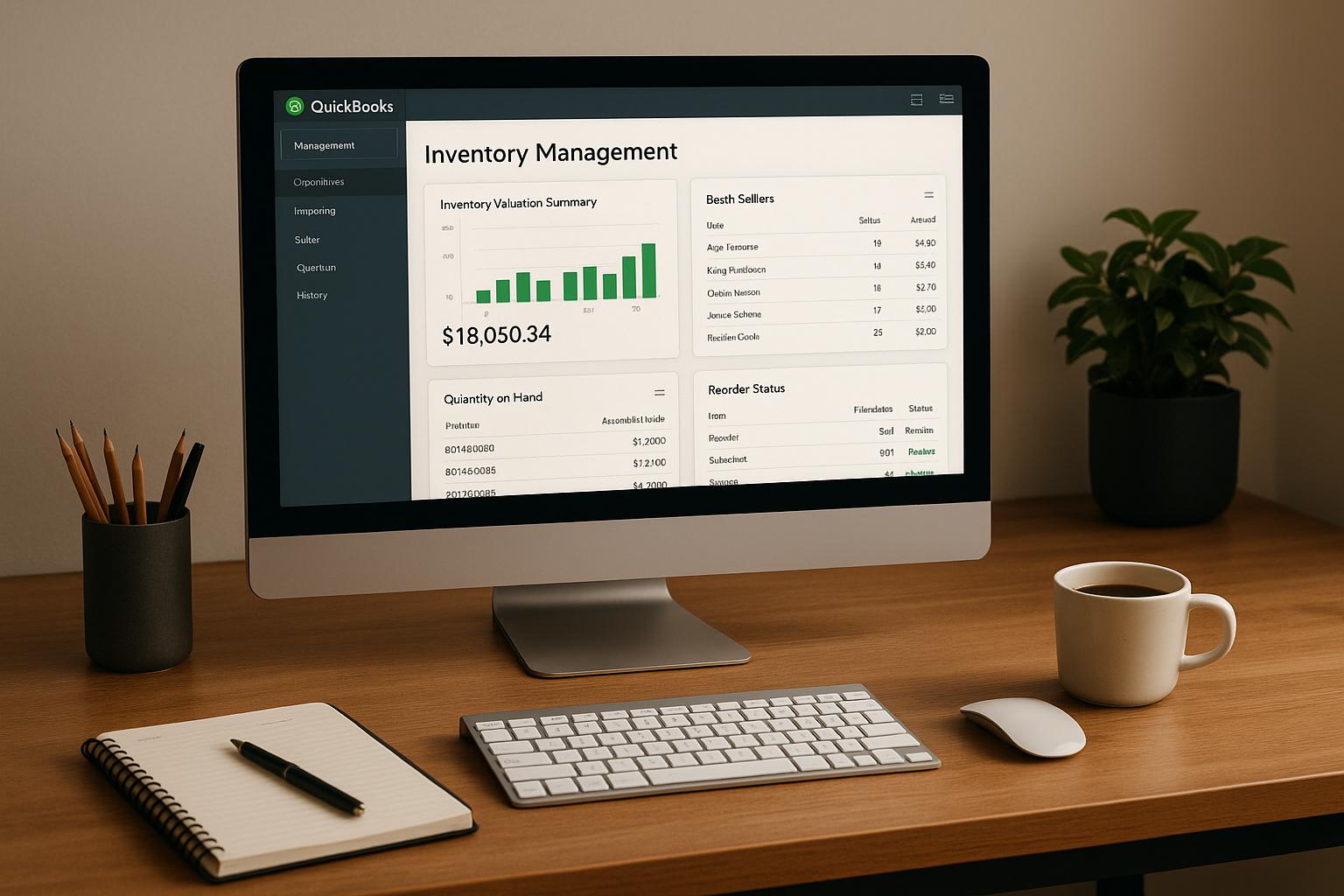

Managing inventory in QuickBooks Desktop can be challenging when you're tied to a single computer. Cloud-based inventory sync changes this by connecting QuickBooks Desktop to a web platform, allowing automatic two-way updates. This means you can access real-time inventory data from anywhere, streamline operations, and reduce manual errors.
Here’s what you’ll gain with Rapid Inventory:
- Real-time updates: Instant syncing between QuickBooks and your inventory system.
- Remote access: Check stock levels, sales orders, or reports from any web browser.
- Improved accuracy: Barcode scanning and cycle counts help maintain up to 97% accuracy.
- Enhanced security: Features like TLS encryption and multi-factor authentication protect your data.
Setting up Rapid Inventory involves integrating it with QuickBooks Desktop, mapping data, and enabling advanced features like FIFO/FEFO picking and barcode scanning. With free onboarding and support, most users are fully operational in under a week.
This solution simplifies inventory management, reduces errors, and ensures your QuickBooks data stays updated in real time.
Benefits of Cloud-Based Inventory Sync
Real-Time Inventory Updates
Syncing QuickBooks Desktop to the cloud ensures every warehouse action updates your accounting records instantly. For example, when an item is picked, QuickBooks is updated automatically - no manual input required. This two-way communication keeps both your inventory system and QuickBooks in perfect sync.
This process significantly improves accuracy. Businesses that combine mobile barcode scanning, regular cycle counts, and real-time cloud syncing can reach inventory accuracy rates of around 97%. Barcode integration also minimizes typing errors during activities like receiving, picking, and cycle counting, ensuring your cloud database and QuickBooks mirror the actual inventory on your shelves.
Plus, this real-time precision allows you to access accurate data remotely, anytime you need it.
Access Your Data from Anywhere
With cloud sync, QuickBooks Desktop becomes more than just an office tool - it transforms into a web-accessible platform. Whether you're working from home, traveling, or checking in from a remote warehouse, you can easily view stock levels, analyze reorder reports, and track sales order statuses through any web browser.
This accessibility creates a unified source of truth across all locations. You can confidently review live inventory counts, make informed purchasing decisions, and coordinate fulfillment efforts no matter where you are. One long-time user shared their experience, saying they’ve relied on the system for six years with great success.
But the benefits don’t stop at convenience. Cloud syncing also strengthens data security.
Reduced Data Loss Risk
Traditional setups often face challenges like interrupted data syncs during system downtime. Cloud-based systems solve this by using dedicated sync engines that run independently of user activity. Even a system reboot won’t disrupt the synchronization process.
Additionally, cloud platforms include advanced security features such as TLS encryption, multi-factor authentication, and rollback procedures. These measures protect your inventory records during data transfers and create a detailed audit trail for recovery if needed. The result? Fewer corrupted files, no lost transactions, and greater confidence in your system’s reliability, even during technical glitches.
sbb-itb-19ed50f
Prerequisites and Tools You'll Need
QuickBooks Desktop Requirements
Before setting up cloud inventory sync, make sure your QuickBooks Desktop system meets the necessary technical standards. You'll need a 64-bit Windows operating system, such as Windows 11 or Windows Server versions 2016, 2019, or 2022. Keep in mind that QuickBooks Desktop 2024 no longer supports 32-bit systems or virtual environments.
Your computer should have a 2.4 GHz x86 processor (Intel or AMD) and at least 8 GB of RAM, though 16 GB is recommended for better performance. Allocate 2.5 GB of disk space for installation, plus extra space for your data files. For faster access, store your QuickBooks data files on a solid-state drive (SSD).
Secure cloud connections require TLS 1.2 support, and you’ll also need Google Chrome installed for web-based features. Make sure you have administrative access during the setup process to connect the QuickBooks Web Connector for two-way synchronization.
Lastly, verify that your internet settings align with the requirements detailed below.
Internet Connection Requirements
A stable internet connection is critical for cloud sync. While QuickBooks Desktop can operate with a minimum speed of 56 Kbps, a connection of at least 1 Mbps is recommended for better performance. Rapid Inventory, being a web-based platform, depends on a steady connection for real-time inventory updates and remote access. If you’re using mobile barcode scanners in your warehouse, ensure they have reliable Wi-Fi or cellular data to sync activities without delay.
Once your internet connection is set, you’re ready to integrate Rapid Inventory for cloud-based inventory management.
Using Rapid Inventory for Cloud Sync
Rapid Inventory is designed specifically for QuickBooks Desktop users to enable seamless cloud-based inventory management. Compatible with QuickBooks Desktop Enterprise, Pro, and Premier versions, it uses the QuickBooks Web Connector for automatic two-way synchronization.
This tool offers features like multi-location tracking, FIFO/FEFO picking strategies, lot and serial number tracking, and mobile barcode scanning. Supported barcode scanner models include the Zebra TC20, TC25, and TC51, all running Android 6.0 or higher. With over 17 years of experience and more than 400 customers, Rapid Inventory is a trusted solution for inventory management.
Pricing starts at $90 per user per month for the Pro plan, which is suitable for teams of 1–9 users. For larger teams (10+ users), the Unlimited plan costs $900 per month. Both plans include free training, onboarding, and data migration services valued at up to $2,100. The setup process typically takes about a week, from initial planning to going live with your team.
How to Set Up Cloud Inventory Sync with Rapid Inventory

4-Step Cloud Inventory Sync Setup Process for QuickBooks Desktop
Ready to sync your inventory with the cloud? Here's a step-by-step guide to setting up Rapid Inventory with QuickBooks.
Step 1: Install and Connect Rapid Inventory
Rapid Inventory's setup process is structured into a 7-day onboarding plan. It starts with a demo and discovery session, followed by migration planning, staging QuickBooks, and configuring user settings. The final steps include system integration, data migration, and staff training. During the staging phase, prepare QuickBooks Desktop for the Web Connector and set up users, warehouses, and locations in Rapid Inventory. The QuickBooks Web Connector enables an automatic, two-way sync: items and orders flow into Rapid Inventory, while inventory adjustments sync back to QuickBooks. Both the Pro and Unlimited plans offer free onboarding and migration services.
Step 2: Map Your Inventory Data
Start by standardizing SKUs and reconciling inventory counts. Create a mapping document that aligns QuickBooks items with their corresponding entries in Rapid Inventory. Consistency in naming conventions and data formats is critical, so merge any duplicate items in QuickBooks before mapping. During the staging phase, configure warehouses and locations in Rapid Inventory to match QuickBooks Desktop inventory sites. If you're using QuickBooks Enterprise, confirm that Inventory Sites are integrated correctly. To avoid complications, pause warehouse transactions during the initial mapping and sync process. Run audits before and after syncing to ensure item quantities and locations match across both systems.
Step 3: Turn On Advanced Features
Once the basic sync is running smoothly, you can enable advanced features. Activate lot and serial number tracking in Rapid Inventory to improve traceability for recalls and compliance. Set up FIFO or FEFO picking strategies for specific items or categories to streamline stock rotation and minimize waste. If you're using mobile barcode scanners, configure them to append an "Enter" after each scan. Rapid Inventory works with USB/HID and Bluetooth scanners. Additionally, enable the Cycle Count Scheduler to conduct smaller, regular audits using mobile scanners. This method can help maintain inventory accuracy levels of around 97% without needing full-scale physical counts.
Step 4: Test Your Sync Setup
Before fully transitioning, run test transactions - such as adding items, adjusting quantities, or creating purchase orders - in both QuickBooks Desktop and Rapid Inventory. Check that changes in one system are accurately reflected in the other. Test mobile scans and review real-time inventory reports to confirm accuracy across all locations. Document any discrepancies and address common issues like duplicate items or unreconciled counts. Consider running both systems in parallel for a short period to ensure a smooth transition. Use the free support provided during this testing phase to quickly resolve any issues that arise.
Configuration Tips and Best Practices
Recommended Settings for Inventory Management
To keep your inventory running smoothly, start by enabling cycle counting in the Rapid Inventory dashboard. This allows you to review high-value items weekly and can reduce discrepancies by up to 30%. Next, configure backorder tracking to automatically flag low-stock items and send alerts to QuickBooks Desktop when inventory dips below reorder points. If you handle partial shipping and receiving, enable split transactions to sync incrementally with QuickBooks. For instance, if you ship 50 out of 100 units, this feature ensures the $500.00 value is updated immediately, avoiding sync errors.
For businesses managing inventory across multiple locations, multi-location tracking is essential. Assign inventory to specific warehouses so that updates sync instantly. If your inventory includes perishable goods, set up FEFO (First Expired, First Out) to prioritize expiration dates (formatted as MM/DD/YYYY). This is especially helpful for food distributors who need to pick items nearing expiration first while ensuring cost adjustments sync seamlessly with QuickBooks.
Once your settings are fine-tuned, take advantage of professional training and support to maximize your system’s potential.
Take Advantage of Free Training and Support
You can access the free training portal by navigating to "Support > Onboarding" in the web dashboard. Scheduling a 1-hour onboarding webinar can speed up your setup by 50%, particularly when learning data mapping techniques tailored to US-specific requirements. For more comprehensive help, the white-glove onboarding service - valued at $600 - provides expert assistance with initial setup and migrating data from your current systems.
"My team was up and running in a few days. Very straightforward and easy to use." - Jacob, CEO
For real-time troubleshooting, especially during busy seasons, use the free support chat. If you experience delays with backorder syncing, priority support ensures QuickBooks reflects updates accurately. Additionally, the knowledge base offers step-by-step guides on advanced features, like setting up mobile barcode scanning.
Once your system is configured and your team is trained, real-time reports can help you stay on top of your inventory performance.
Monitor Performance with Real-Time Reports
Real-time reports are a powerful tool for tracking your inventory’s performance. Through the Rapid Inventory dashboard, you can monitor stock levels, sync latency (aim for under 5 minutes), and variance percentages. Keep an eye on key metrics like a 4–6× inventory turnover ratio, a sync error rate under 1%, and minimal stockout occurrences.
Set up daily email alerts for variances exceeding 5% and use mobile access for on-the-go monitoring. For example, one warehouse cut stockouts by 40% by reviewing FIFO reports hourly during shifts. All data is displayed in US formats, including imperial units. You can also export reports to Excel to create aging buckets, helping you identify slow-moving inventory that’s tying up cash. Finally, running the "Open Sales Orders by Item" report allows you to calculate backorder costs and prioritize order fulfillment based on actual dollar values.
Conclusion
Integrating cloud-based sync can completely reshape how you handle inventory management. Using Rapid Inventory alongside QuickBooks Desktop eliminates the hassle of manual data entry while offering real-time updates - whether you're at the warehouse or working remotely.
To make this integration successful, focus on accurate data mapping and careful testing. Ensure SKUs are standardized and map fields correctly between QuickBooks and Rapid Inventory to minimize errors. Start with a small test batch to confirm that features like cycle counting and backorder tracking work as expected.
Take advantage of free inventory management training and personalized onboarding services to speed up the setup process - most users fully implement the system within 6–7 days.
With live dashboards, you can maintain inventory accuracy (up to 97% through cycle counts) and efficiently manage stock levels or backorders from anywhere.
Start small by syncing a subset of your inventory and monitoring the results for 24 hours. This approach ensures a seamless transition and reliable performance with Rapid Inventory.
FAQs
Will syncing change my QuickBooks Desktop item list or quantities?
Syncing your inventory with QuickBooks Desktop ensures your item lists and quantities stay updated in real-time. Whether it’s a sale, a purchase, or an adjustment, changes are instantly reflected across both systems.
Getting this set up correctly is essential. Make sure to standardize your SKUs, reconcile inventory counts, and map fields accurately. These steps help prevent errors and keep your inventory data aligned, making management smoother and more reliable.
How do I handle multi-warehouse inventory with QuickBooks Desktop sync?
To handle inventory across multiple warehouses using QuickBooks Desktop, start by enabling Advanced Inventory in QuickBooks Desktop Enterprise. This feature allows you to set up and manage multiple locations, monitor stock levels, and oversee transfers seamlessly.
For smoother operations, consider integrating tools like Rapid Inventory with QuickBooks. This integration offers real-time stock updates, centralized dashboards, and automated workflows. Plus, a two-way sync keeps records accurate across all locations, cutting down on errors and minimizing manual tasks.
What happens to syncing if my internet goes down or my PC restarts?
If your internet connection drops or your PC restarts, syncing with QuickBooks Desktop might pause for a while. Any changes made during the downtime will be queued and will sync automatically once the connection is back. However, after a PC restart, you might need to reopen the sync tools or reconnect to the cloud service manually. To avoid interruptions and ensure real-time updates, maintaining a stable internet connection is key.