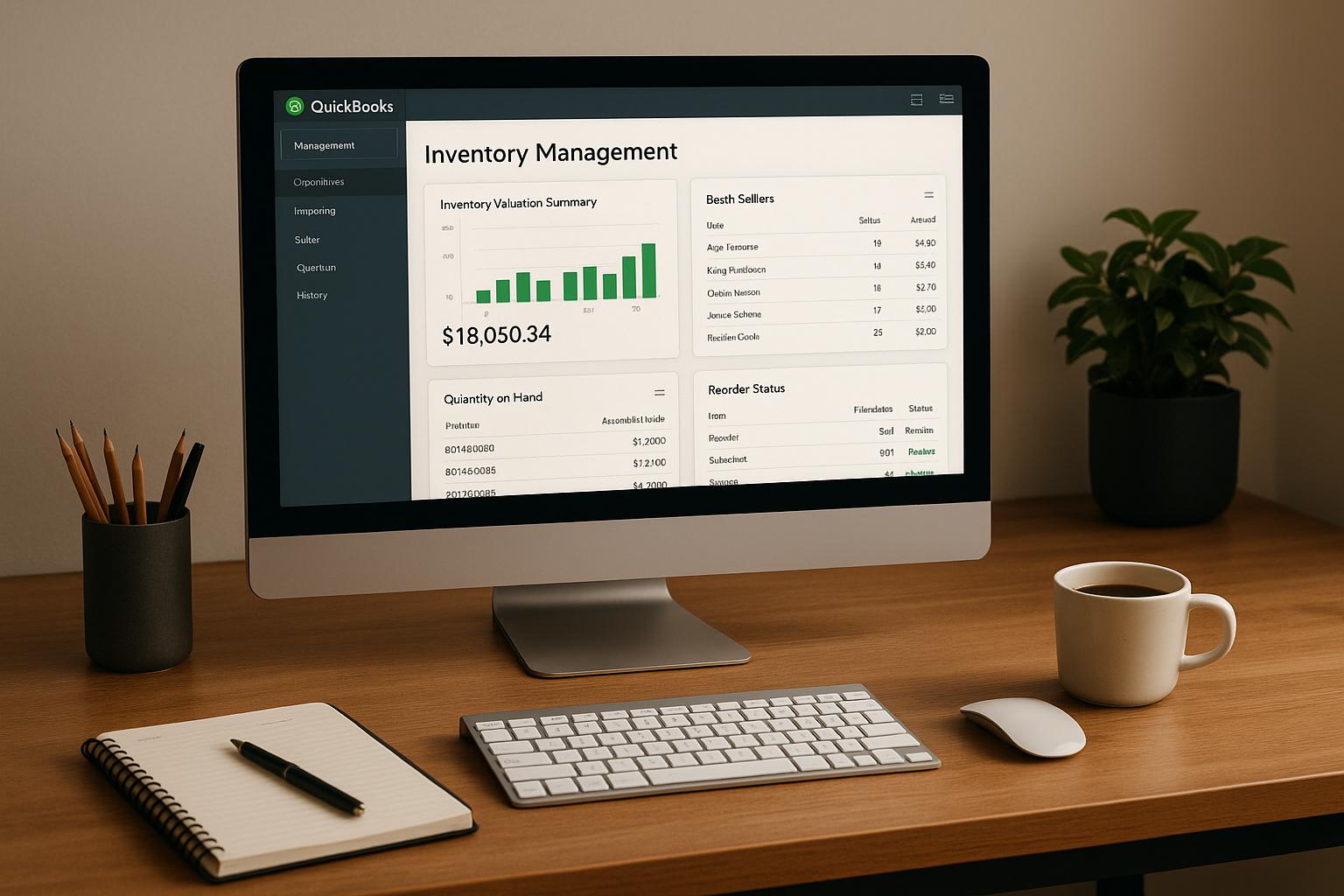

Managing backorders in QuickBooks Desktop can be time-consuming and prone to errors. Automating the process helps save time, reduce mistakes, and improve inventory management. Features like Sales Orders allow you to track backorders, while tools such as reorder points and reports streamline the workflow. However, QuickBooks has some limitations, such as no automatic low-stock alerts or backorder prioritization.
To set up automation, enable inventory tracking, configure reorder points, and use reports like Open Sales Orders by Item to monitor backorders. For advanced needs, third-party tools like Rapid Inventory provide features like barcode scanning and multi-location tracking. Proper team training and standardized procedures are essential for smooth operations.
Key takeaways:
- Use Sales Orders to track backorders.
- Set reorder points to avoid stockouts.
- Leverage reports to monitor inventory and backorders.
- Consider tools like Rapid Inventory for advanced automation.
- Train your team and document workflows for consistency.
Automation simplifies backorder management, but understanding QuickBooks' capabilities and limitations is crucial for effective implementation.
QuickBooks - Back Orders 2017
QuickBooks Backorder Features Explained
Understanding how QuickBooks manages backorders - and recognizing its limitations - can help you create a more efficient workflow for handling inventory and sales.
How QuickBooks Tracks Backorders
In QuickBooks Desktop, Sales Orders are the backbone of backorder tracking. These orders allow you to monitor items that customers have requested but haven’t yet received. Importantly, Sales Orders don’t impact your accounting records until they’re converted into invoices.
When you partially invoice a Sales Order, QuickBooks automatically calculates the remaining quantities and moves them into a "Backordered" column. At the same time, the system adjusts your "Available" inventory count to ensure you don’t accidentally sell stock you don’t have.
"The Backorder column will automatically update [when you] enter the Quantity of items you're shipping in the Invoiced column." - Trish_T, QuickBooks Team
This functionality is included in QuickBooks Premier (Wholesale & Manufacturing or Retail editions) and QuickBooks Enterprise. However, it’s not available in the standard Premier or Pro versions. If you’re using these versions, the "Open Sales Orders by Item" report can help you monitor pending items by showing details such as Quantity, Invoiced, and Backordered.
While these tools are helpful, they come with several manual processes you’ll need to manage.
Limitations in QuickBooks Backorder Functionality
Although QuickBooks provides basic backorder tracking, it does have some notable shortcomings.
For starters, QuickBooks doesn’t offer alerts for low inventory or pending backorders. Similarly, it doesn’t automatically allocate new stock to backorders, leaving you to manually review and assign inventory. There’s also no built-in way to prioritize backorders based on factors like order date or customer importance.
"QuickBooks Enterprise... Cannot provide proactive notifications when inventory levels are low." - Crystal Systems
Another challenge involves printing. Packing slips often show the original order quantity instead of the remaining backorder amount, which can confuse warehouse teams. To address this, you’ll need to customize your templates to include the "Backordered" column. Additionally, backorder tracking isn’t supported for Sales Receipts. If an item is out of stock during a Sales Receipt transaction, you’ll need to remove it and create a separate Sales Order to track it properly.
These limitations highlight areas where manual effort or additional tools may be required to streamline your backorder process.
Setup Checklist for Backorder Automation

QuickBooks Backorder Automation Setup Checklist: 5-Step Implementation Guide
To automate backorders in QuickBooks Desktop, you'll need to adjust a few settings. The steps vary slightly depending on whether you're using the standard version or QuickBooks Enterprise with Advanced Inventory.
Turn On Backorder Tracking in Sales Orders
Start by enabling inventory tracking. Go to Edit > Preferences > Items & Inventory, then open the Company Preferences tab. Check the box labeled Inventory and Purchase Orders are Active to activate this feature.
For QuickBooks Enterprise users, you'll also need to enable Advanced Inventory. In the same Company Preferences tab, click on Advanced Inventory Settings. This unlocks the Sales Order Fulfillment Process, allowing you to track backorders across multiple warehouses. If the button is grayed out, sync your license by navigating to Help > Manage my License > Sync License Data Online.
Once tracking is enabled, set reorder points to avoid stockouts.
Configure Reorder Points and Automatic Purchase Orders
Reorder points help maintain inventory levels. To set one, find the inventory item in the Item List, double-click it, and enter the minimum quantity in the Inventory Information section.
"Reorder points ensure that your inventory levels never fall below the minimum required to fulfill demand."
- Raeann Salter, QuickBooks Advanced ProAdvisor, Minding My Books
If you're using QuickBooks Enterprise, you can take this a step further by setting reorder points for specific warehouses. Open the item record, click Inventory Site Info, and assign unique thresholds for each location based on their requirements.
To streamline purchase orders, use the "Low Stock" filter in your Products and Services list. Select items at or below their reorder points, then go to Batch Actions > Reorder. This generates draft purchase orders with pre-filled details. For accuracy, group items by vendor before reordering, as QuickBooks creates a single purchase order per vendor.
Next, organize your inventory setup for multi-location tracking.
Set Up Inventory Sites and Bin Locations
For businesses managing multiple warehouses or needing detailed tracking, inventory sites and bin locations are essential. This feature is exclusive to QuickBooks Desktop Enterprise with Advanced Inventory.
Activate the feature by going to Edit > Preferences > Items & Inventory > Company Preferences > Advanced Inventory Settings. Check the box for "Track bin Locations within Inventory Sites (row, shelf, or bin)."
Then, create warehouse locations by navigating to List > Inventory Site List > Inventory Site > New. Enter a name for each warehouse or storage area. To add bins, click "New" again, name the bin (e.g., "Aisle 3, Shelf B"), and select "is a bin within site" to link it to the correct warehouse.
"QuickBooks will put all your items in a bin called 'Unassigned'. Later, you can transfer them to their correct bins using the Transfer Inventory form."
- Rea_M, Moderator, QuickBooks Community
Once this is set up, QuickBooks adds Site and Location columns to Sales Orders, Invoices, Purchase Orders, and Bills. This allows precise tracking of where items are being fulfilled or received. Use the Transfer Inventory tool to move items between bins or sites as needed. Regularly run the Inventory Stock Status by Site report to keep an eye on reorder points for each location.
Using Reports to Manage Backorders
QuickBooks Desktop includes built-in reports designed to help you stay on top of open orders and plan for incoming stock effectively.
Monitor Open Backorders with Reports
Once you've set up backorder tracking, you can use specific reports to keep your inventory organized and manageable.
The Open Sales Orders by Item report is a key resource for tracking customer orders that haven't yet been converted to invoices. To access it, go to Reports > Sales > Open Sales Orders by Item. This report highlights all items still on sales orders, making it easy to monitor pending shipments.
You can customize this report by including the Backordered column for a clearer view of outstanding orders. To save your settings for future use, click Memorize.
"QuickBooks Desktop has a report that shows backordered items. We can customize it to show only the backorders." - AlexV, QuickBooks Team
For a broader overview, the Inventory Stock Status by Item report is invaluable. It displays quantities on hand, items currently on sales orders (backorders), and those on open purchase orders. Access this report by navigating to Reports > Inventory > Inventory Stock Status by Item.
If you're looking for historical insights, the Custom Transaction Detail report can provide a deeper dive. By setting the Posting Status filter to Non-posting and the Transaction Type filter to Sales Order, you can view backorders that were never shipped or invoiced before the order was closed. This report can also be exported to Excel for additional analysis.
These tools empower you to stay ahead of inventory challenges and streamline stock management.
Use Backorder Data to Prevent Stockouts
The insights gained from these reports can help you adjust inventory strategies and avoid running out of stock.
By analyzing backorder patterns, you can identify which products are consistently in high demand. If certain items frequently appear in backorder reports, it may signal that demand is outpacing your current inventory levels.
"Tracking backorder analytics can help your organization use data to pursue expansion goals by helping you prioritize your most in-demand products and services." - QuickBooks
Export reports like Open Sales Orders by Item and Inventory Stock Status by Item to Excel. Then, compare backordered quantities against historical sales data to pinpoint demand spikes. If a product shows consistent backorders over several months, consider increasing its reorder point or safety stock levels.
Additionally, the Open Purchase Order Detail report (found under Reports > Expenses & Vendors) can help you track expected deliveries. Comparing this data with backorder trends allows you to determine if incoming stock will meet demand. If not, placing additional purchase orders may be necessary.
For assembly items, the For Assemblies column in the Inventory Stock Status by Item report can help you prioritize the reordering of raw materials to ensure production stays on track.
sbb-itb-19ed50f
Extending QuickBooks with Rapid Inventory
QuickBooks Desktop does a decent job tracking basic backorders, but it falls short when it comes to automation and real-time updates. That’s where Rapid Inventory steps in, offering advanced tools to simplify backorder management and eliminate manual work.
What Rapid Inventory Brings to the Table
Rapid Inventory integrates seamlessly with QuickBooks Desktop (Enterprise, Pro, and Premier) using an automatic two-way sync, trusted by over 400 businesses.
Key features include advanced backorder workflows that allow partial shipping and receiving. This means you can ship what’s available immediately while keeping the rest of the order flagged as backordered. With mobile barcode scanning and multi-location tracking, you can pinpoint inventory down to the exact bin and warehouse, streamlining fulfillment. The platform also supports FIFO (First In, First Out) and FEFO (First Expired, First Out) strategies to ensure efficient stock rotation.
"Rapid Inventory helps us run our warehouse operations. Easy to use and reliable. Using it since 2015, we especially love the barcode scanning and mobile picking and we've implemented it for all our warehouse operations." - Fernanda C, Director of Operations
Making Backorder Management Smarter
Rapid Inventory provides real-time reporting for purchase orders, sales orders, and reorder points, giving you instant visibility into your inventory status. Its Reorder Report helps you identify items that are running low before they turn into backorders, letting you take action ahead of time.
The onboarding process is quick - just 7 days - and includes staging, data migration, and team training. Pricing starts at $90 per user/month for 1-9 users with the Pro plan. For larger teams, the Unlimited plan is $900 per month, covering 10+ users, custom reporting, and a dedicated account manager.
"My team was up and running in a few days. Very straightforward and easy to use." - Jacob, CEO
Training Your Team on Backorder Workflows
Even the most efficient backorder system falls short without proper training. Your team needs to be familiar with both QuickBooks' built-in tools and any third-party software you use to manage backorders.
Train Staff on QuickBooks Backorder Features
Start by ensuring your employees are using a QuickBooks edition that supports backorders, such as Premier Wholesale & Manufacturing, Premier Retail, or Enterprise. You can confirm this by checking the title bar of their QuickBooks software.
Next, guide your team on enabling the "Backordered" column. This is done by navigating to Manage Templates > Additional Customization > Columns. Once activated, this column will show backorder quantities on both screens and printed documents.
Step-by-step training on the fulfillment workflow is essential. Teach your team how to create a Sales Order, then use the "Create Invoice" option to input the shipped quantity in the "Invoiced" column. This automatically calculates backorders. Additionally, show them how to use the "Message" field on Sales Orders to share expected shipping dates for backordered items with customers.
For businesses using Rapid Inventory, make sure your training includes features like mobile barcode scanning and multi-location tracking.
Once your team is comfortable with these QuickBooks features, establish standardized procedures to ensure everyone follows the same backorder management practices.
Create Standard Procedures for Backorder Management
Documenting clear procedures helps maintain consistency across your team. Start with a five-step communication plan: confirm the ETA from suppliers, update product pages with backorder messages, collect customer contact details, send delay notifications with estimated arrival dates, and notify customers as soon as stock is available.
Set firm accounting guidelines. For instance, train your team to delay charging customers until backordered items are ready to ship. This simplifies financial records and reduces the need for refunds if an order is canceled. For mixed orders, instruct employees to use Sales Receipts for in-stock items and separate Sales Orders for backordered items. This prevents inventory from being counted twice.
Make sure the entire workflow is well-documented. This includes converting backorders into Purchase Orders, sending them to suppliers, receiving the items at the warehouse, and fulfilling customer orders. It's also important for your team to understand the difference between backorders - where a restock date is known - and stockouts, where no arrival date is available.
"Honest, empathetic, and clear communication is the key to managing backorders and customer expectations effectively." - QuickBooks
Summary
Here’s a quick rundown of the key steps to automate backorder processing in QuickBooks Desktop.
Start by enabling inventory tracking. Go to Edit > Preferences > Items & Inventory > Company Preferences, and set up your items as Inventory Parts to ensure proper tracking. Don’t forget to set reorder points - this way, QuickBooks can notify you or create purchase orders when inventory levels dip too low. If you’re using QuickBooks Enterprise, turn on Advanced Inventory to access features like bin tracking, support for multiple locations, and FIFO costing.
Once your inventory settings are ready, keep a close eye on orders. Use Sales Orders to log demand for items that are temporarily out of stock. The "Open Sales Orders by Item" report is a handy tool for tracking backorders. To maintain accurate financials, record these orders as backorders and delay charging customers until the items are ready to ship.
For businesses managing multiple warehouses or needing more automation, consider integrating Rapid Inventory. This tool syncs seamlessly with QuickBooks, offering mobile barcode scanning, specialized backorder workflows, and two-way data updates. It’s designed for quick setup and reliable performance, helping streamline the entire backorder process.
Finally, don’t overlook your team’s readiness. Train your staff on QuickBooks features and any additional tools you’re using. Create clear, documented procedures for communication, payment schedules, and order fulfillment to keep everything running smoothly.
"Honest, empathetic, and clear communication is the key to managing backorders and customer expectations effectively." - QuickBooks
Standardized workflows and consistent training are essential. They reduce the risk of human error - a major contributor to backorders - and ensure your automation efforts deliver the results you’re looking for.
FAQs
Which QuickBooks Desktop editions support backorders?
Backorder processing is a feature available in QuickBooks Desktop Enterprise. However, if you're using standard editions like QuickBooks Desktop Pro or QuickBooks Desktop Premier, you won't find built-in support for managing backorders.
How do I automate purchase orders from reorder points?
To automate purchase orders in QuickBooks, start by setting up reorder points for your inventory items. Head to Settings, choose Products & Services, edit the specific product, and input a Reorder point. This ensures QuickBooks alerts you when your stock runs low. Once notified, you can manually create a purchase order by clicking Reorder in the Action column. For a fully automated process, you might need to integrate additional inventory management tools with QuickBooks.
When should I use Rapid Inventory with QuickBooks?
Rapid Inventory integrates seamlessly with QuickBooks to provide advanced inventory management tools for businesses needing features like backorder tracking, multi-location management, and real-time inventory updates. It helps streamline operations, minimize mistakes, and boost accuracy.
Key features include:
- Two-way QuickBooks sync for seamless data updates.
- Barcode scanning to simplify tracking.
- Support for FIFO/FEFO inventory strategies.
- Cycle counting to maintain inventory accuracy.
This tool is an excellent choice for businesses looking to enhance their inventory processes within QuickBooks Desktop.