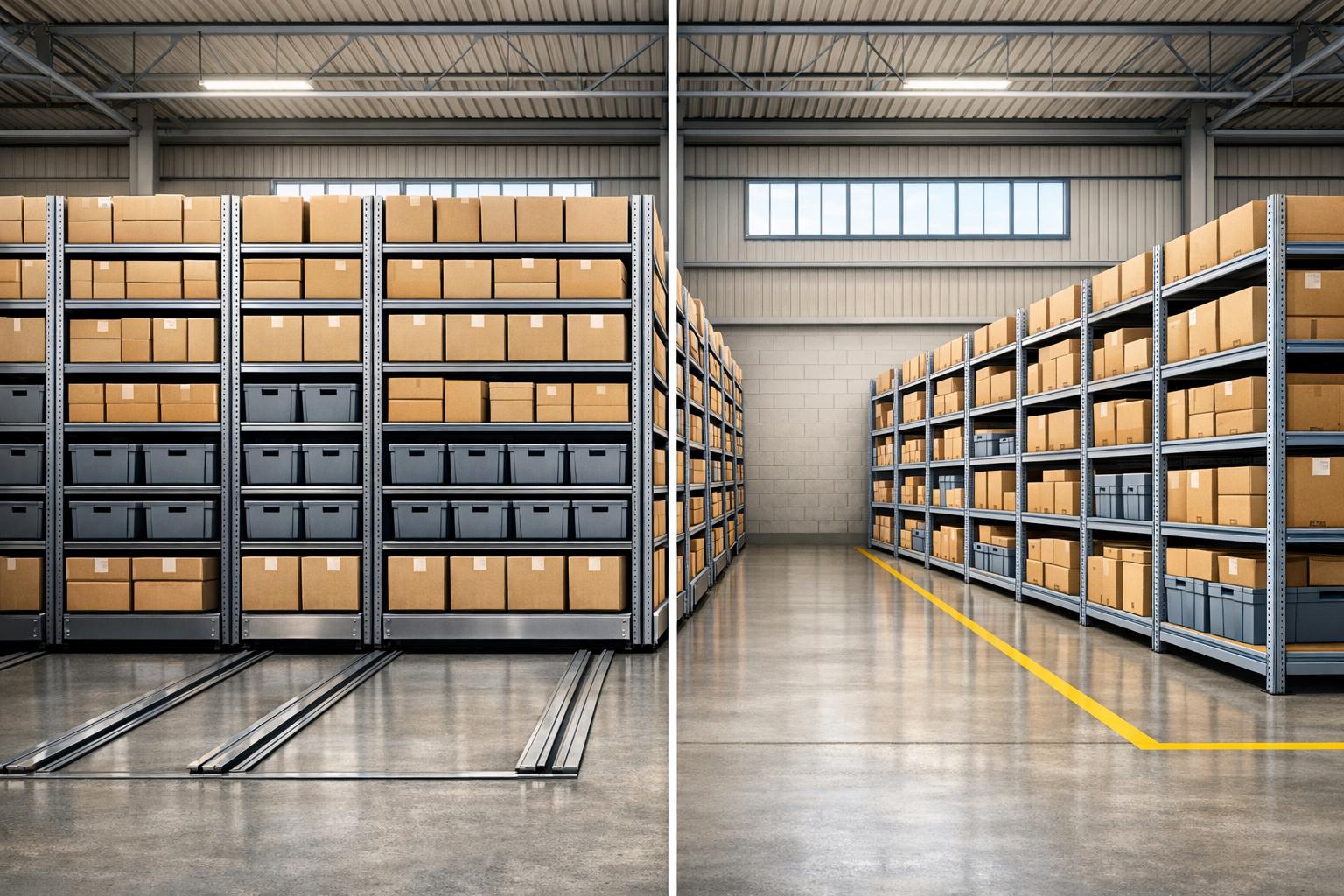
Choosing the right shelving system for your warehouse can impact space use, efficiency, and costs. Mobile shelving maximizes storage by eliminating fixed aisles, increasing floor area utilization to 90%, but comes with higher upfront costs and slower access. Static shelving, on the other hand, offers immediate access to all aisles, making it ideal for high-turnover operations, but uses more floor space (40%-70% for aisles). Your decision should align with your inventory needs, pick frequency, and budget.
Quick Comparison
| Feature | Static Shelving | Mobile Shelving |
|---|---|---|
| Floor Area Utilization | 50%-60% | Up to 90% |
| Storage Capacity Gain | Baseline | +80%-100% |
| Access | All aisles available | One aisle accessible at a time |
| Upfront Cost | Lower | Higher |
| Maintenance | Minimal | Regular upkeep for moving parts |
| Best For | High-turnover items, fast picking | Limited space, dense storage |
Static shelving is simpler to install and maintain, while mobile shelving saves space and offers long-term ROI, especially in high-rent or temperature-controlled environments. A hybrid setup can balance speed and density effectively. Pairing your shelving choice with inventory management software ensures smoother operations.
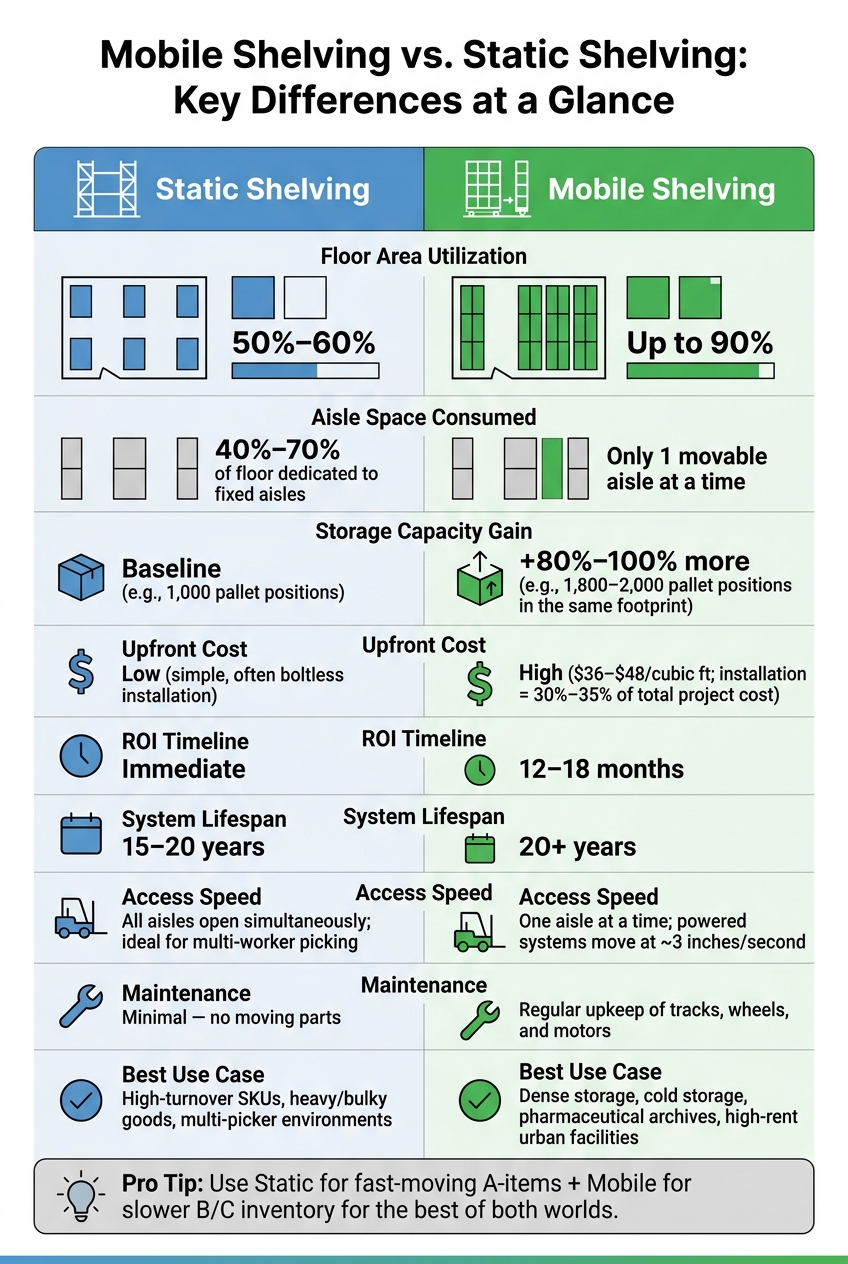
Mobile Shelving vs. Static Shelving: Side-by-Side Comparison
Static Shelving: How It Works, Pros, and Cons
How Static Shelving Works
Static shelving is made up of fixed racks or bays with permanent aisles, offering a straightforward and reliable storage solution. Since there are no moving parts or tracks, workers can easily retrieve items directly from these fixed aisles. This system forms the foundation of many warehouses and distribution centers across the U.S.
Some common setups include:
- Selective Racking: Provides direct access to every pallet.
- Drive-In/Drive-Thru Racking: Ideal for FIFO (First In, First Out) or LIFO (Last In, First Out) operations, offering higher storage density.
- Pallet Flow Racking: Uses gravity-fed lanes to handle high-volume throughput efficiently.
The fixed nature of these configurations ensures immediate access to stored items, making them a reliable choice for various operational needs.
Advantages of Static Shelving
Static shelving offers several benefits, starting with its simplicity. Workers can pick items simultaneously from different aisles without needing to wait or coordinate. According to Rackline:
"If you're picking items constantly throughout the day, static shelving keeps everything within arm's reach." - Rackline
This system is also cost-effective. It has a lower upfront cost compared to mobile shelving systems and requires minimal maintenance since there are no motors or moving components. Boltless designs, such as Speedrax, make installation quick and allow for easy staff training.
Here’s a quick comparison between static and mobile shelving:
| Feature | Static Shelving | Mobile Shelving |
|---|---|---|
| Upfront Cost | Lower initial cost | Higher; includes tracks and mechanisms |
| Installation | Simple; often boltless and fast | Complex; requires tracks and leveling |
| Maintenance | Minimal; no moving parts | Requires servicing of moving components |
| Access | Immediate; all aisles available | Only one aisle accessible at a time |
| Best For | High-turnover, heavy or bulky goods | High-density storage in limited space |
Limitations of Static Shelving
While static shelving has clear advantages, it also comes with some drawbacks. One major issue is its inefficient use of space. Aisles can take up between 40% and 70% of the total warehouse area, leaving less room for actual storage. As Justic Corp explains:
"The main drawback of any racking system that is static is the area occupied by aisles... This void space directly leads to a lower capacity for storage and higher operating costs per pallet." - Justic Corp
This large footprint not only limits storage density but also increases the distance workers and forklift operators must travel, which can slow down operations. Additionally, static shelving lacks adaptability. If your inventory changes or your business expands, reconfiguring the system often requires a full redesign rather than simple adjustments.
sbb-itb-19ed50f
Mobile Shelving: How It Works, Pros, and Cons
How Mobile Shelving Works
Mobile shelving operates on heavy-duty carriages that glide along embedded tracks, creating a flexible system for accessing stored items. Unlike static shelving, where permanent aisles separate every row, mobile shelving compacts the rows together, leaving just one aisle open at a time. Workers can open the desired aisle as needed, which minimizes wasted space and enhances security.
"Mobile shelving: sometimes called roller racking or mobile storage: takes a completely different approach. Instead of permanent aisles everywhere, mobile shelving sits on tracks." - Rackline
There are three main drive systems for mobile shelving:
- Manual systems: Workers push the shelves by hand, suitable for lighter loads.
- Mechanical-assist systems: A geared crank wheel allows one person to move up to 4,000 lbs with minimal effort.
- Powered electric systems: Motors controlled by push buttons or remotes handle heavy industrial loads. These systems often include safety features like infrared sensors and aisle-entry detectors to protect workers.
Modern powered systems can move shelves at about 3 inches per second, combining efficiency with safety.
Advantages of Mobile Shelving
The standout benefit of mobile shelving is its ability to maximize space. By eliminating fixed aisles, which typically occupy 40%–70% of a warehouse floor, mobile systems can boost floor area utilization to 90%, compared to 50%–60% for traditional shelving. This translates into an 80%–100% increase in storage capacity within the same space.
This efficiency is particularly valuable in facilities where space comes at a premium, such as cold storage warehouses, pharmaceutical archives, or urban distribution centers. In cold storage, for instance, the reduced footprint lowers the air volume that needs to be cooled, cutting energy costs.
| Metric | Static Shelving | Mobile Shelving |
|---|---|---|
| Floor Area Utilization | 50–60% | Up to 90% |
| Storage Capacity Gain | Baseline | +80% to +100% |
| Aisle Space Reclaimed | None | Up to 70% |
| Security | Open aisles | Locked solid block |
Security is another advantage. When compacted, mobile shelving forms a locked block, preventing unauthorized access to individual shelves. This feature is especially useful for storing high-value or sensitive items.
Limitations of Mobile Shelving
Despite its strengths, mobile shelving has some tradeoffs. Since only one aisle is accessible at a time, it can slow operations during peak activity when multiple workers need access simultaneously.
The cost is another factor. Mobile systems require a larger upfront investment compared to static shelving. Mechanical-assist systems cost around $35–$36 per cubic foot, while powered systems range from $42–$48 per cubic foot. These prices don’t include additional expenses like track installation, floor preparation, and leveling work. The floor must also be flat and reinforced to support the concentrated weight of fully loaded, compacted shelving units.
Maintenance is another consideration. Unlike static racks, mobile systems have moving parts - tracks, wheels, and motors - that need regular inspection and lubrication. These ongoing maintenance costs should be factored into long-term budgets.
What are High Density Shelving Systems? | Mobile Shelving | SSG
Mobile Shelving vs. Static Shelving: Key Differences
When choosing between mobile and static shelving, it’s important to weigh their differences in storage capacity, cost, and operational efficiency.
Space Use and Storage Density
The standout difference lies in how each system uses aisle space. Static shelving dedicates 40%–70% of floor space to fixed aisles, while mobile shelving eliminates most of that waste by maintaining just one movable aisle at a time. This approach allows mobile shelving to utilize up to 90% of the available floor area.
"By having just one or two movable aisles instead of five or six permanent ones, you can fit far more storage in the same footprint." - Rackline
For example, a warehouse with static shelving that holds 1,000 pallet positions could store 1,800 to 2,000 positions within the same space by switching to mobile shelving - all without expanding the building.
This boost in storage density often has a direct impact on overall project costs.
Cost Comparison Over Time
Static shelving is more affordable upfront. It’s simple to buy, quick to install, and has almost no maintenance needs since there are no moving parts. Mobile shelving, on the other hand, comes with higher initial costs due to hardware, track installation, floor preparation, and labor. Installation alone typically accounts for 30%–35% of the total project budget. Smaller manual systems start at around $5,000, while larger powered options can cost hundreds of thousands of dollars.
However, mobile shelving often pays off in the long run. Many commercial projects recover their investment within 12 to 18 months, thanks to savings from avoiding facility expansion, reducing rent per stored unit, and lowering energy costs in temperature-controlled spaces. Additionally, mobile systems are built for the long haul, with a typical lifespan exceeding 20 years when given basic maintenance.
| Cost Factor | Static Shelving | Mobile Shelving |
|---|---|---|
| Upfront Cost | Low | High ($36–$46/linear ft) |
| Installation | Minimal | 30%–35% of total project cost |
| Maintenance | Near zero | Periodic (tracks, wheels, motors) |
| Typical ROI Timeline | Immediate | 12–18 months |
| System Lifespan | 15–20 years | 20+ years |
Next, let’s look at how these systems affect workflow and picking speed.
Picking Speed and Workflow Impact
When it comes to picking speed, static shelving has the edge. With all aisles accessible at all times, multiple workers can retrieve items simultaneously without delays. This makes static shelving ideal for high-turnover SKUs where speed is critical.
Mobile shelving, however, introduces a slight delay as units need to shift to open the desired aisle. Powered systems move at about 3 inches per second, keeping wait times manageable, but the “one aisle at a time” setup can create bottlenecks during busy periods. That said, mobile systems reduce travel distances since the storage area is more compact, which can save time over the course of a shift.
"The right solution depends on how your warehouse operates today - and how it needs to operate tomorrow." - Better Storage Systems
A smart compromise is a hybrid layout: using static shelving for fast-moving "A-item" SKUs that require constant access and mobile shelving for slower-moving "B" and "C" items where maximizing space is more important than speed. This approach balances storage density with operational efficiency, offering the best of both worlds.
How to Choose the Right Shelving System for Your Warehouse
Factors to Weigh When Selecting a Storage System
When deciding on a shelving system, focus on four main factors: pick frequency, floor space cost, workforce needs, and floor condition. For warehouses with frequent, multi-SKU picks, static shelving is ideal since it keeps all aisles accessible at all times. On the other hand, if most of your inventory moves only a few times a day or week, mobile shelving can save 50%–70% of the floor space taken up by fixed aisles. This can help reduce the need for leasing additional space. However, mobile shelving requires a level and reinforced floor, something static shelving doesn’t demand.
Static shelving also shines when multiple workers need to pick items simultaneously, as it eliminates aisle congestion. These considerations not only impact space and costs but also need to align with your inventory software to ensure everything runs smoothly.
Connecting Your Storage System with Rapid Inventory
A shelving system is only as effective as the digital tools that support it. Accurate digital mapping of your storage layout is crucial, especially for mobile shelving. Because mobile shelving compacts units together, pickers must know exactly which bay to open before moving anything. Without precise bin-level tracking, the time saved by dense storage can quickly turn into delays.
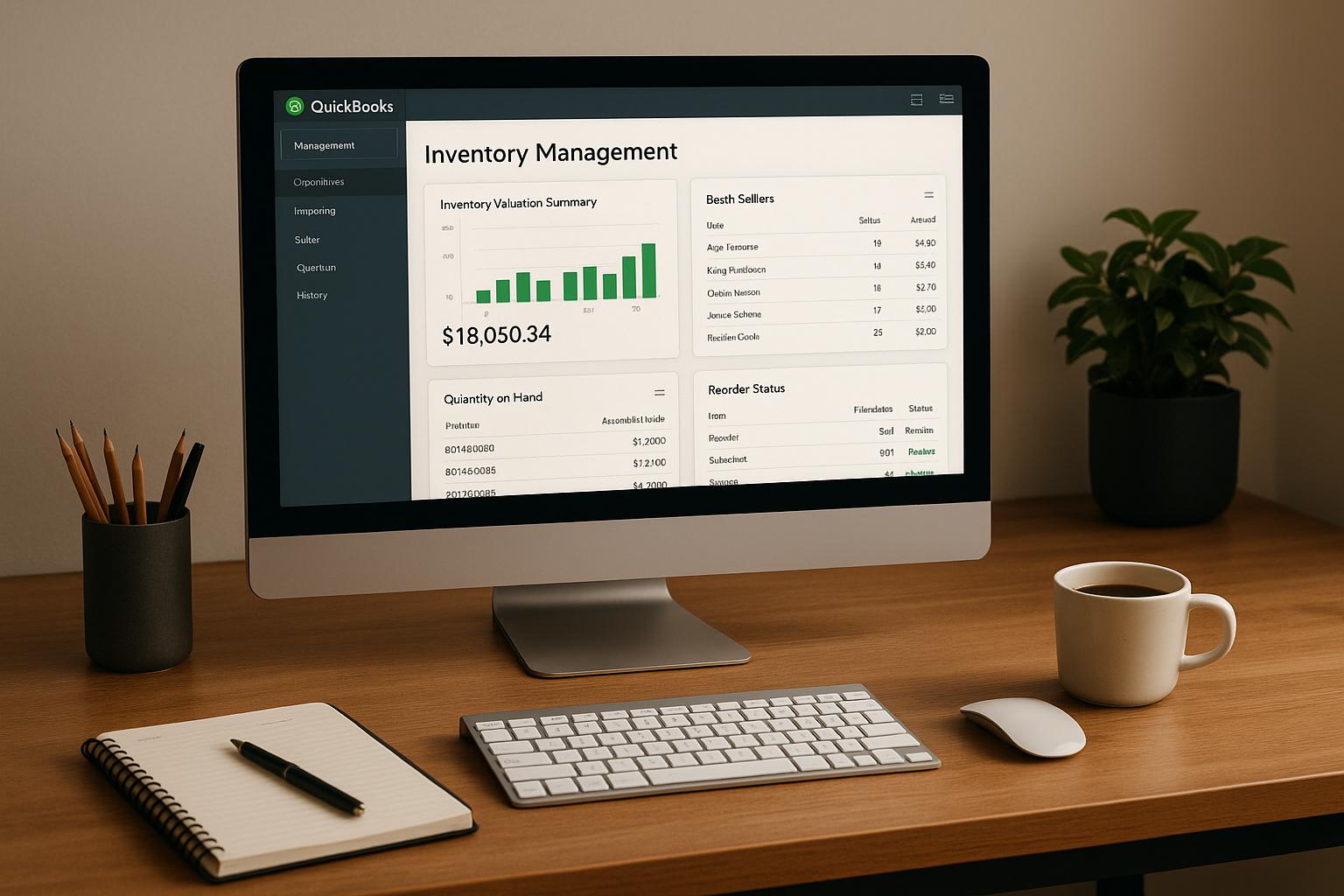
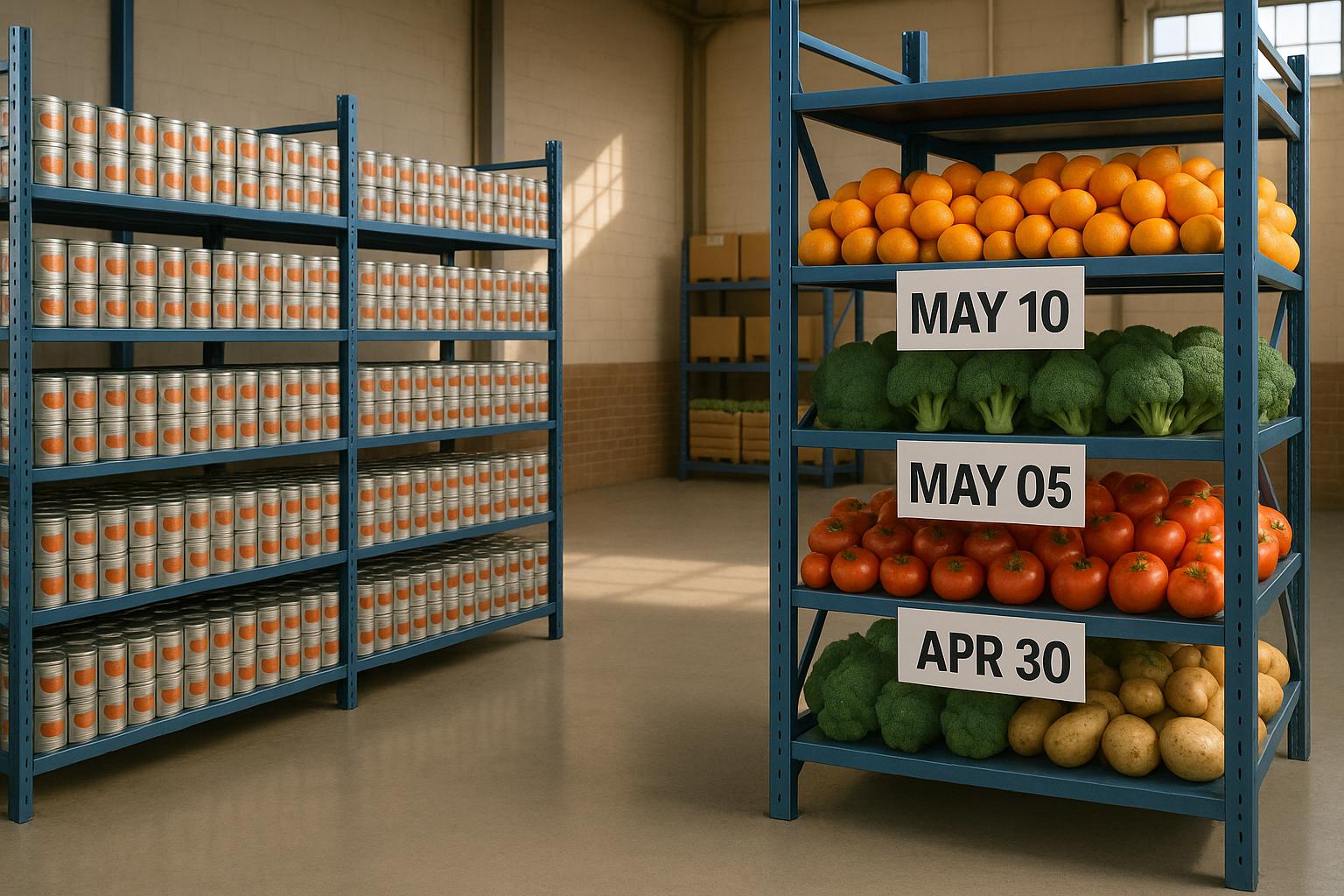
Rapid Inventory helps bridge this gap by offering multi-location and warehouse tracking, mobile barcode scanning, and real-time inventory updates. If you use QuickBooks Desktop, it automatically syncs inventory data in both directions, keeping quantities and locations accurate without manual effort. Features like FIFO/FEFO picking strategies and lot or serial number tracking are particularly beneficial for mobile shelving systems, where different receipt dates might share the same compacted space.
Final Recommendations
For QuickBooks Desktop users, the choice often boils down to budget and pick frequency. Static shelving is more affordable upfront and easier to install. However, if floor space is tight and expansion isn’t an option, mobile shelving’s 12–18-month ROI makes it a compelling option, particularly in high-rent areas.
A hybrid approach works well for many operations: use static shelving for fast-moving "A" items and mobile shelving for slower "B" and "C" inventory. No matter which system you choose, pairing it with accurate digital location tracking ensures maximum efficiency.
FAQs
Will my floor support mobile shelving?
When considering mobile shelving systems, it's important to evaluate whether your floor can handle the concentrated weight these systems create. Unlike static shelving, mobile units are mounted on tracks, which focus the load on specific points rather than distributing it evenly.
To avoid potential safety risks, it's a good idea to consult a structural engineer or the shelving system provider. They can help assess your floor's load-bearing capacity and determine if any reinforcements are needed. Proper planning is essential to account for the total weight of both the shelving units and the items they will hold.
How do I prevent mobile shelving pick bottlenecks?
To prevent bottlenecks in mobile shelving systems, careful planning is key since accessing items often involves moving bays. Make sure your team is well-trained in both efficient usage and safety protocols. In areas with heavy traffic, consider storing high-demand items in locations that are easy to reach or on static racks to minimize disruptions. Tools like Rapid Inventory can simplify this process by offering multi-location tracking and clear stock visibility, helping you organize storage effectively and cut down on delays.
What inventory tracking do I need for mobile shelving?
For mobile shelving, a warehouse management system with real-time inventory tracking is essential for staying organized in tight storage spaces. Rapid Inventory provides helpful tools like multi-location tracking, mobile barcode scanning, and lot/serial number tracking. These features make it easier to monitor and manage high-density storage while ensuring items are accurately tracked and accounted for.