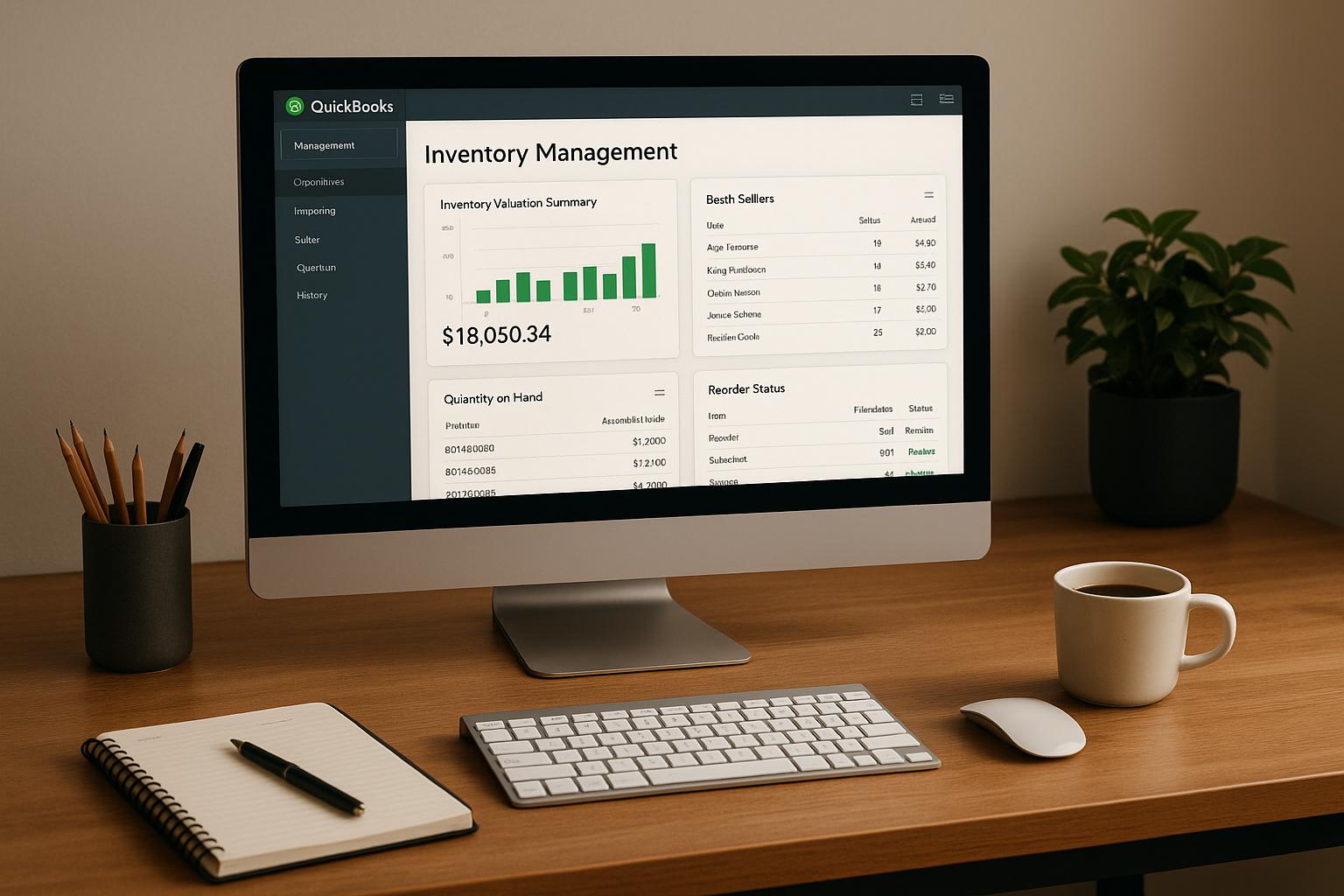

Managing seasonal inventory effectively can prevent stockouts, reduce excess inventory, and improve cash flow. For QuickBooks Desktop users, leveraging historical data and built-in tools can simplify this process. Here's a quick summary of key strategies:
- Analyze Sales Trends: Use reports like Sales by Product/Service Detail to identify peak seasons and adjust inventory levels accordingly.
- Set Reorder Points: Tailor reorder thresholds to seasonal demand to avoid stockouts or overstocking.
- Calculate Safety Stock: Use seasonal demand data to determine buffer stock and account for supplier lead times.
- Forecast with Moving Averages: Smooth out erratic sales patterns using QuickBooks' forecasting tools.
- Cycle Counting: Regularly verify inventory accuracy, especially for high-demand items during busy periods.
- Track Multi-Location Inventory: Use QuickBooks Enterprise to monitor stock across locations and optimize distribution.
- Automate Replenishment Alerts: Integrate tools like Rapid Inventory for real-time syncing and automated alerts.

Essential QuickBooks Reports for Seasonal Inventory Planning
1. Review Past Sales Data to Identify Seasonal Trends
Seasonal Demand Forecasting
QuickBooks Desktop can be a powerful tool for spotting seasonal demand patterns. Start by running the Sales by Product/Service Detail report. This report helps you pinpoint the exact dates when items like winter coats or garden supplies saw a surge in sales.
To differentiate between genuine seasonal trends and temporary promotional spikes, compare the Sales by Item Summary report over a consistent three-month period for the past two to three years. By calculating the daily average sales during these peak times, you can get a clearer picture of inventory turnover and plan accordingly.
After identifying these trends, double-check your current inventory data to ensure your forecasting is spot on.
Inventory Accuracy and Tracking
Forecasting is only as good as your inventory data. Before diving into predictions, use the Physical Inventory Worksheet to confirm current stock levels. This step helps you avoid errors that could lead to overstocking or shortages.
The Inventory Valuation Detail report is another key resource. It provides insights into how your stock levels fluctuated during past peak seasons, showing which items sold out the fastest. Additionally, keeping an eye on the Open Purchase Order Detail report ensures your seasonal stock will arrive on time, well before demand spikes.
| QuickBooks Report | Purpose for Seasonal Planning |
|---|---|
| Sales by Product/Service Detail | Identifies specific dates with increased demand from sales history |
| Sales by Item Summary | Highlights top-performing SKUs during seasonal periods |
| Inventory Valuation Detail | Tracks inventory depletion during previous busy seasons |
| Physical Inventory Worksheet | Confirms stock accuracy before seasonal demand kicks in |
To stay ahead, update the "Reorder Point" and "Max" fields at least 60 days before your peak season. This gives you enough time to account for supplier lead times and avoid last-minute inventory issues.
sbb-itb-19ed50f
2. Update Reorder Points Before Peak Seasons
Seasonal Demand Forecasting
Standard reorder points often fall short during seasonal demand spikes. Year-round averages can’t account for the sharp increases in sales during peak seasons, which can lead to delayed restocking and frustrating stockouts.
Start by classifying your products. For instance, purely seasonal items like holiday decorations typically require a single, large order placed about 90 days before the season begins. On the other hand, products that see occasional seasonal surges - like food staples around Thanksgiving - might need several replenishment cycles during the peak period to avoid running out.
Use this data to fine-tune your QuickBooks settings for better seasonal inventory management.
Integration with QuickBooks Desktop

Once you’ve identified seasonal trends, adjust your QuickBooks settings to reflect them. In QuickBooks Desktop, you can update reorder points based on increased seasonal sales and supplier lead times. For example, if a product’s demand spikes during the holidays, calculate the extra inventory needed to cover the lead time during that high-demand period and adjust reorder points accordingly.
Manually updating reorder points can be time-consuming and prone to mistakes, especially if you manage a large number of SKUs across multiple locations. Using advanced inventory tools, like Rapid Inventory, that integrate with QuickBooks can simplify this process. These systems can automate seasonal adjustments and synchronize changes across your sales channels, helping you avoid stockouts and streamline operations.
It’s also smart to prepare for unexpected scenarios. If demand exceeds your forecast and your primary supplier has longer lead times, having local backup suppliers with quicker turnaround times can save the day. Additionally, if seasonal stock remains unsold as the season winds down, consider offering clearance discounts a few weeks before it ends to free up storage space and recoup costs.
3. Calculate Safety Stock Based on Seasonal Demand Changes
Seasonal Demand Forecasting
Safety stock acts as a crucial buffer to handle the unpredictability of seasonal demand. It's your safeguard against sudden sales spikes, supplier delays, and errors in forecasting. During peak seasons, this buffer becomes even more essential. Why? Stockouts during these times can lead to losses of 4-8% of annual revenue.
To start, use QuickBooks Desktop to pull the Inventory Stock Status by Item and Sales by Item Detail reports. These reports will help you identify patterns in past seasonal demand. For instance, if December sales consistently surge, calculate the average daily demand during that period. Then, adjust for variability. If sales typically fluctuate by 20% during peaks, multiply your average by 1.2 to factor in that uncertainty.
Integration with QuickBooks Desktop
The formula for calculating safety stock is straightforward:
Safety Stock = (Max Daily Usage × Max Lead Time) - (Avg Daily Usage × Avg Lead Time)
Let’s break it down with an example. Imagine you sell a holiday item with average daily sales of 10 units during the off-season but 50 units during peak times. Your supplier's lead time ranges from 7 to 14 days. Using the formula:
- Max Daily Usage: 50 units
- Max Lead Time: 14 days
- Avg Daily Usage: 10 units
- Avg Lead Time: 7 days
The calculation would be:
(50 × 14) - (10 × 7) = 700 - 70 = 630 units of safety stock.
Once calculated, input these values into QuickBooks Desktop to set up reorder alerts. If you’re managing multiple SKUs or locations, tools like Rapid Inventory can simplify the process. This software syncs with QuickBooks Desktop, providing real-time updates on demand trends. It can also automatically adjust safety stock levels when demand surges by 20% or more, ensuring you're prepared for seasonal fluctuations.
Inventory Accuracy and Tracking
Accurate inventory data is the backbone of effective safety stock planning. Before seasonal peaks, conduct cycle counts using QuickBooks’ Physical Inventory Worksheet to confirm on-hand quantities. As mentioned earlier, regular accuracy checks ensure your safety stock aligns with real inventory levels, avoiding costly mistakes caused by outdated records.
Managing Inventory in QuickBooks Desktop
4. Apply Moving Average Forecasting in QuickBooks
Refining your forecasting methods with moving averages can help you align inventory levels more effectively with seasonal trends.
Seasonal Demand Forecasting
Moving average forecasting smooths out erratic sales patterns, making it easier to identify genuine seasonal trends. This allows you to adjust inventory levels smartly - avoiding stockouts during high-demand periods and preventing overstocking when demand tapers off.
QuickBooks Desktop simplifies this process by analyzing historical data from your Profit and Loss statements. The "Average of actuals" method is particularly helpful here. It uses a specific range of past data to predict future inventory needs. You can either consolidate the forecast or break it down by class or dimension to uncover seasonal patterns across various product lines or business areas.
Integration with QuickBooks Desktop
Once you've identified seasonal trends, you can integrate these insights directly into QuickBooks for streamlined planning.
Start by cleaning up your historical data. Run a Profit and Loss Detail report to ensure all transactions are categorized correctly. Then, check that your fiscal year settings align with your seasonal cycles. This can be done by navigating to Advanced settings and confirming the "First month of the fiscal year" matches your business's operational rhythm.
To implement moving averages, select "Average of actuals" from the "Forecast using" dropdown menu. Specify the number of months of historical data you want to include in your calculations. Keep your forecasts up-to-date by regularly using the "Refresh actuals" option, especially during busy seasons when sales data changes frequently.
This approach builds on earlier strategies by using historical data to create a more flexible and informed inventory management system.
Automation and Efficiency Improvements
For even greater efficiency, pair QuickBooks Desktop with tools like Rapid Inventory. This integration enables automated demand forecasting and real-time synchronization, achieving inventory accuracy rates of up to 97%. Additionally, running "Forecast vs. Actuals" reports lets you compare your moving average projections against actual sales performance, ensuring your forecasting remains on track.
5. Use Cycle Counting to Keep Inventory Accurate During Busy Periods
Cycle counting is a practical way to maintain inventory accuracy, especially during hectic seasons. It builds on solid demand forecasting and safety stock strategies by regularly auditing portions of your inventory instead of performing a full-scale count. This method minimizes disruptions while ensuring your QuickBooks Desktop records stay aligned with your actual stock. During busy times, when transaction volumes spike and errors or theft are more likely, cycle counting helps catch discrepancies early.
Inventory Accuracy and Tracking
A great place to start with cycle counting is by using the ABC classification system. Focus on your A items (the top 20% of inventory that accounts for 80% of value) with daily or weekly counts during peak periods. B items can be checked monthly, and C items quarterly. For instance, weekly audits of top-selling products once revealed a 15% discrepancy, which prevented $5,000 in potential stockouts and boosted on-time order fulfillment by 20%.
This systematic approach ensures that high-value or fast-moving items are regularly verified, helping you spot trends early and avoid issues like overstocking or missed sales opportunities. Updating your QuickBooks records in real time during these counts makes it easier to stay on top of inventory trends.
Integration with QuickBooks Desktop
After completing each cycle count, immediately update your QuickBooks Desktop records to keep everything accurate. Use tools like the Inventory Valuation Summary report to double-check quantities and values. This real-time data keeps your safety stock calculations and reorder points precise, reinforcing the adjustments made during seasonal planning.
Automation and Efficiency Improvements
QuickBooks Desktop offers reports and alerts that work seamlessly with cycle counting to minimize errors and save time. If you want to streamline the process further, tools like Rapid Inventory can automate cycle counting. With mobile barcode scanning and QuickBooks synchronization, manual data entry is reduced, and updates happen in real time, making inventory management even more efficient.
6. Track Inventory Across Multiple Locations for Seasonal Distribution
Managing inventory across multiple locations becomes especially important during seasonal peaks. Regional demand can vary significantly, requiring stock transfers between warehouses to meet customer needs. QuickBooks Enterprise simplifies this process with its multi-location inventory tracking feature. It consolidates totals across locations, helping you analyze sales trends and make smarter distribution decisions.
Seasonal Demand Forecasting
When planning for seasonal shifts, it’s crucial to focus on location-specific trends. QuickBooks sales reports can help pinpoint which locations see higher demand during specific times of the year. For example, historical data might show that urban warehouses need extra stock during the holiday season, while rural locations experience less demand. By leveraging this data, you can allocate inventory more effectively - avoiding overstocking in low-demand areas while ensuring high-demand sites are fully prepared.
Inventory Accuracy and Tracking
QuickBooks Enterprise also allows you to assign items to specific locations and monitor stock levels for each site. Comprehensive reports across warehouses make it easier to track inventory during seasonal changes. However, syncing delays can occasionally occur, so manual adjustments might be necessary. Regular on-site audits can help identify discrepancies early, ensuring your physical inventory matches your financial records. This level of accuracy supports better seasonal planning and keeps operations running smoothly.
Integration with QuickBooks Desktop
For enhanced multi-location tracking, consider integrating QuickBooks Desktop with Rapid Inventory. This integration provides two-way syncing and real-time reporting, eliminating the need for manual data entry. With an accuracy rate of approximately 97%, this tool ensures you have a clear view of inventory across all locations, making it easier to meet seasonal demand.
Automation and Efficiency Improvements
You can also set reorder points specific to each location, which automates alerts and generates purchase orders or transfer requests. This automation ensures accurate stock levels across all channels without requiring constant manual updates. By reducing errors and saving time, automated syncing makes multi-location inventory management more efficient and reliable.
7. Set Up Automated Replenishment Alerts with QuickBooks Integrations
Integration with QuickBooks Desktop
QuickBooks Desktop offers a handy feature called reorder points, which triggers alerts when inventory levels fall below a set threshold. While this works for basic inventory management, seasonal businesses often require a more advanced solution. Tools like Rapid Inventory take automation a step further with automatic two-way syncing. This feature keeps inventory levels and orders updated in real-time, eliminating the need for manual data entry. With over 400 businesses relying on it, Rapid Inventory has earned a 5-star rating for its user-friendly design and excellent technical support.
"Automatic 2 way sync with Quickbooks means that your items and orders are synced... Say goodbye to spreadsheets and manual entry." - Rapid Inventory
These integrations make it easier to manage inventory efficiently, even during high-demand periods.
Automation and Efficiency Improvements
QuickBooks integrations aren’t just about syncing - they also help prepare for seasonal changes. By adjusting the "Reorder point" field in QuickBooks, you can set thresholds tailored to peak demand periods. The dashboard provides a clear view of "Low stock" and "Out of stock" items, helping you spot replenishment needs quickly. For added convenience, the "Batch actions" menu allows you to combine multiple low-stock items into a single purchase order, speeding up the process. Integrated systems also generate real-time reorder reports, making it easier to respond to sudden inventory demands during busy seasons.
Inventory Accuracy and Tracking
To ensure inventory accuracy during hectic periods, consider using mobile barcode scanners. These tools help verify incoming shipments and track outgoing orders, reducing the risk of errors caused by "ghost stock". Regularly reviewing "Open Purchase Order Detail" reports also helps you track what’s been ordered versus what’s been received, preventing over-ordering during seasonal transitions. Onboarding for QuickBooks Desktop inventory integrations is straightforward, typically taking 6–7 days to complete. This includes data migration and team training to get everyone up to speed.
"My team was up and running in a few days. Very straightforward and easy to use." - Jacob, CEO
Conclusion
Efficiently managing seasonal inventory is all about finding the right balance - keeping enough stock to meet demand without disrupting day-to-day operations or tying up too much cash. By analyzing past sales data, adjusting reorder points, calculating safety stock, and leveraging forecasting tools, you can align your inventory levels with customer needs while maintaining financial stability. These steps form the foundation of a well-executed seasonal inventory strategy.
QuickBooks Desktop provides a solid starting point for inventory management, and tools like Rapid Inventory take it a step further. Features like real-time two-way sync, mobile barcode scanning, and multi-location tracking make it easier to maintain accuracy - even during busy seasons. Automated cycle counting, for example, can help keep inventory accuracy at about 97%, ensuring your forecasting, reorder points, and stock counts work in harmony.
Automation is a game-changer here. It reduces manual errors, lowers carrying costs, and improves cash flow. A perpetual inventory management system, as Katana puts it,
"automatically maintains inventory counts through live systems that record and account for sales and orders in real time".
This means fewer manual audits and more accurate data. Proper forecasting also prevents overstocking, which QuickBooks Canada highlights as crucial because
"minimizing the working capital required to operate your business is ideal because it limits the amount of cash you have tied up".
Ditching spreadsheets in favor of automated tools can streamline your operations significantly. Many integrations with advanced inventory systems can be set up in about a week, giving you rapid access to improved accuracy and efficiency. Combining QuickBooks' accounting capabilities with these modern tools creates a scalable system that’s ready to handle the challenges of seasonal inventory management.
FAQs
Which QuickBooks Desktop reports are best for spotting seasonal demand?
The Sales by Item Summary, Inventory Valuation Summary, and Stock on Hand reports in QuickBooks Desktop are great tools for spotting seasonal demand trends. These reports provide insights into sales patterns, help you track inventory value, and let you monitor stock levels - making it easier to adjust and plan for seasonal changes.
How do I set seasonal reorder points without overstocking?
To establish seasonal reorder points and prevent overstocking, focus on three key factors: average daily usage, lead time, and safety stock. This approach helps you stay prepared for peak demand while avoiding excess inventory that ties up resources.
Leverage tools like QuickBooks or specialized inventory management software to simplify these calculations. These tools can also track seasonal trends and send alerts, making it easier to keep your stock levels on point all year round.
When should I use an integration like Rapid Inventory for seasonal planning?
For seasonal planning, an integration like Rapid Inventory can be a game-changer. It offers real-time inventory updates, automated reorder alerts, multi-location tracking, and advanced inventory management tools. These features are designed to handle seasonal fluctuations effectively, helping you avoid stockouts or overstocking while keeping inventory levels aligned with demand. Plus, integrated systems simplify tasks such as cycle counting and reorder alerts, ensuring your seasonal inventory planning is both accurate and efficient.